

Alternatives to Traditional Dementia Memory Games
Table of Contents
- Why Traditional Memory Games Often Fall Short
- The Benefits of Nostalgia Therapy for Memory Care
- Nostalgia Photo Books: A Practical Alternative
- Sensory Activities for Dementia: Beyond Visual Memory
- How to Start a Reminiscence Therapy Group
- Comparison: Traditional Games vs. Nostalgia-Based Alternatives
- Choosing the Right Alternative for Your Situation
- Frequently Asked Questions
Last Updated: September 16, 2026
Why Traditional Memory Games Often Fall Short
Recall-based card games and timed matching exercises ask a person to retrieve information on demand. For someone living with dementia, that demand produces anxiety rather than engagement, measuring what has been lost instead of what remains.
The problem is not dementia memory games themselves but the pressure they carry. When a wrong answer is visible to everyone at the table, the activity becomes a test. Many carers report that a resident who happily joins a singalong will refuse a memory card game within minutes: one offers connection, the other assessment.
Traditional memory games also lean on visual recall alone, rarely engaging smell, touch, sound or the social cues that anchor a person in the present. That narrow focus explains why so many activity boxes end up on a shelf. This guide from Remember When Shop looks at what works instead, from nostalgia photo books to sensory activities for dementia.
The Benefits of Nostalgia Therapy for Memory Care
Nostalgia therapy works because of how memory is stored. Long-term memories formed between roughly ages 15 and 30 remain the most accessible as dementia progresses, while recent episodic memory declines first. A photograph of a 1950s milk bar or a 1960s family sedan can trigger a genuine, unprompted story when a question about yesterday cannot.
The benefits of nostalgia therapy extend beyond recall. Reminiscence gives a person a role: the one who was there, who knows how it was. That reversal of expertise is powerful for someone who otherwise spends their days being assisted, one of the few activities where the person living with dementia holds the authority in the room.
There is also a measurable calming effect. Familiar imagery and objects reduce agitation because they signal safety rather than novelty. A person struggling to place themselves in time can often be settled by a single recognisable image, whether a Hills Hoist in a backyard or a corner shop counter.
Emotional Regulation Through Non-Competitive Play
This is the angle most activity guides miss. The primary benefit of nostalgia-based activity is not cognitive maintenance but emotional regulation. A person who is anxious, sundowning or repeatedly asking to go home is not short of cognitive stimulation, they are dysregulated, and what settles them is familiarity, not difficulty. Grounding the nervous system through sensory stimulation exercises provides a reliable pathway to calm when verbal communication fails to bridge the gap between a person and their environment.
Non-competitive play works on regulation in three ways:
- Predictability. No rules means no unknown outcome, which lowers the threat response that timed or scored games can trigger.
- Competence. The person is the expert on their own past, so there is no failure state to anticipate.
- Co-regulation. A calm carer sitting alongside, turning pages at the person's pace, transmits calm directly. This is why one-to-one sessions often outperform group sessions for people who are easily agitated.
A resident who refuses a memory card game will often sit with a photo book for twenty minutes, not because the book is easier, but because nothing in it can be got wrong.
The Caregiver-Patient Collaboration Angle
Most dementia activity content is written for the person with dementia. In practice, the activity is a two-person event, and the relationship is the point. Collaborative play, where the carer participates rather than facilitates, changes the dynamic from supervision to companionship.
This matters for the carer as much as the person. Carers reporting the highest satisfaction describe the same thing: the session gave them a conversation, not a task. A photo book opened on a kitchen table does that; a memory game with a scorecard does not.
Nostalgia Photo Books: A Practical Alternative
The simplest alternative to dementia memory games is a large-format photo book built around a specific decade. It requires no rules, scoring or verbal instruction, so a person can pick it up independently or share it with a visitor.
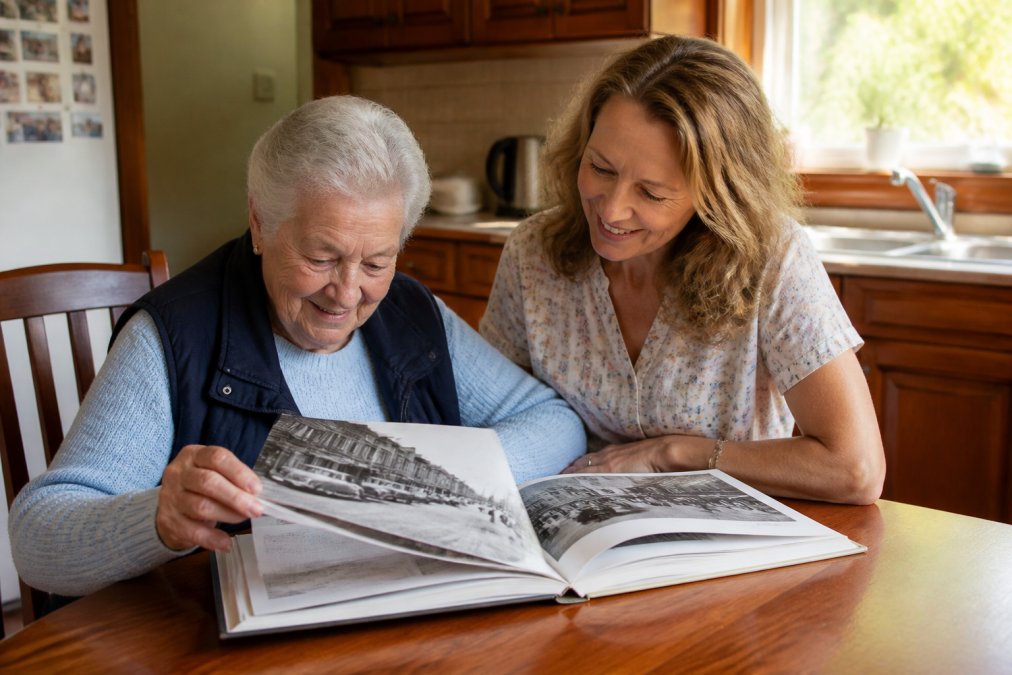
These books pair an image with a short caption or story, so the page does the prompting.
Book; Remember When...Snapshots of →
What to Look for in a Nostalgia Book
Four things separate a book that gets used from one that sits on the shelf.
Sensory Activities for Dementia: Beyond Visual Memory
Sensory activities for dementia engage smell, touch and sound, reaching people whose verbal recall has declined significantly.
Low-Cost DIY Sensory Kits
A sensory kit does not need to be purchased.
How to Start a Reminiscence Therapy Group
A simple structure for the first session:
- Welcome and a familiar song or piece of music (5 minutes)
- Pass a tactile object around the circle, one at a time (10 minutes)
- Open the photo book to a single spread and invite stories (20 minutes)
- A shared cup of tea with a familiar biscuit (15 minutes)
- Close with the same song each week (5 minutes)
Comparison: Traditional Games vs. Nostalgia-Based Alternatives
The two approaches suit different people and stages.
| Approach | Engagement Style | Best For | Main Drawback | Carer Effort |
|---|---|---|---|---|
| Traditional memory card games | Recall under mild pressure | Early-stage, competitive personalities | Can cause anxiety and withdrawal | Low setup, high supervision |
| Nostalgia photo books | Open conversation, no scoring | Most stages, especially shared sessions | Needs a willing conversation partner | Very low, can be independent |
| Sensory kits | Touch, smell, sound | Mid-to-late stage, non-verbal participants | Requires preparation and rotation | Medium, needs assembly |
| Reminiscence groups | Social, turn-taking | Maintaining social interaction | Needs a consistent leader and venue | High, requires coordination |
| Music and singalongs | Auditory, group participation | Low-effort group engagement | Limited to the session itself | Low, but time-bound |
| DIY sensory trays | Tactile, exploratory | Agitated or restless participants | Needs safe, familiar objects | Low, uses household items |
The Dimension the Table Cannot Capture
A table compares activities, not what the activity does to the relationship.
Matching the Activity to the Moment, Not Just the Stage
- Restless or pacing: sensory kit or DIY tray. Give the hands something to do.
- Withdrawn or quiet: photo book, opened to one spread, no questions at first.
- Anxious or asking to go home: familiar music, then a single recognisable image. Do not introduce anything new.
- Alert and talkative: reminiscence group, where the person can hold the floor.
- Low energy, late afternoon: a shared cup of tea alongside a photo book. The activity is the tea; the book is the prompt.
Choosing the Right Alternative for Your Situation
Match the activity to the person, not the diagnosis.
Frequently Asked Questions
What are the best non-game activities for dementia patients?
Nostalgia-based activities work well because they tap into long-term memories, which often remain intact longer than short-term recall. Photo books from the 1940s to 1970s, sensory items like textured fabrics or familiar scents, and simple creative tasks such as sorting or folding can engage without pressure. The key is choosing activities that match the person's past interests and current abilities, and letting them lead the conversation rather than testing their memory.
How does reminiscence therapy compare to traditional memory games?
Traditional memory games often focus on recall tasks, which can cause frustration when someone cannot remember. Reminiscence therapy uses prompts like photos, music, or objects to spark conversation and emotional connection. Unlike a game with right or wrong answers, reminiscence has no failure point, making it a gentler alternative for people with dementia.
Why might traditional memory games cause frustration for people with dementia?
Memory games typically require players to remember sequences, match pairs, or recall names. For someone with dementia, these tasks highlight their cognitive decline, which can lead to embarrassment, anxiety, or withdrawal. The pressure to perform can also trigger agitation. Activities that focus on shared enjoyment rather than correct answers, such as looking through a nostalgia book together, tend to be more successful and less stressful for everyone involved.
What sensory activities are recommended for dementia care?
Sensory activities for dementia engage touch, smell, sound, and sight to stimulate without demanding memory recall. Examples include handling soft fabrics, smelling familiar scents like lavender or baking, listening to music from the person's youth, and looking at high-contrast photos. A low-cost DIY sensory kit might include textured swatches, a small bottle of essential oil, and a few laminated pictures from a favourite decade. These activities can be calming and can help with focus and concentration.
How can nostalgia-based activities improve quality of life for seniors?
Nostalgia-based activities give seniors a chance to share stories and feel valued. When an older adult looks at a photo from their 20s and recalls a detail, it reinforces their sense of identity and self-worth. These moments also create natural opportunities for social interaction with family or carers. Many carers report that nostalgia books help start conversations that go beyond daily care tasks, strengthening emotional connections and reducing feelings of isolation.