

Are Australian Car Books Worth the Money? A 2026 Review
Table of Contents
- The Verdict: What You Get for $39.95 to $54.95
- Why Australian Car Books Cost More Than a Discount Novel
- The Four Titles That Answer the Question
- Rare Australian Car Books and What Drives Their Value
- How to Preserve Vintage Car Books So They Hold Their Value
- What the Critics and Buyers Say
- Conclusion: Who Should Buy, and Who Should Borrow
- Frequently Asked Questions
Last Updated: September 15, 2026
The Verdict: What You Get for $39.95 to $54.95
Are Australian car books worth the money? For most buyers, yes, if you know what you're paying for. These are carefully researched, heavily illustrated histories of an automotive culture found nowhere else.
At Remember When Shop, we stock four of the best. Golden Miles is $39.95, The Passion for Holden and The Passion for Utes are $39.99 each, and Cars We Used to Drive is the premium title at $54.95, earned with 264 pages and 280 photographs.

If you want a gift that sparks conversation, or a reference you'll return to for years, the money is well spent. If you want a cheap paperback to flick through once, it isn't. Below: where the value sits, which titles suit which reader, and how to keep a signed copy holding its worth.
Why Australian Car Books Cost More Than a Discount Novel
Print economics explain most of the gap. A discount novel runs to tens of thousands of copies on cheap paper, while Cars We Used to Drive reproduces 280 photographs, many from private collections assembled over decades. Such archival efforts preserve the visual history of our roads, providing a necessary foundation for those who curate retro car collections.
That image-heavy format costs more to licence, scan, colour-correct and print, and publishers such as Wakefield Press and Woodslane Press work in modest print runs, keeping per-unit costs high. You are also paying for authorship: Don Loffler turned a lifetime interest in early Holdens into books, and Joel Wakely raced and owned the cars he writes about.
What most buyers miss is that these books function as primary-source archives: once a private photograph collection is published, it becomes a citable record of automotive heritage, a different product from a coffee table novelty, and priced accordingly.
The Four Titles That Answer the Question
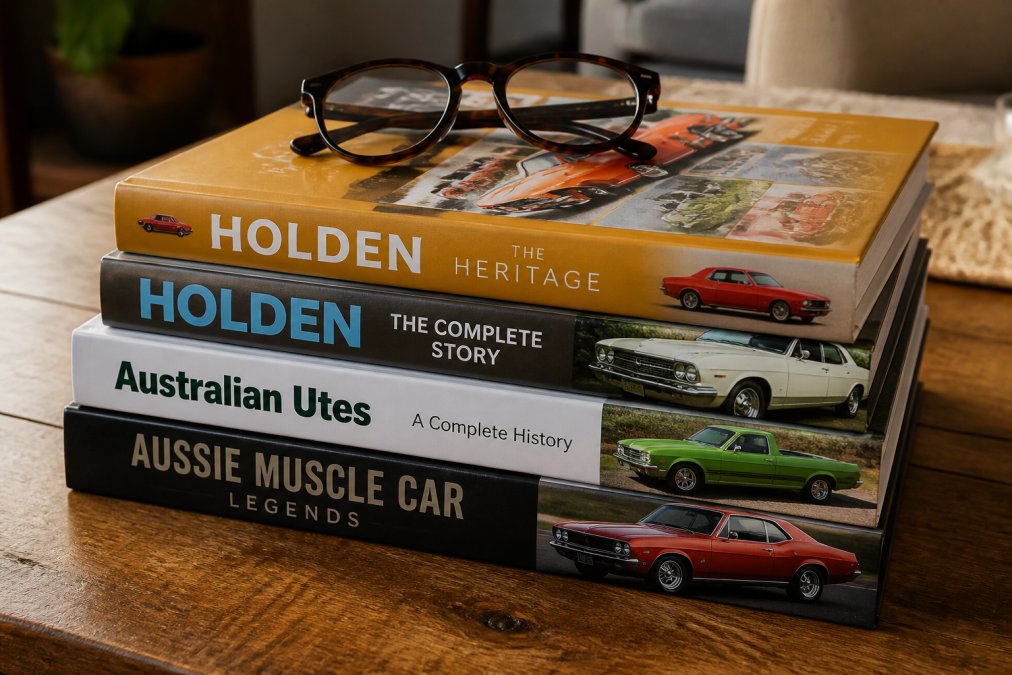
Each title answers the value question differently, one social history, one investigative journalism, two enthusiast commemorations. Match the book to the reader and the price stops feeling steep.
| Title | Price | Format | Best For |
|---|---|---|---|
| Cars We Used to Drive | $54.95 | Hardback, 264 pages | Social history readers |
| Golden Miles | $39.95 | Paperback, 288 pages | Muscle car enthusiasts |
| The Passion for Holden | $39.99 | Paperback, 197 pages | Holden loyalists |
| The Passion for Utes | $39.99 | Paperback, 188 pages | Ute owners and tradies |
Cars We Used to Drive: Australians on the Move, 1940s to 1960s
The most expensive title here is also the most archival. Don Loffler covers 1946 to 1966, when makes like Morris, Vanguard, Wolseley, Oldsmobile and Hudson were household names, and the 280 photographs of owners beside their cars at picnic spots and caravan parks make it as much a record of mid-century family life as of motoring.

Hardback binding at 264 pages justifies the $54.95 for buyers who want a keeper. It is the strongest gift for someone who remembers those years firsthand.
Golden Miles: Sex, Speed and the Australian Muscle Car
Clinton Walker's expanded edition treats the muscle car as a suburban artefact rather than a spec sheet, carrying the energy of a fanzine and the rigour of investigative journalism across 288 pages for $39.95. Reviewers call it provocative and lavishly illustrated, and it appeals as much to pop culture readers as to revheads.
The Passion for Holden: Commemorative Edition
When General Motors announced in February 2020 that Holden was finished, it closed a chapter that began with J. A. Holden's saddlery in the 1850s (holden.com.au). Joel Wakely tells that story across 197 pages, from the 1910s body-building era through 69 years of local manufacturing, with dozens of owner-contributed stories and many photographs printed for the first time.
The Passion for Utes: An Australian Obsession
Wakely's fourth book covers the ute from the home-built vehicles of the 1910s and 1920s to Ford's first true ute in the 1930s and the first all-Australian Holden ute in the early 1950s. At 188 pages and $39.99, it is the shortest of the four, but the fully illustrated format suits the subject.
Rare Australian Car Books and What Drives Their Value
Most guides stop at "older is rarer, so it costs more." That is not how the second-hand market for Australian automotive literature behaves: age is the weakest predictor of price. What moves the number is scarcity, condition, provenance and demand from a specific collecting community, all assessable before you commit money.
A four-step appraisal framework
Treat a purchase the way a dealer treats a trade-in. Work through the steps in order, because a failure at step one makes the rest irrelevant.
- Confirm the edition and printing. Check the copyright page for the edition statement and the printing line (often a descending number sequence such as 10 9 8 7 6 5 4 3 2 1, where the lowest surviving number indicates the printing). A stated "first edition" on the title page is worth more than a later printing of the same title, but only if the printing line agrees (loc.gov).
- Establish the print run. Small Australian publishers such as Wakefield Press and Woodslane Press work in modest runs and rarely reprint.
Condition grading standards for second-hand car books
| Grade | Book block | Dust jacket |
|---|---|---|
| Fine | Appears unread; no foxing, no spine lean, no inscriptions | Intact with no tears, chips or fading |
| Near fine | Minor shelf wear; square spine; pages clean | Light edge wear only |
| Very good | Read but sound; slight spine lean; minor foxing on endpapers | Small tears or chips under 1 cm; no loss of text |
| Good | Complete but visibly worn; foxing through the text block; hinges starting | Noticeable tears, creasing or sun fading |
| Fair | Loose hinges, heavy foxing, possible water staining | Major loss, or jacket absent |
Authenticity checks for first editions and signed copies
What actually drives price in this category
How to Preserve Vintage Car Books So They Hold Their Value
Why physical copies hold value that a digital archive cannot
A storage routine that protects the grade
The provenance file: the cheapest value protection there is
When not to repair
What the Critics and Buyers Say
Conclusion: Who Should Buy, and Who Should Borrow
Frequently Asked Questions
Are signed copies of Australian automotive history books a good investment?
Signed copies carry a premium because the author's signature can't be reproduced. If the author is well known in motoring circles, a signed first edition often holds or grows its value better than an unsigned copy. Store it away from direct sunlight and keep the dust jacket intact. Treat it as a long-term collectible rather than a quick flip, and buy from a reputable seller who can confirm the signature is genuine.
How do I judge whether a vintage car book is worth the asking price?
Check four things: condition, edition, author reputation and demand. A first edition in fine condition with an unclipped dust jacket will always outperform a later reprint with a torn cover. Look for titles covering Holden, Ford or Chrysler models with strong enthusiast followings, and compare recent sold prices rather than asking prices. If a book is out of print and rarely listed, scarcity supports the price.
What makes a rare Australian car book valuable to collectors?
Scarcity, subject matter and provenance drive value. A limited print run, a commemorative edition, or a title tied to a specific marque like Holden or a decade like the 1960s muscle car era all lift demand. Signed copies with a named owner or an author inscription add provenance. Books that document Australian motoring history with original photography tend to be the ones collectors chase hardest.
How should I store a vintage car book to keep it in good condition?
Keep it upright on a shelf, out of direct sunlight and away from damp. Use a clear plastic sleeve or a slipcase to protect the dust jacket. Avoid storing books flat in stacks, which stresses the spine. Handle with clean, dry hands and never use tape to repair tears. A stable room temperature with low humidity is best. These simple habits preserve both the book and its resale value.
Are these books a good gift for someone in aged care or with dementia?
Yes. Large-format photo books with familiar car models and everyday scenes from the 1940s to the 1970s work well for reminiscence because the images prompt conversation without requiring reading. Many carers use them to spark memories and engagement. Choose a title covering the decade the person would remember best, and look for one with clear, well-captioned photographs rather than dense text.