

Best Classic Australian Car Photo Books for Nostalgic Gifts
Table of Contents
- Why Classic Australian Car Photo Books Make Perfect Gifts
- Quick Comparison of Top Classic Australian Car Photo Books
- Cars We Used to Drive: Australians on the Move, 1940s to 1960s
- Golden Miles: Sex, Speed and the Australian Muscle Car
- The Passion for Utes: An Australian Obsession
- The Passion for Holden: A Celebration of the Australian Icon
- Australian Automotive Photography Collections: What to Look For
- Where to Find Signed Classic Car Books by Australian Authors
- Frequently Asked Questions
Last Updated: September 9, 2026
For generations of Australians, the family car was more than a machine; it was the centrepiece of weekend adventures, the backdrop for holiday photographs, and a source of deep pride. Classic Australian car photo books capture that bygone era beautifully, preserving the visual history of local manufacturing and the golden age of motoring in archival images that spark immediate recognition. These pictorial hardcovers unlock cherished memories for older readers, making them far more than simple coffee table books. This guide explores the finest classic Australian car photo books for nostalgic gifts, helping you choose a visual treasure that honours a lifetime of automotive memories, whether for a milestone birthday or a quiet moment of reminiscence.
Why Classic Australian Car Photo Books Make Perfect Gifts
A classic Australian car photo book works as a powerful tool for connection, particularly for the older generation who lived through the post-war boom in local manufacturing. These books document an automotive heritage filled with muscle cars, classic sedans, and beloved utes, offering a tangible link to a time when motoring represented freedom and progress. Unlike a generic present, a book focused on automotive history shows genuine thought, acknowledging the recipient's specific interests and lived experience.
The true magic lies in the response they generate. Flipping through fully illustrated pages of restored and original vehicles often prompts spontaneous storytelling, as readers recall their first car, a memorable road trip, or a family member's prized possession. This makes them ideal for reminiscence therapy, a practice widely used in aged care to stimulate memory and conversation. The books become a bridge between generations, allowing grandchildren to understand the world their grandparents grew up in through the universal language of the automobile.
Quick Comparison of Top Classic Australian Car Photo Books
To help you find the right fit, here is a quick overview of the titles featured in this guide. Each offers a unique window into Australian automotive culture, from the post-war years to the muscle car era.
| Book Title | Focus Era | Key Focus | Format | Price |
|---|---|---|---|---|
| Cars We Used to Drive | 1940s-1960s | Everyday motoring & social history | Hardback | $54.95 |
| Golden Miles | Late 1960s-1970s | The muscle car & pop culture | Paperback | $39.95 |
| The Passion for Utes | 1910s-present | History of the Australian ute | Paperback | $39.99 |
| The Passion for Holden | 1856-2020 | The Holden marque & its legacy | Paperback | $39.99 |
Cars We Used to Drive: Australians on the Move, 1940s to 1960s
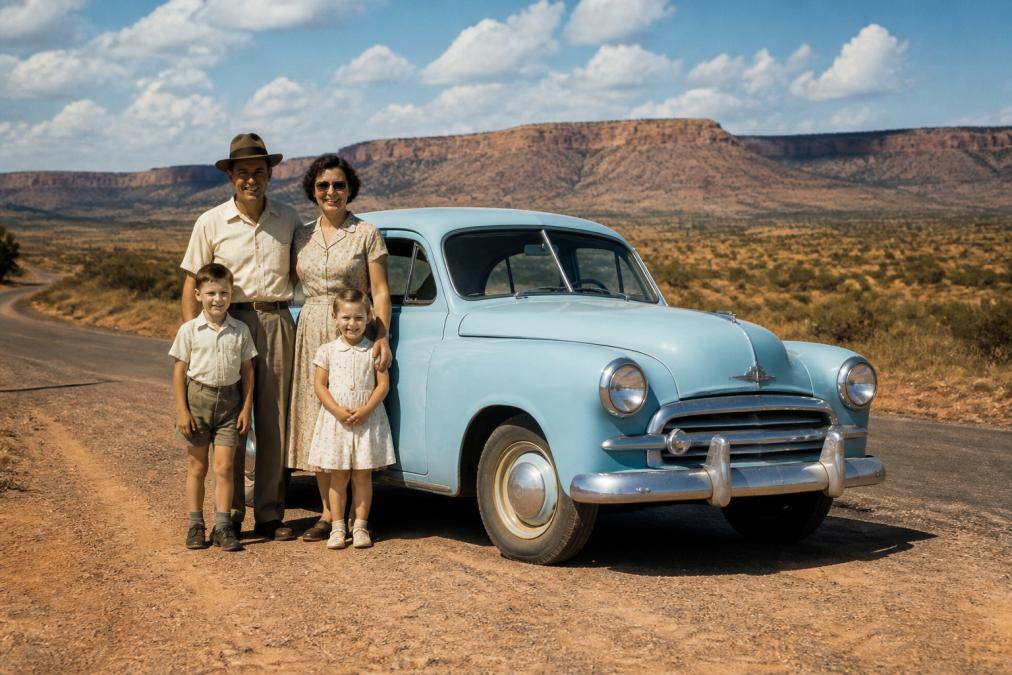
This is the definitive choice for anyone wanting to revisit the roads of their youth. In Cars We Used to Drive, author Don Loffler assembles a remarkable collection of 280 colour slides and black-and-white photographs capturing owners with their cars between 1946 and 1966 (nla.gov.au). Makes like Morris, Vanguard, Wolseley, Oldsmobile and Hudson, long since vanished from showrooms, are brought back to life in images that record the social history of a different era.

The photographs show families enjoying picnics on travelling rugs by the roadside and the early days of caravan holidays, offering a nostalgic trip into times that older readers remember fondly. For younger family members, it provides genuine insight into what life was like during those years. As a hardback featuring 264 pages of visual documentation, it is a substantial and meaningful keepsake.
Golden Miles: Sex, Speed and the Australian Muscle Car
For the enthusiast who loves the energy of the late 1960s and early 1970s, Golden Miles by Clinton Walker is an essential addition. This expanded edition explores the archetypal product of Australian suburbia: the muscle car (nla.gov.au). Written with the irreverent humour of a fanzine and the acuity of investigative journalism, it is as much a cultural history as it is an automotive one.

The book has earned praise for being absorbing and enlightening. It connects the design evolution of these legendary models to the broader social shifts of the time. At 288 pages, this paperback offers a substantial read that goes beyond simple photography to tell the story of an era.
The Passion for Utes: An Australian Obsession
No vehicle is more uniquely Australian than the ute, and Joel Wakely's The Passion for Utes tells its complete story with genuine affection. This fully illustrated personal history covers everything from the first home-constructed vehicles of the 1910s and 1920s to Ford's first true ute in the 1930s and the introduction of the first all-Australian Holden ute in the early 1950s.

Wakely writes from the heart. He includes contributions from dozens of ute enthusiasts alongside hundreds of photographs, many never seen in print before. For anyone who ever owned a farm ute or used one for work, this book is a trip down memory lane that celebrates a true Australian obsession with the respect it deserves.
The Passion for Holden: A Celebration of the Australian Icon
Following the end of Holden production in 2020, this commemorative edition from Joel Wakely serves as a lasting tribute to the marque cherished by generations. The Passion for Holden tells the whole story, from the saddlery set up by J. A. Holden in the 1850s, through the determination to produce the all-Australian car, to the highlights of 69 years of manufacturing. It covers the on-track successes and the deep connection Australians felt with their Holdens.
This book is filled with dozens of fascinating stories and hundreds of photographs, many never seen in print before. It is a book from the heart that goes deep into the passion that Holden engenders, making it a meaningful gift for anyone who has ever owned one of these iconic classic sedans. It offers a way to honour a lifetime of memories associated with a brand that defined Australian roads for decades.
Australian Automotive Photography Collections: What to Look For
Beyond simply matching a book to a favourite era, a discerning collector looks for specific production and curatorial qualities that separate a treasured volume from a disposable picture book. Understanding these details ensures your gift is a worthy addition to a serious library.
Print Quality and Paper Stock
The tactile experience is paramount. Look for books printed on heavy, matte art paper (typically 150-200 gsm) rather than thin, glossy stock. Matte paper reduces glare under direct light, which is crucial for a coffee-table book meant to be viewed in a well-lit living room. scale muscle car models.
Image Sourcing and Provenance
The most compelling collections draw from private archives and community submissions, not just institutional libraries. Books that credit individual photographers and donors in an appendix offer a richer, more personal history. When evaluating a book, skim the acknowledgements, if it lists dozens of private contributors, you know the images are rare and personal.
A Unique Angle: The Rise of Community-Sourced Archives
A growing trend in Australian automotive publishing is the community-sourced archive. These books are built from photographs submitted by car club members, local meet attendees, and everyday owners, rather than solely from professional photographers or news archives. This approach captures the lived reality of car culture, the dust of a country showground, the rust on a farm ute, the pride of a backyard restoration, that polished studio work often misses. Titles built on this model offer a more democratic and often more emotionally resonant visual history. When selecting a gift, consider whether the recipient would value the glossy perfection of a marque history or the raw authenticity of a community album. For many older enthusiasts, seeing a car that looks exactly like the one their neighbour owned is more powerful than seeing a concours-winning showpiece.
Binding and Longevity
A book intended to be revisited for decades needs a robust binding. Look for sections that are sewn, not just glued, and a spine that allows the book to lay flat when open. A lay-flat binding is essential for viewing double-page spreads of long, low muscle cars without a distracting gutter crease down the middle. The cover material also matters: a textured cloth or buckram cover with a foil-stamped title will age more gracefully than a glossy paper dust jacket that scuffs easily.
The Digital vs. Print Preservation Trade-off
It is worth acknowledging the elephant in the room: why buy a physical book when thousands of classic car images are available online? The answer lies in permanence and curation. Digital archives are vast but ephemeral, websites shut down, social media algorithms bury posts, and hard drives fail. A physical photo book is a fixed, permanent record that does not require a device or an internet connection to access. It is also a curated edit; an editor has made deliberate choices about what matters, creating a narrative arc that a random scroll through an online gallery cannot provide. For the older generation, the physical object also holds intrinsic value, it can be held, gifted, inscribed, and passed down in a way that a folder of digital files cannot. A well-made photo book is not just a collection of images; it is a preservation of memory in a tangible, enduring form.
Where to Find Signed Classic Car Books by Australian Authors
A signed copy transforms a book from a commercial product into a personal artefact, connecting the owner directly to the author's hand and intent. For collectors of Australian automotive literature, signatures carry particular weight because the community of authors is small, passionate, and often personally connected to the cars they write about.
The Market for Signed Editions
Signed copies of Australian motoring books are not as widely available as signed literary fiction. Authors like Don Loffler (Cars We Used to Drive) and Joel Wakely (The Passion for Utes, The Passion for Holden) are not international celebrities; they are specialists who often sell books at car shows, club meetings, and local launches. This scarcity makes signed copies genuinely collectible. Unlike mass-market bestsellers, where signatures are often produced via autopen or bookplate stickers, Australian motoring authors typically sign by hand at small events, making each inscription unique.
How to Verify Authenticity
When purchasing a signed book, especially online, ask the seller directly: Was the book signed in person at an event, or is the signature a printed facsimile? A reputable specialist retailer should be able to tell you the circumstances of the signing. Look for a signature in ink on the title page or half-title page, not a tipped-in card or a sticker. If the author has inscribed it to someone ('To John, happy motoring'), that is a sign of a genuine, personal signing session, though it may reduce its appeal as a generic gift.
Where to Look Beyond General Retailers
Specialist nostalgia and motoring bookshops are the primary source for signed editions. These retailers maintain direct relationships with authors and often commission dedicated signing sessions for their customers. Attending automotive swap meets, All-Holden Day events, and classic car club gatherings is another reliable way to find signed copies, authors frequently appear at these events to sell and sign their work. Auction sites occasionally list signed copies, but provenance is harder to verify, and prices can be unpredictable. A specialist retailer offers the advantage of a clear returns policy and a guarantee of authenticity.
The Value of a Personal Inscription
When ordering a signed book as a gift, consider asking the retailer if a personal inscription can be arranged. Many authors are happy to write a short dedication for a specific recipient. This elevates the book from a collectible to a one-of-a-kind keepsake that marks a specific occasion, a retirement, a 70th birthday, or a father's day tribute. The inscription turns the book into a three-way connection: between the author, the giver, and the recipient. It is this personal layer that no digital archive or unsigned copy can replicate, making the signed book a true heirloom rather than just another volume on a shelf.
Frequently Asked Questions
What are the most iconic Australian-made cars to look for in photo books?
The most iconic Australian-made cars include the Holden FX and FJ, the Holden Monaro, the Ford Falcon GT and the Valiant Charger. Photo books like The Passion for Holden celebrate the brand that defined local manufacturing from 1948 to 2017. Muscle car enthusiasts will appreciate Golden Miles, which covers the GTHO Phase III and other legends. Ute lovers should look for early Holden and Ford utility vehicles, which are featured extensively in The Passion for Utes.
Where can I find signed editions of classic Australian car books?
The Remember When Shop offers signed classic car books by Australian authors, including titles from Don Loffler and Joel Wakely. Author-signed copies add a personal connection to the gift, making them ideal for milestone birthdays or anniversaries. Check the product description for signing details before ordering. Because signed stock is limited, it is worth confirming availability and delivery timing, especially if you are purchasing for a specific occasion.
How do I choose the right coffee table book for a car enthusiast?
Start with the recipient's era of interest. Someone who grew up in the 1950s will connect with Cars We Used to Drive, which covers 1946 to 1966 with 280 colour slides and black-and-white photographs. Enthusiasts of the late 1960s and early 1970s will prefer Golden Miles for its muscle car focus. Consider whether they prefer Holdens, utes, or a broader range of makes, then match the book to that passion.
Are these books suitable for reminiscence therapy with elderly Australians?
Yes. The photographs in these books capture everyday scenes of Australian life, from roadside picnics to family cars, which can spark conversation and memories. The visual nature of the books makes them accessible even for those with advanced dementia. Carers in aged care facilities have found decade-specific nostalgia books helpful for engagement. The Passion for Utes and Cars We Used to Drive are particularly effective because they focus on vehicles many older Australians remember from their younger years.