

Collecting Rare Holden Factory Service Manuals: A Guide
Table of Contents
- Why Holden Factory Service Manuals Are Worth Collecting
- Holden Factory Workshop Manuals: What They Contain and Why They Matter
- Model and Series Coverage: From FX to VF
- The HQ Holden Service Manual and Other Hard-to-Find Editions
- How to Authenticate an Original Factory Manual
- Condition Grading, Completeness and Realistic Valuation
- Finding Original Holden Workshop Manuals for Sale Safely
- Storing, Preserving and Cataloguing Your Collection
- Frequently Asked Questions
Last Updated: October 17, 2026
Why Holden Factory Service Manuals Are Worth Collecting
Collecting rare Holden factory service manuals is a pursuit that rewards patience, knowledge and a sharp eye for detail.
A factory manual is not a coffee-table book. It is a working document, written for dealership mechanics and printed by the manufacturer.
Three things drive demand:
- Nostalgia. For anyone who owned or repaired a Holden, the manual is a direct link to that time.
- Practical use. Restorers still rely on factory specifications when rebuilding engines, brakes and bodywork.
- Scarcity. Many were thrown out when dealerships closed or updated their libraries, so surviving copies grow rarer each year.
The trick is knowing what you're actually buying. Below, we'll show you exactly how to identify, grade and value these manuals, and where to find them without getting burned.
Holden Factory Workshop Manuals: What They Contain and Why They Matter
Holden factory workshop manuals are the internal service documents dealers used to diagnose, repair and maintain vehicles to factory specifications. They cover mechanical servicing, engine overhaul, lubrication, body, heating and ventilation, plus the general information a working mechanic needed every day.
These aren't general guides. They are technical documents with torque settings, tolerances, wiring detail and step-by-step service procedures. A restorer rebuilding a V6 or an older six-cylinder relies on them because aftermarket books often simplify or omit the detail.
Factory Manuals vs Owners' Handbooks vs Reproduced Copies
The distinction matters more than most new collectors realise.
- Owners' handbooks are the small glovebox booklets given to buyers. Useful, but light on repair detail.
- Factory workshop manuals are the thick dealer documents. This is what serious collectors want.
- Reproduced copies are reprints or scans of the originals. Handy for daily use in the shed, but not collectible in the same way.
A printed original holds its value because it is a genuine piece of dealership history. A reproduction helps you work on the car, but it won't appreciate.
Model and Series Coverage: From FX to VF
Holden's model range spans decades, and each era produced its own manual. Coverage generally follows the model and series, with supplements issued as changes arrived mid-cycle. The single most useful thing a collector can do is map the model, series code and year against the manual type before buying, because listings rarely spell this out.
Use this checklist as a starting reference. It is not exhaustive, but it covers the models most collectors chase and the manual types that accompany them.
- FX and FJ (1948-1956). Early workshop documentation is scarce and often consists of loose-leaf pages or bound volumes with limited print runs. Expect to find general repair sections rather than the comprehensive wiring and body detail of later manuals.
- FE, FC, FB, EK, EJ, EH (1956-1963). Each series typically had its own workshop manual, with supplements for mid-series changes. Engine-specific information varies, so confirm whether the manual covers the grey or red motor before committing.
- HD, HR, HK, HT, HG (1963-1971). Dedicated workshop manuals exist for each series, and supplements appear for running changes. Body and interior sections become more detailed through this period.
- HQ, HJ, HX, HZ (1971-1980). The HQ is the most sought-after of this group, and clean originals are uncommon. Later series in this run often had supplements covering trim and mechanical updates, so a complete set may be several books rather than one.
- VB through VK (1978-1986). The first Commodore generation. Manuals cover the sedan and wagon, with separate documentation for some variants. Confirm whether the manual you are looking at covers the six-cylinder or V8 drivetrain.
- VL through VN (1986-1991). The VL introduced the Nissan six-cylinder, and the VN moved to the Buick-derived V6. Engine-specific manuals matter here because the drivetrains changed significantly between series.
- VP through VS (1991-1997). The VR and VS are popular with restorers, and manuals for these series often include supplements for safety and trim updates. Ute variants sometimes shared manuals with the sedan range but not always.
Commodore, Calais, Statesman and Caprice
The Commodore family is the most collected group, and for good reason. It ran for decades and spawned the Calais, Statesman and Caprice variants, each with its own documentation.
A Commodore manual won't always cover Calais trim differences, and Statesman and Caprice models often had separate supplements. If you're building a collection around one model line, map out the series first, then hunt the matching books.
The HQ Holden Service Manual and Other Hard-to-Find Editions
The HQ Holden service manual sits near the top of most wish lists. It covers one of the most beloved models of the early 1970s, and clean original copies don't come up often.
Other hard-to-find editions include early FX and FJ documentation, limited-run supplements for mid-series updates, and any manual tied to a low-volume variant.
What makes them rare? Dealerships discarded superseded manuals, and few private owners kept them once the car was sold.
How to Authenticate an Original Factory Manual
Authenticating an original factory manual comes down to paper, printing and provenance. Genuine originals have a period-correct feel that reproductions rarely match.
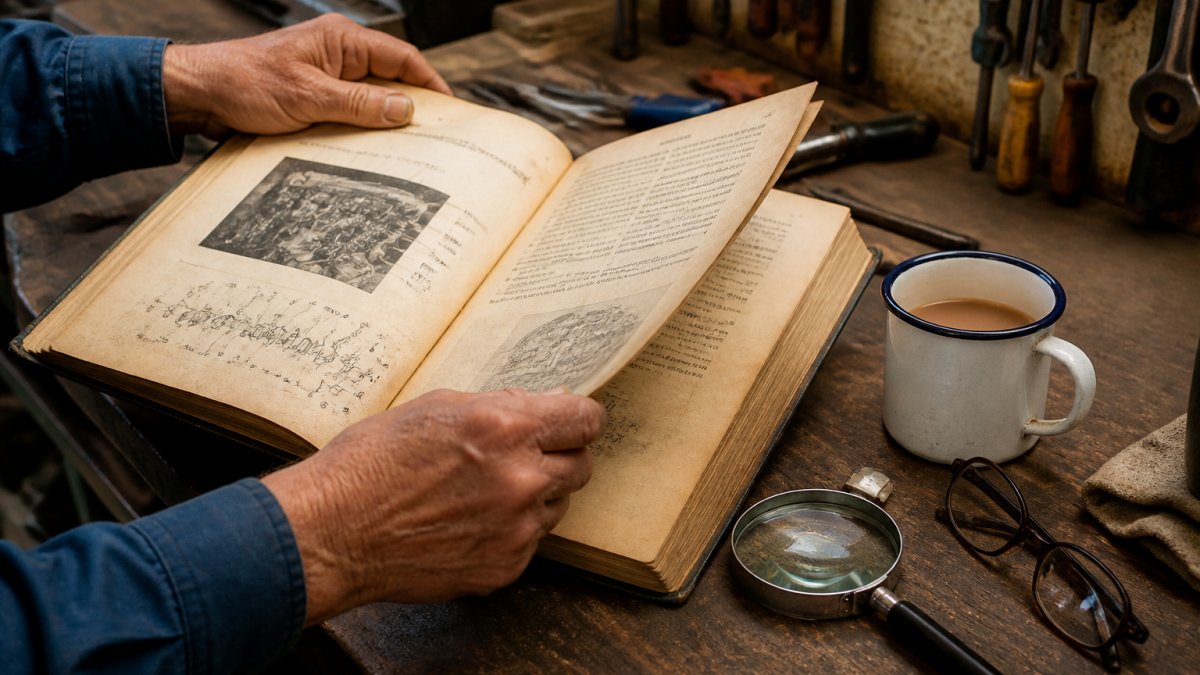
Work through this checklist:
- Paper stock. Original pages have a distinct age and weight. Reprints often feel too crisp and uniform.
- Print quality. Genuine manuals show period printing methods, not modern digital sharpness.
- Binding. Check for original stitching or staples consistent with the era.
- Publisher marks. Look for Holden branding, part numbers and print references.
- Provenance. Dealership stamps, owner names and service notes all support authenticity.
- Completeness. Confirm all sections and any supplements are present.
If a seller can't show clear photos of the binding, title page and any stamps, ask before buying. Honest sellers won't mind.
Condition Grading, Completeness and Realistic Valuation
Condition grading gives you a shared language for value. Most collectors work to a simple scale, and defining it clearly makes comparisons between listings far easier.
- Mint. Appears unused. No marks, no creases, binding tight, all inserts present. Rare for working manuals.
- Excellent. Minimal wear. Pages clean, binding sound, no missing sections. May have a faint owner name.
- Good. Honest workshop wear. Some greasy fingerprints, pencilled notes or a dealership stamp, but complete and fully legible.
- Fair. Heavy wear. Stained pages, loose binding, possibly a missing supplement or wiring diagram. Useful as a working copy but not as a collectible.
- Poor. Damaged, incomplete or heavily annotated. Buy only if it is a scarce edition and you intend to use it, not display it.
Completeness matters just as much as condition. A manual missing its wiring section or a supplement is worth less than a complete set, even if the cover looks better.
On pricing, there's no fixed market rate. Values depend on rarity, model, series, condition and completeness, and they move with demand.
A practical valuation method:
- Identify the exact edition. Model, series, year and whether supplements are included.
- Grade condition honestly. Use the scale above and photograph any flaws.
- Check completeness. Compare the section list to the contents page.
- Compare recent sales. Look for sold listings of the same edition rather than asking prices.
- Adjust for provenance. Dealership stamps and workshop notes can add appeal for some buyers, while missing pages reduce it.
Finding Original Holden Workshop Manuals for Sale Safely
Original Holden workshop manuals for sale turn up through estate sales, swap meets, specialist dealers and online marketplaces. Each channel carries different risks.
A safe approach:
- Ask for detailed photos of the title page, binding and any damage.
- Confirm the series and model before paying.
- Check seller feedback on marketplaces, and prefer sellers with a track record.
- Get provenance in writing where possible, especially for rare editions.
Be wary of listings that use a single stock photo or vague descriptions. If the seller can't tell you which series the manual covers, walk away.
For collectors who also love the broader story of these cars, pairing a manual with a classic Australian car book makes a wonderful display, and it's the kind of gift that resonates with the generation who grew up with these vehicles.
Storing, Preserving and Cataloguing Your Collection
Storage decides whether your collection survives. Paper is vulnerable to damp, light and pests, so treat your manuals like the fragile documents they are.
Practical steps:
- Store flat or upright in acid-free sleeves and boxes.
- Keep them out of direct sunlight to prevent fading.
- Control humidity; a dry, stable room is best.
- Handle with clean, dry hands, and avoid tape or adhesives.
- Catalogue each item with model, series, condition and any provenance notes.
A simple spreadsheet or index card system works well. Record where and when you acquired each manual, and photograph the title page for your records. That catalogue becomes valuable in itself if you ever pass the collection on.
Frequently Asked Questions
Are old Holden service manuals worth money?
Some are. Value depends on rarity, model coverage, condition and completeness. Early and limited-run editions, plus factory supplements for low-volume variants, tend to attract the strongest interest from collectors. A clean, complete original with its supplement set will always outperform a tatty loose-leaf copy. Because the market is thin and prices move with demand, check recent sale results on collector and auction listings before you buy or sell, and treat any single figure as a guide rather than a fixed price.
How can I tell whether a Holden workshop manual is an original edition?
Look at the paper, the printing and the binding. Originals usually have period-correct paper stock, letterpress or early offset printing, and staples or a glued spine consistent with the publication year. Check the imprint page for the publisher, part number and print date, and look for dealer stamps or handwritten mechanic's notes, which are strong signs of a genuine working copy. Reproductions often have brighter, uniform paper and digital typefaces. Compare the part number against known factory listings before committing.
Which Holden factory service manuals are hardest to find?
The scarce ones are usually the early post-war editions, low-volume performance and commercial variants, and the thin service manual supplements issued mid-series. Supplements were printed in small runs and were often thrown out when superseded, so complete sets are rarer than the base manual. Late-model factory workshop manuals in printed form are also increasingly uncommon because manufacturers moved to digital distribution. Condition matters as much as rarity: a rare manual in poor condition is harder to sell than a common one in excellent order.
How should I store and preserve a rare Holden service manual?
Keep manuals flat, dry and out of direct sunlight. A cool, stable room with low humidity prevents the foxing and musty smells that damage paper. Store loose-leaf and stapled manuals in acid-free folders or archival boxes, and avoid plastic sleeves that trap moisture. Handle pages by the edges, keep food and drink away, and photograph or scan each manual as a record for insurance. If a binding is failing, have it conserved rather than repaired with household tape, which stains paper permanently.
Building a collection of rare Holden factory service manuals takes patience, but the reward is a tangible link to Australia's motoring past. If you're shopping for the car enthusiast in your life, Remember When Shop offers author-signed classic Australian car books alongside our nostalgia titles, all curated to spark memories and start conversations. Browse our collection today and find a keepsake that lasts.