
What Is Life Story Work in Aged Care? A Practical Guide
Table of Contents
- What Life Story Work Means in Aged Care
- How Life Story Work Supports Person-Centered Care and Well-Being
- Reminiscence Therapy Activities for Seniors: What Works in Practice
- How to Start a Reminiscence Therapy Group in Your Facility
- What You'll Need
- Step 1: Choose Your Participants [Time: 1 week]
- Step 2: Gather Your Materials [Time: 3-5 days]
- Step 3: Run the First Session [Time: 45 minutes]
- Step 4: Note What Worked [Time: 10 minutes]
- Step 5: Repeat Weekly [Time: Ongoing]
- Life Story Book Templates for Aged Care: Choosing and Using Them
- Ethical Considerations: Consent, Trauma-Informed Care, and Family Involvement
- Measuring Outcomes: How to Know Life Story Work Is Making a Difference
- Frequently Asked Questions
Last Updated: September 18, 2026
What Life Story Work Means in Aged Care
Life story work is the practice of helping an older person record and share their memories, relationships and life experiences so that carers understand the whole person, not just their diagnosis. A photo book of old Australian scenes can open a conversation that a standard care assessment never will.
In practice, life story work usually includes:
- A memory collection of key events, places and people
- A written or digital record kept with the care plan
- Photos, objects and music that prompt conversation
- Ongoing updates as new memories surface
How Life Story Work Supports Person-Centered Care and Well-Being
Person-centered care means treating each resident as an individual with their own history, preferences and identity. Life story work is one of the most practical ways to deliver that kind of care.
The benefits often reported include:
- Stronger emotional connection between staff and residents
- Less anxiety during personal care tasks
- Better resident engagement in group activities
- A clearer sense of personhood and identity preservation
Reminiscence Therapy Activities for Seniors: What Works in Practice
Reminiscence therapy activities for seniors work best when they tap into real memories from the person's own life. Generic quizzes rarely spark the same response as a familiar photo or song.
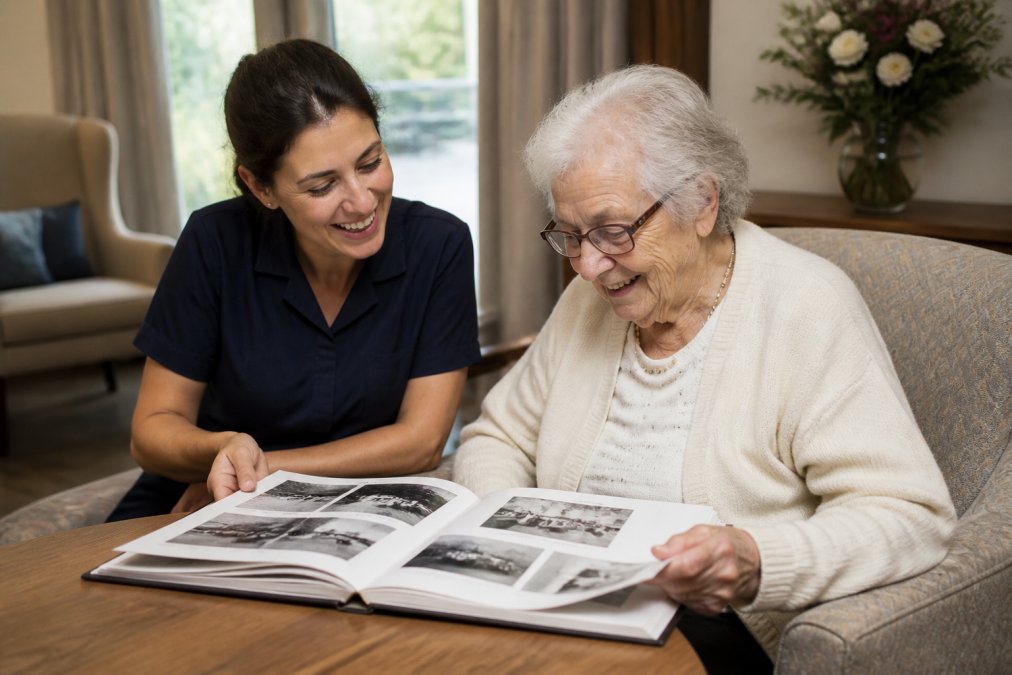
The most reliable activities include:
- Looking through decade-specific photo books together
- Listening to music from the person's teenage years
- Handling familiar objects like old tools, crockery or coins
- Cooking or tasting foods from their childhood
- Sharing stories in small groups with a facilitator
How to Start a Reminiscence Therapy Group in Your Facility
Starting a reminiscence therapy group takes planning but not a big budget. Five or six residents in a quiet room is enough to begin.
What You'll Need
- A quiet, comfortable room with good lighting
- Decade-specific photo books or memory prompts
- A facilitator who can listen more than they talk
- A simple consent form for each participant
- A way to record what works
Step 1: Choose Your Participants [Time: 1 week]
Ask care staff which residents enjoy conversation and would cope well in a group. Avoid mixing very different needs in the same session at first.
Expected result: A shortlist of five or six residents.
Step 2: Gather Your Materials [Time: 3-5 days]
Pick prompts that match the group's era. Photos and Memories of Australia from the 1950s gives you ready-made conversation starters with real images and stories.

Expected result: A box of materials you can reuse each week.
Step 3: Run the First Session [Time: 45 minutes]
Start with one photo or object. Let the conversation go where it goes. Do not correct small errors in memory.
Expected result: Residents talking to each other, not just to you.
Step 4: Note What Worked [Time: 10 minutes]
After each session, write down which prompts sparked the most talk. Build the next session around those.
Expected result: A running list of reliable prompts.
Step 5: Repeat Weekly [Time: Ongoing]
Consistency matters more than variety, the same time, room and faces help residents feel safe.
Expected result: Growing comfort and more open sharing over time.
Life Story Book Templates for Aged Care: Choosing and Using Them
Life story book templates for aged care give you a structure, so you are not starting from a blank page. The best leave room for the person's own words and photos.
Book; Australia Remember 1976: A look →
A simple template usually covers:
- Early years and family
- School and first job
- Marriage, children and friendships
- Homes, holidays and hobbies
- Values, routines and favourite things
Ethical Considerations: Consent, Trauma-Informed Care, and Family Involvement
Most guides treat ethics as a footnote, yet it is the part of life story work that most often goes wrong and determines whether a resident trusts the process. Three areas need deliberate handling: consent, trauma, and family.
Consent when capacity fluctuates
Consent is not a single signature at the start. Under the Privacy Act 1988 and the Australian Privacy Principles, personal information collected for life story work, photographs, audio recordings and written memories, must be collected with consent, used only for that purpose, and stored securely. Providers also work within the Aged Care Quality Standards, where Standard 1 (Consumer dignity and choice) expects care that respects the person's identity, culture and preferences.
- Ask at the start of each session whether they are happy to continue, in plain language.
- Watch for non-verbal withdrawal, looking away, going quiet, changing the subject, and treat it as a withdrawal of consent.
- Revisit consent whenever the material will be shared more widely (for example, displayed on a wall, included in a newsletter, or handed to a new staff member).
- Record who consented, when, and to what, so the next carer does not have to guess.
Trauma-informed practice
Some memories are painful, war service, forced migration, the loss of a child, institutional care or family violence can all surface. Trauma-informed practice does not mean avoiding these topics; it means not steering into them and not leaving the person alone with them.
A few practical rules most experienced facilitators follow:
- Do not probe. If a resident mentions a difficult memory and stops, let it sit. Silence is not a prompt to dig.
- Redirect, do not correct. If a memory is distressing and the person wants to move on, offer a familiar object, a song, or a change of room.
- Stay with the feeling, not the facts. You do not need to establish what happened. You need to be present while it is felt.
- Debrief. A short note after the session, and a conversation with a supervisor if something was heavy, protects both the resident and the staff member.
Family involvement, and its limits
Families are often the richest source of material, photographs, letters, recipes, childhood pets, and the source of the most difficult conversations. Common friction points:
- Disagreement about what to include. One sibling may want a difficult period omitted; another may see it as central to who their parent is.
- Correcting the resident's memory. Families sometimes insist on the 'accurate' version of an event. For life story work, the resident's version is the one that matters.
- Using the story for their own purposes. A relative may want the book to serve as a tribute or a eulogy rather than a tool for care.
Storage and sharing
Digital life story tools raise their own questions: who owns the recording, what happens when the resident dies, can it be shared with a hospital? A simple rule: collect only what you will use, store it where the resident or their decision-maker can access it, and have a clear policy for after death.
Measuring Outcomes: How to Know Life Story Work Is Making a Difference
Most facilities run life story work on goodwill and never check whether it is doing anything. That is a missed opportunity, the outcomes that matter are observable and cheap to record. You do not need a research team, just a consistent way of writing down what you see.
What to measure (and what not to)
Avoid measuring 'happiness' or 'engagement' in the abstract. Measure specific, countable behaviours a casual observer could also see. Four domains cover most of the value:
- Initiation, how often the resident starts a conversation, or refers to something from their life story, without being prompted.
- Participation, attendance at group activities, and how long they stay.
- Affect during sessions, a simple three-point rating (settled / neutral / distressed) taken at the start and end of each session.
- Staff knowledge, whether new or casual staff can name three facts about the resident's history without checking the file.
A simple tool you can build this week
A one-page session log is enough. For each session, record:
| Field | What to write |
|---|---|
| Date and duration | e.g. 12 May, 40 minutes |
| Participants | First names only |
| Prompts used | Photo book, song, object |
| Response | Which prompt sparked the most talk |
| Affect start / end | Settled / neutral / distressed |
| Follow-up | Anything to avoid or repeat next time |
Qualitative signals that matter more than numbers
Some of the clearest evidence is anecdotal, which is fine as long as you write it down. Watch for:
- A resident who was withdrawn starting to greet a particular staff member by name.
- A carer who has never met the resident's family referring to their former job or hometown in conversation.
- A reduction in agitation during personal care tasks, noted in the care plan.
- A family member commenting that their relative seems 'more themselves'.
Review rhythm
A quarterly review is usually enough. Bring session logs, care plan notes and one or two staff observations to a short meeting. Ask three questions:
- Which residents have shown a clear change, positive or negative?
- Which prompts are reliably working, and which have gone stale?
- What needs to change in the next quarter?
What 'success' actually looks like
A note on formal tools
If your facility wants a validated instrument, tools such as the Cornell Scale for Depression in Dementia or the Cohen-Mansfield Agitation Inventory are sometimes used to track change in aged care. They are not designed for life story work and require training. For most facilities, a well-kept session log and a quarterly conversation will tell you more, faster, than a scale you are not trained to administer.
Frequently Asked Questions
What are some examples of life story work?
Life story work can take many forms. Common examples include creating a life story book with photos and written memories, building a digital slideshow set to music, making a memory box filled with meaningful objects, recording audio interviews with family members, and displaying a timeline poster in a resident's room. In practice, many aged care staff use decade-specific photo books, such as those covering the 1950s or 1960s, as conversation starters. These resources work well because the images prompt specific memories rather than vague questions like 'tell me about your childhood'.
How does life story work support person-centered care?
Person-centered care means treating each resident as an individual with a unique history, preferences, and identity. Life story work supports this by giving staff concrete knowledge about who the person was before they entered care. Knowing that a resident worked as a nurse, loved beach holidays, or grew up on a farm changes how you approach daily conversations and care tasks. It also helps build emotional connection and trust. When a resident feels known rather than processed, their engagement and well-being improve.
What resources are needed to start a life story project?
You need very little to begin. Essentials include a quiet space for one-on-one conversations, a notebook or digital device for recording memories, and a way to gather photos or objects. A life story book template helps structure the process so nothing gets missed. Decade-specific nostalgia books are useful because they provide visual prompts that spark memories without pressure. For group sessions, you will want a comfortable room, a facilitator, and a consistent time slot. Start small with two or three residents, refine your approach, then expand.
How can life story work improve quality of life for people with dementia?
For people with dementia, long-term memories often remain stronger than short-term recall. Life story work taps into those preserved memories, giving the person a sense of identity and competence. It reduces social isolation by creating meaningful interaction, and it gives carers practical tools to redirect distress or agitation toward a comforting topic. Many families find that sharing a nostalgia book with a relative who has dementia opens conversations that had stalled. The key is to follow the person's lead, use visual prompts, and avoid correcting or quizzing.