

1950s Photo History Books: A Guide to Australian Nostalgia
Table of Contents
- Why 1950s Photo History Books Matter
- 1. Photos and Memories of Australia from the 1950s by Bob Byrne
- 2. Growing Up in Adelaide in the 1950s by Susan Blackburn
- 3. Adelaide Remember When by Bob Byrne
- 4. Australia Remember When by Bob Byrne
- 5. Cars We Used to Drive by Don Loffler
- Preserving Family History Photos Alongside These Collections
- Collecting Australiana Books: What Makes These Titles Essential
Why 1950s Photo History Books Matter
The 1950s shaped modern Australia through post-war rebuilding, suburban expansion, television's arrival, the Queen's visit, and the Melbourne Olympics. These weren't distant events but lived experiences for millions still here today.
1950s photo history books serve multiple purposes: reminiscence therapy in aged care settings, meaningful gifts that acknowledge formative experiences, and primary historical sources. At Remember When Shop, we've curated Australian 1950s photo history books specifically because our nostalgia books (particularly Australia Remember When and Remember When: Snapshots of Australia 1950s - 1980s) have been widely recognised as helpful by carers in aged care and those working with people with dementia.

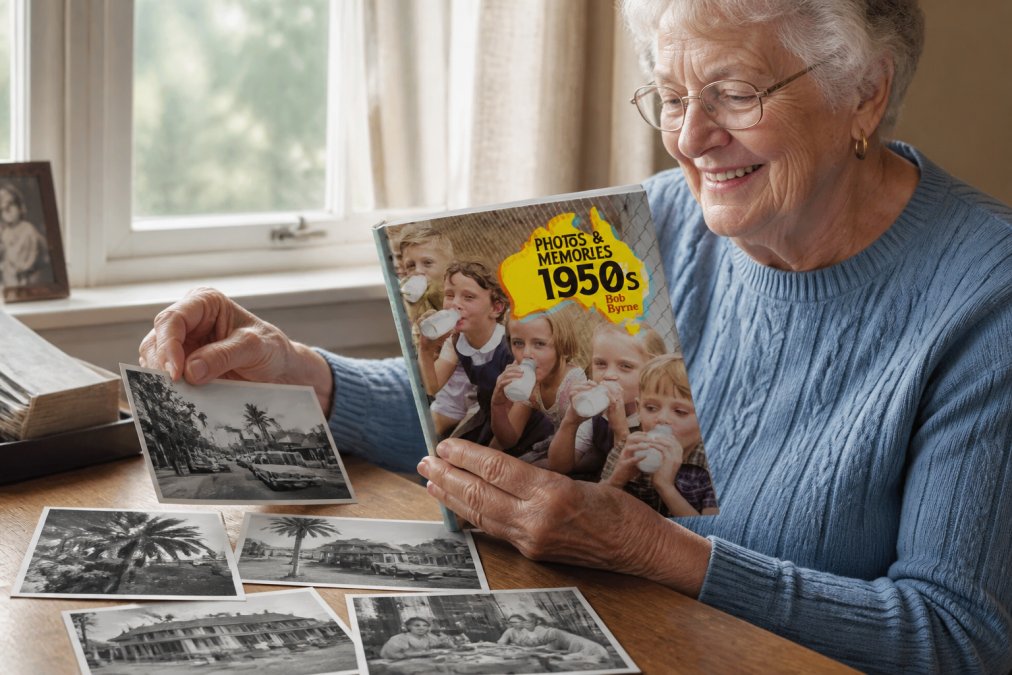
What makes these books special is authenticity. They capture mid-century Australian experience through genuine photographs: the look of 1950s street corners, suburban home design, fashion, and daily life. Black and white photography dominates, preserved alongside colour Kodachrome slides where available. For carers working with memory loss, these books can trigger autobiographical memory (peer-reviewed research). For families, they're conversation starters. For collectors, they're essential reference material.
1. Photos and Memories of Australia from the 1950s by Bob Byrne
Bob Byrne's "Photos and Memories of Australia from the 1950s" ($29.99, author-signed available) is the essential entry point for understanding the decade through visual storytelling. Byrne contextualises photographs within the lived experience of Australians emerging from wartime rationing into genuine optimism.

The book covers post-war rationing's end, television's arrival, suburban expansion, the Queen's visit, and the 1956 Melbourne Olympics. It captures the specific texture of 1950s life: first jobs, first cars, first homes, backyard cricket, corner shop visits, European immigrant integration, and emerging teenage culture.
Byrne brings credibility through 40 years in Australian media, including radio broadcasting, journalism, and authorship. His Australia Remember When Facebook page has attracted over 375,000 engaged followers. This 208-page paperback combines black and white and colour photography, consistently becoming a conversation starter at family gatherings.
Remember When Shop's collection of Australian nostalgia books stocks the author-signed edition.
2. Growing Up in Adelaide in the 1950s by Susan Blackburn
Susan Blackburn's "Growing Up in Adelaide in the 1950s" ($29.99) takes a different approach: 13 personal reminiscences from people who experienced childhood and adolescence in Adelaide during that era. Rather than a single authorial perspective, it's a collection of voices.
Blackburn, an associate professor at Monash University, applied her research skills to personal archives, asking friends and acquaintances to reconstruct their 1950s Adelaide memories. Contributor Max Lees captures the era's emotional landscape: "Growing up in the fifties was a time of isolation and innocence. We didn't know what was going on in the rest of the world."
The book doesn't shy away from shadows, polio fears, neglected children in orphanages, yet maintains an overall positive tone. Contributors look back with genuine enjoyment, inviting readers into their childhood worlds. For Adelaide residents, specific place names trigger immediate recognition. For others, it offers a window into broadly shared childhood experiences.
This straightforward paperback is designed for reading rather than display. Photographs support written reminiscences, making it particularly valuable for carers working with people experiencing memory loss, as personal narratives provide conversation hooks alongside visual material.
3. Adelaide Remember When by Bob Byrne
Bob Byrne's "Adelaide Remember When" ($34.99, 256 pages) brings city-specific expertise to bear, drawing from his popular Adelaide Remember When Facebook page. The book captures what Adelaide residents remember: elephant cart rides at the zoo, sun-warmed milk in glass bottles, Saturday nights at Downtown or Tilt, Magic Mountain and Dazzleland rides, local dances with local bands, sleeping on lawns during hot summers.

This book preserves Adelaide's specific character during significant change, documenting "bits of Adelaide we've forgotten, local identities and landmarks we loved." The production combines black and white and colour photographs across 256 pages, rewarding random browsing. For Adelaide residents or former residents, it's an essential keepsake. For historians of Australian cities, it's a primary source documenting mid-century urban transformation.
Byrne's background in commercial radio, particularly at 5DN Adelaide, gives him insider knowledge of the city's media landscape and cultural moments.
4. Australia Remember When by Bob Byrne
"Australia Remember When" ($34.99, 250+ pages) is Byrne's most ambitious project, compiling the best material from his Facebook page plus additional content. It covers the 1940s to 1980s, capturing the full arc of the post-war period and Baby Boomer years through 200+ photographs.
The book's thematic coherence spans four decades: the milkman's horse and cart, paper boys selling late editions, early television personalities like Graham Kennedy and Bert Newton, 45rpm singles and 33rpm albums at local record shops, home record players. These details constitute the texture of lived experience.
Subtitled "Kodak moments of a generation," it captures pictorial memories of the Baby Boomer years, moments people actually photographed and kept. This focus on documented experience gives the book authenticity that curated collections sometimes lack. The colour images, particularly Kodachrome photographs, have distinctive warmth contrasting with black and white material.
For people wanting gifts spanning multiple decades or for aged care reminiscence therapy, the extended timeframe increases the likelihood that readers will find resonant material.
5. Cars We Used to Drive by Don Loffler
Don Loffler's "Cars We Used to Drive: Australians on the Move, 1940s to 1960s" ($54.95) represents a different category, focusing on a specific object carrying enormous cultural significance. This hardback with 264 pages showcases 280 colour slides and black and white photographs of owners and their cars, spanning 1946 to 1966.
Loffler, a well-known Holden author, documents the social history of the era through automotive culture. Photographs capture people enjoying picnic lunches by roadsides, caravans at scenic locations, families gathered around their cars, revealing how Australians actually lived, their leisure activities, their pride in vehicle ownership. historical wall art.
The book spans crucial Australian automotive history: the transition from imported vehicles to domestic manufacturing, Holden's rise as a symbol of Australian identity, and the shift toward car-based holidays and caravan travel. Loffler's photographs document this transformation at ground level, capturing not just vehicles but people and landscapes.
The production is hardback with quality colour slides retaining warmth and saturation across decades. For automotive enthusiasts, historians of Australian manufacturing, and anyone with memories of 1950s-1960s cars, this book is essential.
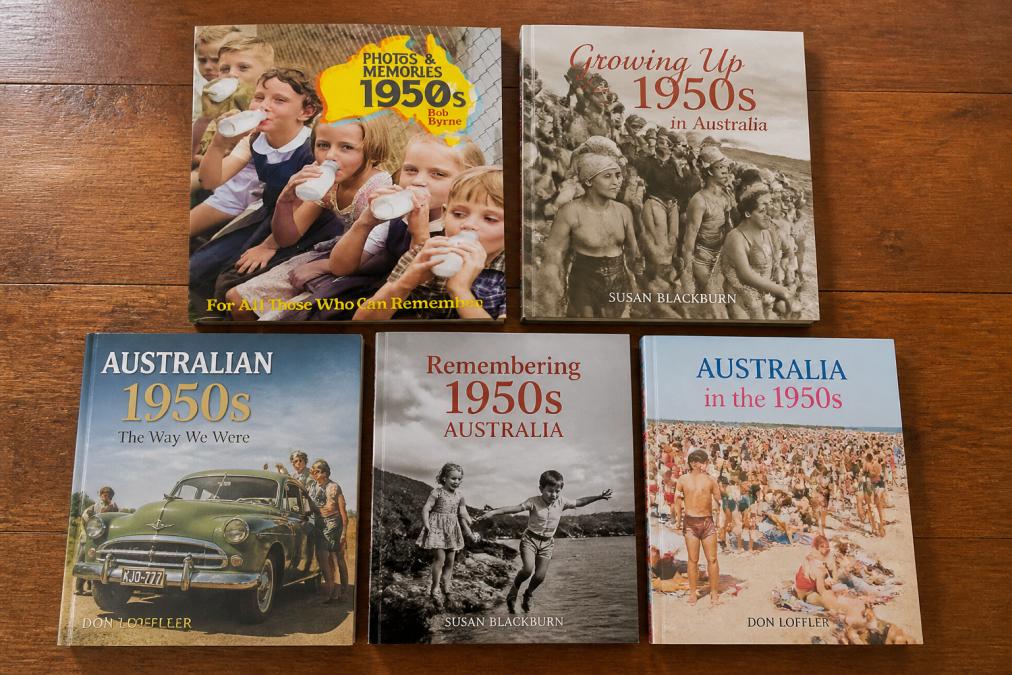
Quick Comparison: Which Book Suits Your Interests
| Book | Price | Focus | Best For | Key Feature |
|---|---|---|---|---|
| Photos and Memories of Australia from the 1950s | $29.99 | National 1950s survey | Broad introduction to the decade | Covers post-war rebuilding to Olympics |
| Growing Up in Adelaide in the 1950s | $29.99 | Personal reminiscences | Adelaide residents, intimate narratives | 13 contributors' childhood memories |
| Adelaide Remember When | $34.99 | Adelaide-specific nostalgia | Long-term Adelaide residents | Local landmarks and cultural moments |
| Australia Remember When | $34.99 | Multi-decade national survey | Broad post-war coverage | 1940s-1980s, 200+ photographs |
| Cars We Used to Drive | $54.95 | Automotive history and culture | Car enthusiasts, social historians | 280 period photographs, 1940s-1960s |
Preserving Family History Photos Alongside These Collections
Published photo history books provide context and validation for your own family photographs. When you see a street you remember in "Australia Remember When," it legitimises your own images and memories. Your family photographs are primary sources feeding into broader historical understanding.
Preservation starts with basics: store photographs in acid-free materials, avoid direct sunlight, maintain stable temperature and humidity, and resist cleaning with household materials. Colour photographs from the 1950s-1960s, particularly Kodachrome film, are vulnerable to fading (loc.gov).
Digital scanning creates preservation backups and makes images accessible to younger family members. Aim for at least 600 DPI resolution for archival purposes (loc.gov). Store digital files in multiple locations: external hard drives, cloud storage, and ideally a second physical backup.
These books facilitate conversation around photographs and memories. When you sit with an elderly relative and look through "Growing Up in Adelaide in the 1950s" or "Australia Remember When," you're creating opportunities for them to tell stories photographs alone cannot convey. That narration is preservation work.
Consider creating a simple family archive alongside these published collections. Gather family photographs, organise by decade or person, add captions with names and dates, and store properly. Many families find this process becomes a bonding activity across generations.
Collecting Australiana Books: What Makes These Titles Essential
Australiana collecting is increasingly sophisticated. What might once have been dismissed as nostalgia is now recognised as legitimate cultural heritage documentation. These books represent the upper tier of Australian 1950s photo history, carefully researched, curated collections serving multiple purposes.
Essential Australiana books share several characteristics: authenticity of source material (genuine archival photography, personal collections, documented reminiscences rather than stock imagery), editorial expertise (Byrne's media background, Blackburn's academic training, Loffler's specialist knowledge), specificity of focus (temporal, geographical, thematic, or methodological), and purpose-driven design for engagement and memory-triggering.
These books aren't designed primarily for academic research, though they serve that function. They're designed for triggering memory, facilitating conversation, and creating emotional connection. This explains their recognition as tools in aged care and reminiscence therapy.
For serious collectors, author-signed editions carry additional value both emotionally and potentially financially. A book signed by Bob Byrne or Susan Blackburn is not just a historical document but an object touched by its creator. For gift-giving, signed copies signal thoughtfulness and investment.
Production values matter to collectors: paperback versus hardback, page count, photograph quality, binding durability. These books are designed for longevity, meant to be reread, shared, and handed down.
Consider the collection's gaps and overlaps. "Photos and Memories of Australia from the 1950s" provides national scope but focuses on one decade. "Australia Remember When" extends across four decades with less depth per decade. "Adelaide Remember When" provides geographical specificity. "Growing Up in Adelaide in the 1950s" offers personal narrative depth. "Cars We Used to Drive" provides thematic focus. Together, they create a multifaceted archive of post-war Australian life.
For collectors building meaningful libraries, identify your primary interest, temporal, geographical, thematic, or methodological, and build outward. These five titles provide an excellent foundation representing different approaches to the same historical period.
Reconnecting with the past through visual history is cultural preservation and personal meaning-making. The 1950s photo history books featured here offer different entry points, whether you seek broad national surveys, place-specific exploration, thematic focus, or intimate personal reminiscence. Remember When Shop has curated these titles because they work as conversation starters, memory triggers, and keepsakes. For anyone seeking meaningful gifts for those with roots in post-war Australia, or wanting to understand the decade that shaped modern Australian identity, these books deliver genuine value. Start with "Photos and Memories of Australia from the 1950s" for broad introduction, or choose based on specific interests, geographical focus, thematic emphasis, or personal connection. Author-signed copies add personal touches that transform purchases into keepsakes.
Frequently Asked Questions
What makes 1950s photo history books valuable for reconnecting with the past?
1950s photo history books capture the post-war era when Australia was rebuilding, from the end of rationing to the arrival of television and suburban expansion. These visual archives document everyday life through archival photography, showing how families embraced new suburbs, celebrated cultural milestones like the 1956 Melbourne Olympics, and experienced the birth of teenage culture. For those who lived through the decade, they spark cherished memories; for younger readers, they offer a window into how modern Australia took shape. The combination of vintage imagery and personal narratives creates a primary source that connects readers emotionally to their own family histories.
How can preserving family history photos alongside these collections strengthen memory work?
Pairing your own family photographs with published 1950s photo history books creates a richer narrative. When you place your grandparent's snapshot beside images from the same era in a professional collection, you see context, the fashions, vehicles, landscapes, and social moments that surrounded your family's story. This approach is especially valuable for reminiscence therapy with elderly relatives or those with dementia, as it anchors personal memories within a larger historical framework. Organise your family photos chronologically and thematically alongside books like 'Australia Remember When' or 'Photos and Memories of Australia from the 1950s' to create a multi-layered visual record that honours both individual and collective history.
Why are author-signed copies of Australian nostalgia books considered better gifts?
Author-signed copies add a personal, collectible element that transforms a book from a purchase into a keepsake. For older adults and history enthusiasts, a signature from the author, especially someone like Bob Byrne, who has spent decades chronicling Australian social history, creates an emotional connection and a sense of authenticity. Signed editions become treasured possessions suitable for milestone birthdays, anniversaries, and Christmas gifts. They also signal that you've chosen something thoughtfully curated rather than generic, which matters to recipients who value Australian cultural heritage. Many carers in aged care facilities report that the tangible, signed nature of these books makes them feel more special and meaningful during reminiscence sessions.
What's the difference between collecting australiana books focused on specific cities versus national collections?
City-specific books like 'Adelaide Remember When' or 'Growing Up in Adelaide in the 1950s' offer deeply local detail, familiar landmarks, neighbourhood stories, and regional experiences that resonate powerfully with people who lived there. National collections like 'Australia Remember When' and 'Photos and Memories of Australia from the 1950s' provide broader coverage across different regions and social experiences, making them ideal for those who moved between states or want a comprehensive view of the era. When collecting australiana books, choose city-specific titles if you're honouring someone's strong connection to a particular place, and national collections if you want to celebrate the shared Baby Boomer experience across the entire country.
This article was written using GrandRanker