
Benefits of Reminiscence Therapy for Seniors
Table of Contents
- What Reminiscence Therapy Is and How It Works
- The Benefits of Reminiscence Therapy for Seniors
- Reminiscence Therapy Activities for Seniors to Try
- Reminiscence Therapy Questions to Spark Conversation
- Reminiscence Therapy Prompts That Work for Different Needs
- Reminiscence Therapy for Dementia: What to Expect
- When Memories Are Distressing, and How to Measure What Works
- Frequently Asked Questions
Last Updated: October 13, 2026
What Reminiscence Therapy Is and How It Works
Reminiscence therapy is a structured, non-drug approach that uses prompts such as photographs, music, objects and conversation to help older adults recall and share personal memories. At Remember When Shop, we hear regularly from carers who use nostalgic photo books to start these conversations.

The practice draws on a simple observation: long-term memories are stored deeply and are often the last to fade. Rather than testing what someone has forgotten, a facilitator works with what remains vivid.
A common mistake is treating it as a quiz. The goal is not correct answers; it is comfort, expression and shared experience. That distinction shapes everything about how a good session runs.
The Benefits of Reminiscence Therapy for Seniors
The benefits of reminiscence therapy for seniors span mood, social connection, a sense of purpose and overall quality of life. Many care providers find it is one of the few activities that reliably engages people who are otherwise withdrawn, because it starts from strength rather than deficit.
Below, we break down the main areas where the approach tends to help.
Mood, Emotional Wellbeing and Depressive Symptoms
Many practitioners report that recalling positive memories lifts mood and reduces depressive symptoms. Nostalgia is not simply sentimental; revisiting a happy time can generate genuine warmth and pleasure in the present. A regular session gives older adults something to look forward to and a reason to smile.
Stress, Agitation and Dementia-Related Symptoms
For people living with dementia, agitation and distress often stem from confusion or a sense that the world is unfamiliar (Agitation and aggression). A familiar song or photograph can act as an anchor, lowering stress and easing dementia-related symptoms. Carers frequently find that a calm ten minutes with a memory prompt prevents a difficult afternoon.
Identity, Self-Esteem and a Sense of Purpose
Sharing a life story reinforces who a person is. For older adults whose identity feels threatened by memory loss or by moving into long-term care, reminiscence restores self-esteem. Being the expert on their own past gives a senior a meaningful role in the room.
Reminiscence Therapy Activities for Seniors to Try
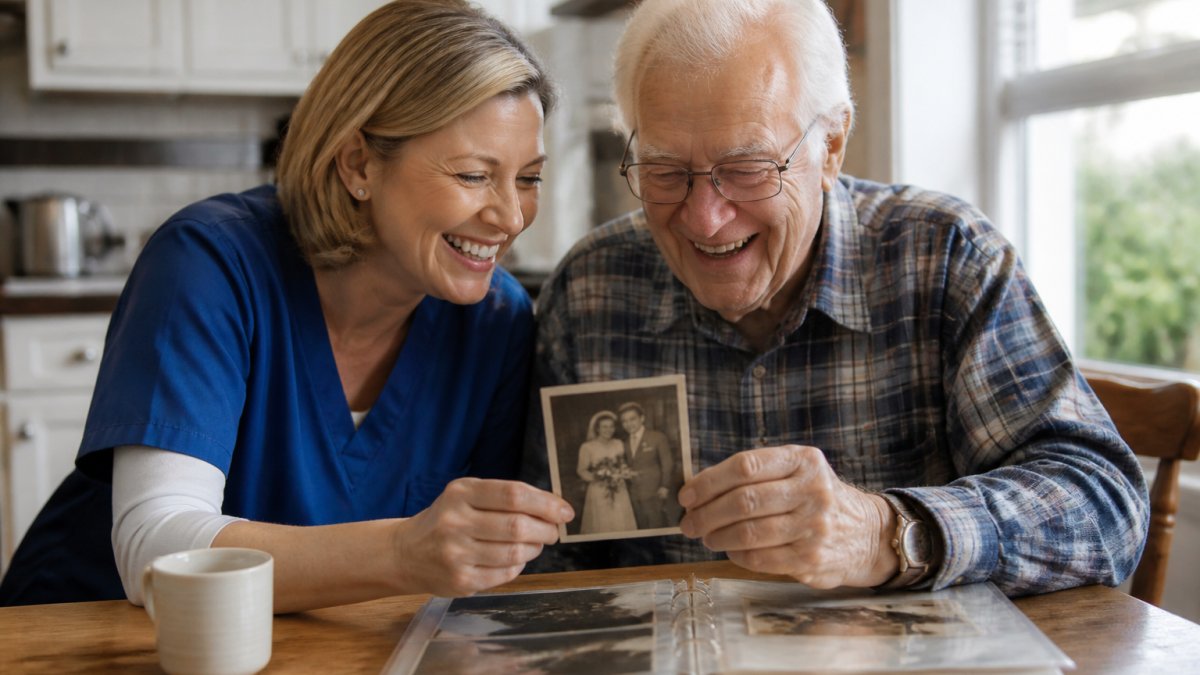
The best reminiscence therapy activities for seniors are simple, sensory and easy to return to. You do not need a clinical setting; a kitchen table works.
- Photo books and albums: The most versatile prompt. A decade-specific collection gives you dozens of conversation starters in one place.
- Music from their youth: Play a song from their teens and watch what happens to the face before the words come.
- Household objects: A wooden spoon, an old radio dial, a ration book. Pass them around and let touch do the work.
We recommend Book; Australia Remember When. Bob Byrne, which pairs more than 200 photographs with familiar moments from the 1940s to the 1980s. It is the sort of book that tends to open a conversation rather than close it.
Reminiscence Therapy Questions to Spark Conversation
Good reminiscence therapy questions are open, specific and gentle. "What was your first job?" beats "Do you remember your first job?" because it assumes a story rather than testing recall.
Try prompts that invite a scene rather than a fact:
- What did your street sound like on a summer evening?
- Who taught you to drive, and what car was it?
- What did you buy with your first pay packet?
Avoid questions with a right or wrong answer. If a senior cannot recall a name, move to what they can recall: the feeling, the place, the people around them.
Reminiscence Therapy Prompts That Work for Different Needs
The right reminiscence therapy prompts change with the person. A prompt that works beautifully for one resident may confuse or distress another, so it pays to adapt rather than to follow a fixed activity plan. The table below is a starting point, not a prescription.
| Need | Prompt type | Why it works |
|---|---|---|
| Limited speech (aphasia) | Photographs, objects, yes/no choices | Removes the pressure to find words and lets a nod or a point carry the answer |
| Hearing loss | Large-print photo books, tactile objects, written cue cards | Shifts the session away from spoken prompts the person may not catch |
| Vision loss | Music, scents, textures, recorded oral history | Uses the senses that remain strong rather than asking the person to see |
| Cultural or language background | Food, festivals, family rituals, songs in a first language | Anchors memory in lived experience rather than in the dominant culture |
| Early-stage dementia | Open life-review questions, decade themes | Invites storytelling while recall is still fluent |
| Mid-stage dementia | One image, one question, short sessions | Keeps the cognitive load low and the session brief |
| Advanced dementia | A single familiar object, a hand massage, a favourite song | Works through presence and sensation rather than conversation |
Adapting for hearing and vision loss
If someone uses hearing aids, check they are in and working before you begin, and sit where your face is well lit and clearly visible. Speak at a normal volume rather than shouting, and reduce background noise, a television left on in the corner will undo most of your work. For vision loss, swap photographs for objects that can be held: a wooden spoon, a folded handkerchief, a set of keys.
Adapting for aphasia and limited speech
Aphasia affects the ability to find and form words, not the ability to remember or to feel. Ask questions that can be answered with a gesture, a nod or a single word, and give the person time, a silence of ten or fifteen seconds is normal and should not be filled. Offering two options ("Was it the beach, or the bush?") is often easier than an open question.
Adapting across dementia stages
In the early stage, people often enjoy leading the conversation and may want to correct your details. Let them. In the middle stage, sessions work best when they are short, concrete and built around one theme. In the advanced stage, the goal shifts from conversation to comfort: a familiar song, a hand held, a favourite scent. A session that produces a calm expression rather than a sentence has still succeeded.
Book; Australia Remember When. Bob Byrne →
Adapting for cultural and language background
Generic prompts land flat for someone who grew up elsewhere. For a person whose first language is not English, a song or a phrase in that language can reach further than any translated question. Locally specific material also lands harder than generic nostalgia: Book; Melbourne Remember When. Bob Byrne works because the landmarks are ones the reader actually knew, and the same principle applies to any city, town or region.

Reminiscence Therapy for Dementia: What to Expect
Reminiscence therapy for dementia is not a cure, and it does not reverse dementia. What it can do is improve mood, reduce agitation and support communication and social interaction for the time you spend together.
Sessions are usually short, often fifteen to thirty minutes, and led by a caregiver or facilitator. Progress is measured in small things: a smile, a sentence, a hand reaching for a photograph.
When Memories Are Distressing, and How to Measure What Works
Not every memory is happy, and a good facilitator plans for that rather than hoping it will not happen. Distress during a session is not a sign that reminiscence therapy has failed; it is a sign that a real memory has surfaced, and how you respond in the next minute matters more than the prompt you chose.
Recognising discomfort early
Watch for the signals that a memory is turning painful: a change in breathing, a tightening of the hands, a flushed face, tears, repeated questions, or a sudden wish to leave the room. Some people become quiet and withdrawn rather than upset, which is just as important to notice. If you see any of these, slow down and lower your voice before you decide what to do next.
Responding without confrontation
Do not argue with the memory and do not try to correct it, even when the details are wrong. For a person living with dementia, the feeling attached to the memory is real regardless of the facts.
If the distress does not settle, end the session. There is no benefit in pushing through, and a difficult experience can make a person refuse the activity for weeks afterwards.
Knowing when to seek professional support
Occasional sadness is normal. Ongoing distress, persistent low mood, agitation that does not settle, or memories that seem to be intruding outside sessions are reasons to speak to a GP, an aged care nurse or a counsellor. Reminiscence therapy sits alongside professional care; it does not replace it.
Measuring what works for one person
Measuring outcomes is where most guides fall short. Rather than looking for a single score, track simple observations that you can compare over time:
- Mood before and after, a word or a number on a simple scale, noted in the same way each session.
- Willingness to join in, did the person come to the table, stay for the session, or ask for it again?
- Agitation, any change in restlessness, calling out or pacing across the week.
A short written note after each session, three lines is enough, gives you a record you can actually review with a carer, a family member or a GP.
This is also why a physical prompt is worth keeping on hand. Book; Photos and Memories of Australia from the 1950s is easy to bring out again, and consistency matters more than novelty when you are trying to see whether something is working.

Frequently Asked Questions
What are the benefits of reminiscence therapy for seniors?
Research points to improved mood, reduced depressive symptoms and less agitation, along with better social connection and quality of life. Seniors often gain a stronger sense of identity and self-esteem as they share personal memories. It does not cure or reverse dementia, but it can make day-to-day life more comfortable and engaging. Sessions work best when they are structured, consistent and built around prompts the person actually recognises.
Can reminiscence therapy help people with dementia?
It can help with emotional wellbeing, communication and social interaction, particularly in group or one-to-one sessions. Dementia-related symptoms such as agitation and low mood may ease during and after sessions, though outcomes vary between individuals. Reminiscence therapy for dementia does not reverse the condition. Long-term care staff often use photographs, music and personal objects as memory prompts because they tap into long-term memories that remain accessible longer.
How often should reminiscence therapy be used?
There is no single correct schedule. Many facilitators run structured sessions once or twice a week for 30 to 60 minutes, adjusting to the person's energy and attention span. Short, regular sessions tend to work better than long ones. If someone becomes tired, restless or upset, end the session and pick it up another day. Consistency matters more than duration.
Can reminiscing bring up difficult memories?
It can. Loss, war, illness and family hardship are part of many life stories, and a prompt about childhood might lead somewhere painful. Skilled facilitators let the person lead, acknowledge what comes up without pushing for detail, and gently redirect to a safer topic if distress builds. Keep a familiar comfort item or a favourite song nearby. If difficult memories recur often, speak with a GP or aged care professional about additional support.
Reminiscence therapy works best when it is personal, and that means starting with material that genuinely reflects a senior's own life. At Remember When Shop, we curate Australian nostalgia books with decade-specific photographs, author-signed copies available, and titles that carers in aged care have found genuinely useful. If you want a prompt that sparks conversation rather than sits on the shelf, browse our collection and find the decade that belongs to someone you love.