
Best Australian History Books for Students: 2026 Guide
Last Updated: October 22, 2026
Quick Summary
The best australian history books for students match the reader's year level, cite verifiable primary sources and fit the curriculum. Our top picks are the Remember When decade books at $29.99 each, from the 1940s through the 1970s, plus Growing up in Adelaide in the 1950s for senior source analysis.
- Match the book to the student's year level before choosing a topic or title.
- Photos and Memories of Australia from the 1950s suits confident readers in Years 4-6.
- Photos and Memories of Australia from the 1960s covers the 1967 referendum and decimal currency.
- Growing up in Adelaide in the 1950s offers thirteen personal reminiscences for oral-history work.
- Every Remember When title costs $29.99, and author-signed copies are available.
Table of Contents
- How to Choose Australian History Books for Students
- Australian History Books for Kids: Primary Years P-6
- Australian History Books for High School Students: Years 7-12
- First Nations History Books for Students: Reading with Context
- Australian History Books for School Projects: Research-Ready Picks
- The Remember When Series: Decade Books for Visual Learners
- Reading Levels, Accessibility and Study Aids at a Glance
- Frequently Asked Questions
How to Choose Australian History Books for Students
The right Australian history books for students do two jobs at once: they satisfy a curriculum requirement and they make a young reader want to turn the page. At Remember When Shop, we have spent years curating titles that celebrate Australian history and culture, and we have learned that the best classroom pick is rarely the thickest book on the shelf. Below, we break down how to match a book to a year level, what to look for in the source base, and which titles we would hand to a student first.
A good history book for a student is one written at their reading level, grounded in verifiable sources, and honest about whose voices it includes.
Most classroom disappointments come from a mismatch, not a bad book. A brilliant text pitched two years too high will sit unread. The five selection strategies in this guide have helped us pair readers with titles that actually get finished.
Match the Book to the Year Level
Age guidance matters more than most reading lists admit. Primary students in Years 3-6 respond to short chapters, large photographs and clear captions, while senior students need footnotes, primary source extracts and a visible bibliography. Ask the student's teacher which reading level the class is working at before you buy. A book that stretches a capable reader is a gift; one that frustrates them becomes a doorstop.
Check the Curriculum Links and Source Base
Curriculum alignment is the quiet differentiator. Look for titles that map to the historical periods and skills a student is assessed on, and check whether the author cites primary sources and a bibliography. The Australian Curriculum, Assessment and Reporting Authority publishes the Humanities and Social Sciences content descriptions that classroom units are built around, so a quick cross-check tells you whether a book supports the actual coursework. Books that show their evidence teach students how history is made, not just what happened.
Australian History Books for Kids: Primary Years P-6
For younger readers, the strongest Australian history books for kids combine big, clear images with short, factual text. Primary students are visual learners first, so a well-captioned photo book often outperforms a dense chapter book. Our pick for the early primary years is Photos and Memories of Australia from the 1950s ($29.99), which pairs everyday scenes with plain-language stories about family life, new suburbs and the arrival of television. It suits confident readers in Years 4-6 and works beautifully as a read-aloud for Years 2-3.

National Library of Australia's Trove digitised newspapers is a free companion resource for curious kids, letting them see original newspaper pages from the eras they are studying.
Australian History Books for High School Students: Years 7-12
High school is where Australian history books for high school students need to carry more weight. Years 7-10 cover the broad sweep of colonial settlement, federation and the twentieth century, while senior students tackle source analysis and historiography. For this age group we recommend Photos and Memories of Australia from the 1960s ($29.99), which moves through Beatlemania, decimal currency, the 1967 referendum and the moon landing with year-by-year chronicles. It gives students a social-history backbone they can hang dates and events on.

First Nations History Books for Students: Reading with Context
First Nations history books for students deserve careful handling. The best approach is to read them alongside source context, not in isolation, so students understand whose perspectives are being presented and why. Look for titles that centre Aboriginal and Torres Strait Islander voices and name their sources. The Australian Institute of Aboriginal and Torres Strait Islander Studies provides authoritative guidance and context that helps teachers frame these books responsibly. A decade book such as Photos and Memories of Australia from the 1960s touches on the 1967 referendum, making it a useful starting point for discussion when paired with First Nations-authored material.
Australian History Books for School Projects: Research-Ready Picks
For project work, Australian history books for school projects need an index, a bibliography and clear chapter headings a student can cite. Photos and Memories of Australia from the 1940s ($29.99) is research-ready: its chapters on rationing, the war effort and the first Holden give students specific, quotable material, and the author, Bob Byrne, draws on a long career chronicling Australian social history. Growing up in Adelaide in the 1950s, edited by Susan Blackburn ($29.99), offers thirteen personal reminiscences, ideal for students learning to compare perspectives and use oral history as evidence.

State Library of New South Wales research guides offers free project support and primary source collections that pair well with these titles.
Book; Photos and Memories of Australia from the 1940s →
The Remember When Series: Decade Books for Visual Learners
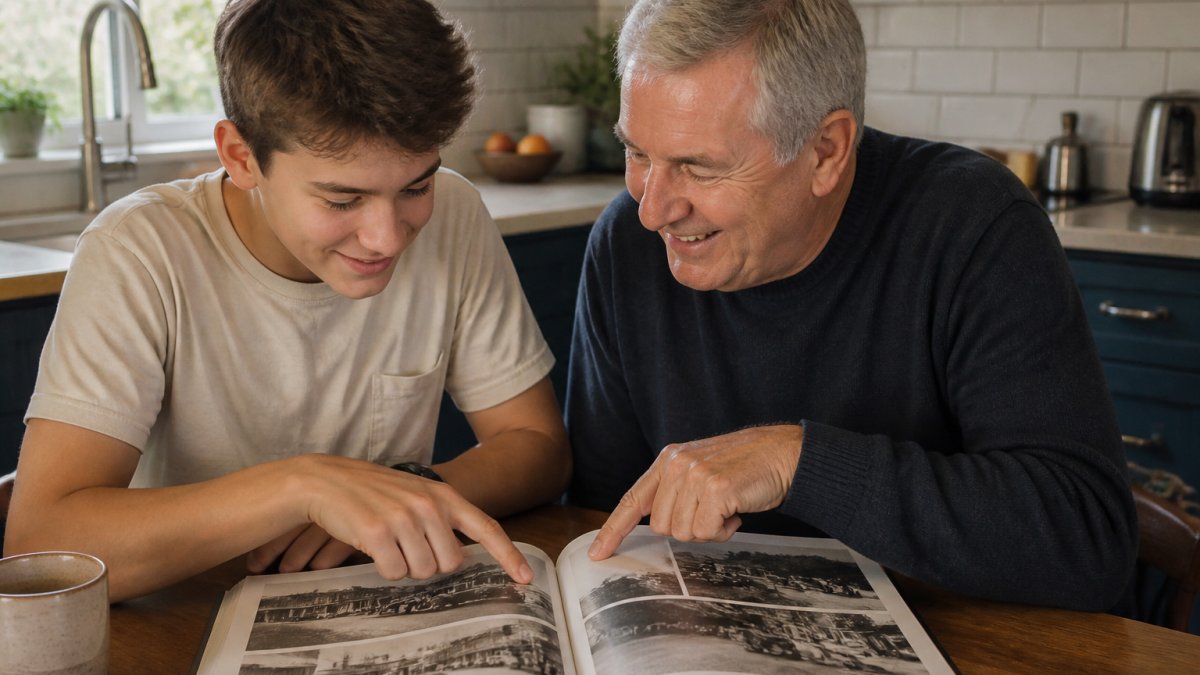
Visual learners get the most from the Remember When series, our decade-by-decade photo books covering the 1940s through the 1970s. Each title is $29.99, and author-signed copies are available. The series works because it shows history rather than telling it: a photograph of a red phone box or a queue at the corner shop makes an era concrete for a student who has only read about it. The books also bridge generations, which is why carers and families use them to spark conversation. One customer told us the books made an excellent gift and arrived quickly, and our 597 reviews reflect that warmth. Connecting these visual snapshots to the lived experiences of characters often deepens a student's empathy, a process that can be further enriched by exploring our historical fiction recommendations.
Reading Levels, Accessibility and Study Aids at a Glance
Accessibility is the factor most reading lists ignore. The table below goes beyond vague labels: it explains what each difficulty rating means in practice, maps titles to common curriculum topics, and notes the study aids a student can actually use for an assignment.
| Title | Best year level | Reading difficulty (what it means) | Curriculum topics it supports | Study aids | Format and price |
|---|---|---|---|---|---|
| Photos and Memories 1940s | Years 7-10 | Moderate: short chapters, some unfamiliar wartime vocabulary, captions carry context | World War II home front, rationing, early manufacturing, post-war migration | Chapter themes, index-style structure, period photographs | Paperback, $29.99; author-signed copies available |
| Photos and Memories 1950s | Years 4-8 | Accessible: large photographs, clear captions, plain-language text | Post-war suburbs, television, family life, early migration | Large photos, clear captions, decade overview | Paperback, $29.99; author-signed copies available |
| Photos and Memories 1960s | Years 8-12 | Moderate: year-by-year chronicles, some political context | 1967 referendum, decimal currency, social change, space race | Year-by-year chronicles, timeline structure | Paperback, $29.99; author-signed copies available |
| Photos and Memories 1970s | Years 8-12 | Moderate: thematic chapters, some abstract social-history concepts | Social movements, immigration, popular culture, economic change | Thematic chapters, period photographs | Paperback, $29.99; author-signed copies available |
| Growing up in Adelaide in the 1950s | Years 9-12 | Advanced: thirteen personal reminiscences, oral-history method, some assumed context | Oral history, comparative perspectives, post-war daily life | Thirteen personal reminiscences, discussion prompts | Paperback, $29.99 |
What the difficulty labels mean. "Accessible" titles use short sentences, large images and a single idea per page, and they suit reluctant readers and English-language learners. "Moderate" titles assume a Year 7 reading age and introduce subject vocabulary with captions and sidebars. "Advanced" titles expect students to weigh perspectives and understand oral-history method, so they suit senior students preparing source-analysis responses.
Study aids to look for. For project work, prioritise books with an index, a bibliography, clear chapter headings and a timeline. A glossary helps younger readers; discussion questions help teachers. Where a title lacks an index, the year-by-year chronicle structure still lets a student locate a specific event quickly.
Access and format. All titles listed are available in paperback at $29.99, and author-signed copies can be requested. Check your local library catalogue first: school and public libraries often hold these titles, and an interlibrary loan can save a purchase. For students who prefer audio or digital formats, ask the publisher or library about availability, as not every title is released in every format.
For classroom use, Scootle's curriculum-linked resource search helps teachers find supporting digital material to sit alongside any of these titles.
Frequently Asked Questions
What is the best Australian history book for kids?
For primary-aged children, look for heavily illustrated titles with short chapters and clear timelines. Decade photo books work well because the images carry the story and the text stays accessible. The Remember When series, including Photos and Memories of Australia from the 1950s ($29.99), suits upper primary readers who respond to visual evidence. Pair any book with a simple map and a glossary so children can place events in time and space, and check the reading level before buying.
Which Australian history books are suitable for secondary students?
High school readers need books that model historical argument, not just narrative. Look for titles with bibliographies, primary source extracts and chapter questions. The Remember When series gives Year 7-10 students accessible social history with photographs they can analyse as sources, while senior students should add academic histories and First Nations-authored works. Check the book against the relevant Australian Curriculum achievement standard before assigning it.
What are the best books for learning about First Nations history in Australia?
Prioritise books written or co-authored by Aboriginal and Torres Strait Islander people, and check that the publisher lists cultural advice or permissions. For students, choose titles that cover local and national perspectives, include oral history and explain terms such as Country and kinship. Pair these with the 1967 referendum material in Photos and Memories of Australia from the 1960s ($29.99) so students can compare a First Nations narrative with a general social history account.
Which books explain Australian history in an engaging way for students?
Engagement comes from story and image. Decade books that mix personal memories with researched events hold attention because each spread is a self-contained story. The Remember When series, with titles from the 1940s to the 1970s at $29.99 each, uses first-person recollections and period photographs. Teachers report that short, image-led chapters work well for reluctant readers and for classroom discussion, especially when students compare a memory with a textbook account of the same event.
What Australian history books are useful for school projects?
A project book needs an index, a timeline, captions and a source list. The Remember When series includes year-by-year chronicles and captioned photographs, which students can cite and analyse. For a local history project, Growing up in Adelaide in the 1950s by Susan Blackburn ($29.99) models oral history with 13 first-person contributions. Always check publication dates and cross-reference facts with a library database or the National Library of Australia's Trove.
Choosing history books for a student is really an act of matchmaking, and the wrong fit wastes both money and a young reader's curiosity. Remember When Shop curates Australian nostalgia and history titles with exactly this in mind: decade-specific photo books, author-signed copies and a collection built to connect readers with the past. Browse our range and give a student a book they will actually finish, remember and want to share.