

How to Display Signed Books in Your Home
Table of Contents
- Why Displaying Signed Books Requires Special Care
- How to Protect Rare Books from Humidity and Environmental Damage
- How to Preserve Author Signatures on Books
- Book Display Cabinet Ideas for Your Home Library
- Creating Aesthetic Shelf Arrangements for Signed Books
- Lighting Solutions for Displaying Your Signed Book Collection
- Insurance and Valuation for Your Collectible Books
- DIY Display vs. Professional Framing for Rare Editions
- Frequently Asked Questions
Last Updated: September 23, 2026
Signed books are treasured possessions. They're not just reading material, they're personal connections to authors and moments in time. But displaying them requires more thought than simply placing them on a shelf.
How to display signed books in your home matters because these items need protection from their environment whilst still being visible and appreciated. At Remember When Shop, we understand the significance of author-signed copies, particularly our collections of Australian nostalgia books that many customers cherish as meaningful gifts or personal keepsakes. The difference between a signed book that stays pristine for decades and one that deteriorates comes down to how you display and protect it.

This guide covers the essential techniques for preserving your signed collection whilst creating an attractive display that brings joy to your home.
Why Displaying Signed Books Requires Special Care
Signed books face unique challenges that regular books don't. An author's signature is irreplaceable. Once faded or damaged, it cannot be restored without professional intervention that may diminish the book's value.
The ink used in signatures varies widely. Some authors use ballpoint pens that fade quickly. Others use permanent markers that hold well. Regardless, exposure to light, humidity, and temperature fluctuations will eventually damage any signature.
Beyond the signature itself, the book's binding, pages, and cover need protection. Rare and collectible editions, especially signed copies from beloved Australian authors, deserve preservation methods that keep them readable and valuable for future generations.
How to Protect Rare Books from Humidity and Environmental Damage
Environmental control is the foundation of book preservation. Temperature and humidity fluctuations cause physical stress to binding, pages, and ink.
Temperature and humidity control
The ideal environment for signed books stays between 16-21°C with relative humidity between 30-40%. These conditions slow paper degradation and prevent mould growth.
Avoid basements and attics. Basements flood and develop moisture. Attics experience extreme temperature swings. Instead, choose interior rooms away from external walls. Bedrooms and living areas typically offer more stable conditions than kitchens or bathrooms.
Use a hygrometer to monitor humidity levels. Many are inexpensive and battery-powered. If humidity exceeds 50%, consider a dehumidifier. If it drops below 25%, a humidifier helps.
Never place signed books near heating vents, radiators, or air conditioning units. Direct airflow causes rapid moisture loss that warps pages and loosens bindings.
Protecting books from UV light and sunlight
Ultraviolet light fades signatures, discolours pages, and weakens paper fibres. Direct sunlight is the enemy of book preservation.
Display signed books away from windows. If you must place them near a window, use UV-filtering curtains or blinds that block 99% of ultraviolet rays. These are widely available and affordable.
Interior lighting matters too. LED lights emit minimal heat and UV radiation compared to incandescent or halogen bulbs. Choose warm white LEDs (2700K colour temperature) that mimic natural light without the harmful spectrum.
Rotate your display occasionally. If certain books receive more light exposure, move them to lower-light positions every few months. This distributes fading evenly if it occurs.
How to Preserve Author Signatures on Books
Signatures are vulnerable in ways that other parts of the book are not. The preservation techniques you choose directly affect whether an author's handwritten inscription remains legible and valuable.
Handling signed copies safely
Treat signed books like archival documents. Wash and dry your hands before handling. Better yet, wear cotton gloves, they cost a few dollars and prevent skin oils from transferring to paper and ink.
Open signed books gently. Support the spine with both hands rather than letting pages hang. Never force a book open past its natural range. Doing so stresses the binding and can crack the spine.
Avoid writing notes, bookmarks, or margin comments in signed editions. Even pencil marks are permanent additions that reduce value and can damage the paper.
Store signed books upright on shelves rather than stacking them horizontally. Weight from stacked books compresses the spine and binding. Vertical storage distributes pressure evenly.
Book; Melbourne Remember When. Bob →
Using archival-safe mounting techniques
For particularly valuable or fragile signatures, consider mounting the signed page or cover under archival-quality glass in a shadow box. This protects the signature from dust and handling whilst keeping it visible.
Use acid-free mounting materials. Regular adhesives and cardboard contain acid that migrates into paper over decades, yellowing and weakening it. Archival mounting supplies are available from conservation suppliers and cost more but preserve the book indefinitely.
Never use tape, glue, or sticky notes on signed books. These leave residue that damages paper and ink. If you must mark a book, use a small archival label on the inside back cover instead.
For signed dust jackets, store them separately in acid-free sleeves. Dust jackets protect the cover underneath but can trap moisture and cause damage if not properly ventilated. Archival sleeves allow air circulation whilst keeping dust out.
Book Display Cabinet Ideas for Your Home Library
The right display method balances aesthetics with protection. Your signed books should be visible and appreciated, not hidden away in a cupboard.
Acrylic display cases and shadow boxes
Acrylic display cases offer excellent protection with visibility. They shield books from dust, humidity fluctuations, and accidental damage whilst allowing you to see the cover and spine clearly.
Shadow boxes work particularly well for signed copies. Mount the book or a framed page under UV-protective glass. This creates an elegant focal point in any room whilst keeping the signature safe from light and handling.
Glass cabinets with adjustable shelving give you flexibility. You can arrange books by theme, era, or colour. Closed cabinets protect from dust. Glass doors allow viewing without opening them.
Ensure any case or cabinet has proper ventilation. Sealed enclosures trap moisture and promote mould growth. Look for cases with small ventilation holes or slightly loose-fitting doors.
Open shelving with proper support
Open shelves work if you maintain proper environmental conditions and use bookends. This display method showcases your collection and makes books accessible for reading.
Choose shelves that don't sag under weight.
Creating Aesthetic Shelf Arrangements for Signed Books
How you arrange signed books affects both their preservation and your home's appearance. The best arrangement balances visual appeal with practical protection.
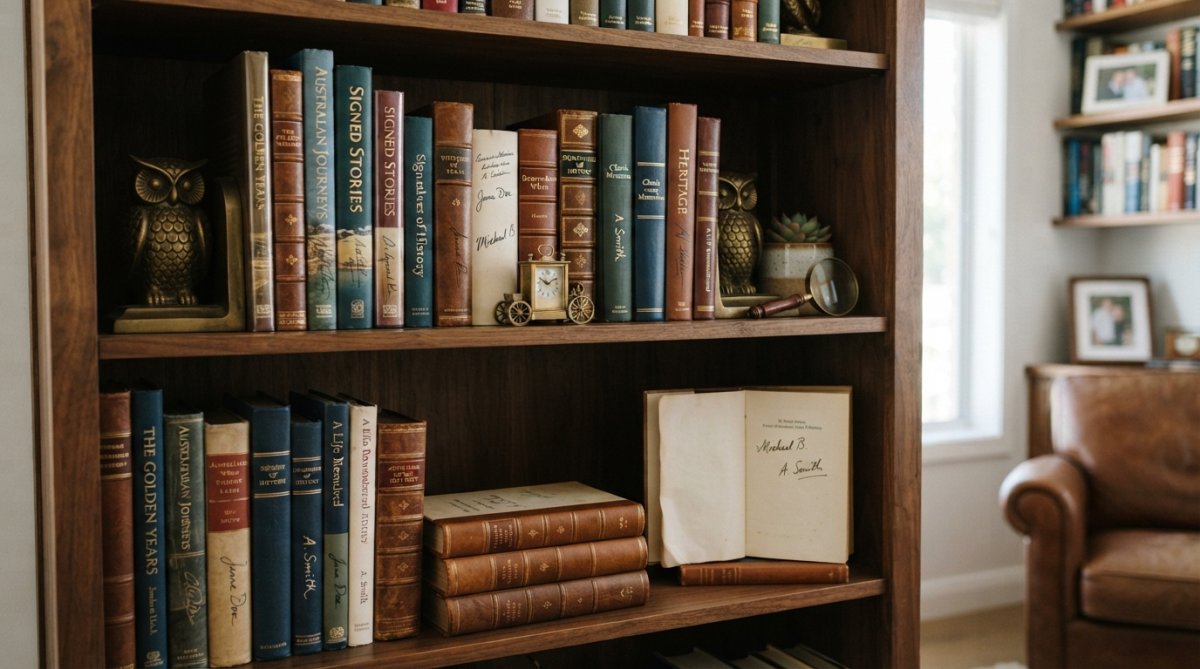
Vertical vs. horizontal display methods
Standing books vertically is the preferred method for long-term preservation. Vertical storage distributes weight along the spine rather than pressing down on pages. Books remain upright and stable.
Using bookends for stability and visual interest
Bookends serve two purposes: they prevent books from tilting and they add visual appeal. Heavy bookends keep books upright without damaging spines.
Lighting Solutions for Displaying Your Signed Book Collection
Proper lighting makes your signed books visible and attractive whilst protecting them from damage. The right lighting approach combines visibility with preservation.
Insurance and Valuation for Your Collectible Books
Valuable signed books deserve protection beyond physical preservation. Insurance ensures that if damage or theft occurs, you're financially protected.
DIY Display vs. Professional Framing for Rare Editions
Some signed books warrant professional framing. Others work perfectly in DIY displays. The decision depends on the book's value, fragility, and your preservation goals.
| Display Method | Best For | Protection Level | Cost |
|---|---|---|---|
| Open shelving with bookends | Accessible collections, regular reading | Moderate | Low |
| Acrylic display cases | Mixed protection and visibility | High | Medium |
| Shadow boxes with framing | Valuable signatures, special editions | Very high | High |
| Glass cabinets | Large collections, climate control | High | Medium to high |
| Archival storage boxes | Long-term preservation, inactive display | Very high | Low to medium |
Frequently Asked Questions
What is the best way to display signed books without damaging them?
Display signed books in a climate-controlled environment away from direct sunlight, ideally in an acrylic display case or shadow box. Keep humidity levels between 30-50% and maintain steady temperatures. Handle signed copies with clean, dry hands and avoid touching the signature itself. Store the dust jacket separately in an acid-free protective sleeve. Use bookends to provide structural support and prevent the book spine from warping. Vertical storage is generally safer than horizontal for most signed editions, though rare first editions benefit from flat storage on acid-free boards.
How do I protect signed books from UV light and humidity?
Position your display away from windows and direct sunlight, which fade signatures and damage book bindings over time. Use UV-filtering glass or acrylic cases if displaying near natural light. Maintain consistent humidity between 30-50% using a dehumidifier or humidifier as needed; fluctuating moisture causes warping and mould growth. Store books in acid-free boxes or archival-quality shelving, and avoid basements or attics where humidity varies significantly. For valuable signed copies, consider climate-controlled display cabinets specifically designed for rare book preservation.
Do signed books increase in value?
Yes, author-signed copies typically hold greater value than unsigned editions, particularly if the signature is authentic and the book remains in good condition. Rarity, author prominence, and the book's condition all influence collectible value. Signed Australian nostalgia books, such as those from Remember When Shop, appeal to collectors and gift-givers seeking meaningful keepsakes with personal touches. Proper preservation, protection from damage, UV exposure, and humidity, helps maintain and protect this investment over time.
What is the best way to arrange signed books on a shelf for visual interest?
Create visual interest by mixing vertical and horizontal orientations, using bookends to anchor groups and add colour contrast. Arrange signed editions by era, colour, or height to establish rhythm. Place taller volumes at the ends and vary spine widths in the middle. Include decorative elements like small plants or vintage objects between book groupings. For signed Australian nostalgia titles, cluster decade-specific volumes together to tell a cohesive story. Ensure proper spacing to prevent dust accumulation and allow air circulation around the book binding.