

How to Research Australian Family History from the 1960s
Table of Contents
- Step 1: Gather Family Details and Set Up Your Research Framework
- Step 2: Access Birth, Death and Marriage Records from the 1960s
- Step 3: Search Trove Newspaper Archives 1960s for Family Stories
- Step 4: Use Australian Electoral Rolls 1960s to Track Addresses
- Step 5: Find Immigration, Travel and Expatriate Records
- Step 6: Understand Privacy Laws and Restricted Access for 1960s Records
- Step 7: Bring Your 1960s Family History to Life with Social Context
- Frequently Asked Questions
Last Updated: September 28, 2026
Step 1: Gather Family Details and Set Up Your Research Framework
Researching how to research australian family history from the 1960s starts with what you already know. Begin by writing down every name, date, place and story your family can recall. This guide from Remember When Shop walks you through a clear, step-by-step process built for the 1960s decade.
That decade was a turning point. Decimal currency replaced pounds, shillings and pence in 1966.
- One notebook or spreadsheet per family line
- A folder for each surname
- A research log recording every search you run
- Space to note what you found and what you didn't
Step 2: Access Birth, Death and Marriage Records from the 1960s
Civil registration records are the backbone of any 1960s search, but the single most important thing to understand is that there is no national registry. Each state and territory runs its own Registry of Births, Deaths and Marriages, sets its own closure periods, its own fees and its own application process. A birth registered in New South Wales in 1964 and a birth registered in Queensland in 1964 are governed by completely different rules.
The closure periods you will actually hit
- Births, usually closed for around 100 years before becoming open historical records. A 1960s birth is therefore almost always restricted, and you will normally need to be the person named, a parent, or a direct descendant with documentary proof.
- Marriages, typically open after around 50 years. That means many 1960s marriages are now available as historical records, though the exact cut-off date moves each year.
- Deaths, usually open after around 30 years, so most 1960s deaths are accessible, often through an online index before you need to buy a certificate.
What each registry gives you
- New South Wales, an online historical index covering births, deaths and marriages, with certificates and transcriptions ordered separately. Transcriptions are cheaper and usually contain the same core facts.
- Victoria, a searchable historical index plus a certificate application service, with clear guidance on who may apply for restricted records.
- Queensland, an online index for historical events and a separate process for recent records requiring proof of relationship.
- South Australia, Western Australia, Tasmania, the Northern Territory and the Australian Capital Territory, each runs its own index and application pathway, and the coverage dates of their online indexes differ significantly.
Practical sequence
- Search the free online index first to confirm the event exists and to capture the registration number.
- Decide whether a transcription or a full certificate is enough. A transcription is normally cheaper and faster and carries the same names, dates and places.
- If the record is restricted, gather your proof of relationship before you apply, a birth certificate showing your link to the person named is the usual requirement.
- Note the registration district, not just the town. Districts changed over time and the district name on the index is what the registry uses to locate the record.
Where the indexes live
Step 3: Search Trove Newspaper Archives 1960s for Family Stories
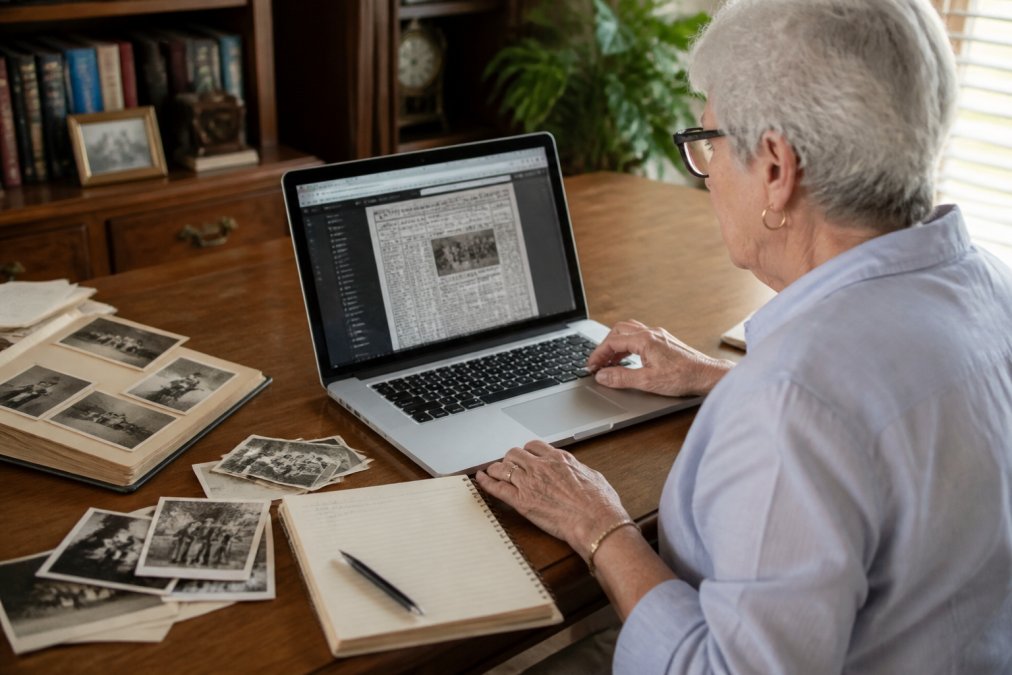
The Trove newspaper archives 1960s collection is one of the most rewarding free tools for family historians. Trove is run by the National Library of Australia and holds digitised newspapers from across the country.
- Search the full name in quotation marks
- Add a town or suburb to narrow results
- Try nicknames and maiden names
- Search for the family surname alone to catch social notices
Step 4: Use Australian Electoral Rolls 1960s to Track Addresses
Australian electoral rolls 1960s entries are a goldmine for tracking where people lived. Electoral rolls list names, addresses and occupations. They were updated regularly, so they work as a kind of census substitute between official counts.
Use them to:
- Confirm a family's address in a given year
- Track a move between suburbs or towns
- Find adult children who had left home
- Check an occupation
Step 5: Find Immigration, Travel and Expatriate Records
Migration history shapes many families, and the 1960s saw big shifts in who arrived and why. Passenger lists, naturalisation records and expatriate records can fill gaps that local records leave.
Look for:
- Inward and outward passenger lists
- Naturalisation and citizenship papers
- Sponsorship and assisted passage records
- Expatriate records for family who left and returned
Step 6: Understand Privacy Laws and Restricted Access for 1960s Records
This is the section most guides skip, and it is the single biggest reason 1960s research stalls. Records from that decade are recent enough to sit inside privacy and access restrictions that simply do not apply to nineteenth-century material. Understanding the framework saves weeks of rejected applications.
Book; Photos and Memories of Australia →
The laws that govern access
- State and territory privacy legislation, each jurisdiction has its own privacy or information privacy Act that governs how its government agencies, including registries and archives, handle personal information.
- State archives Acts, these set the default closure periods for government records transferred to the state archive. A common pattern is a general closure period of around 30 years, with longer periods for records containing sensitive personal information.
- Commonwealth legislation, the Privacy Act 1988 (Cth) and the Archives Act 1983 (Cth) govern Commonwealth agencies and the National Archives of Australia, including immigration, naturalisation and defence records.
- Adoption and health records, these sit under separate, tighter state legislation with their own access schemes, often requiring counselling or a formal application rather than a simple certificate order.
What this means in practice for the 1960s
- Birth records are the most restricted. A 1960s birth is well inside the typical 100-year closure, so you will generally need to be the person named or a direct relative with proof.
- Marriage records are often the easiest 1960s civil record to obtain, because many have now passed the typical 50-year threshold and are available as open historical records.
- Death records are usually the most accessible, with most 1960s deaths now open and indexed.
- Adoption records from the 1960s are governed by dedicated state schemes that have changed significantly over the past two decades, and access pathways differ sharply between jurisdictions.
- Health and hospital records are typically closed for long periods and are held by the health department or hospital rather than the state archive.
How to prove your relationship
- Your own birth certificate, showing your parents.
- Your parent's birth or marriage certificate, linking you to the person in the record.
- Where names have changed through marriage, the marriage certificate bridging the two surnames.
Cheaper and faster alternatives
- Transcriptions instead of certificates, most registries offer a transcription that carries the same core facts at a lower cost.
- Index entries, the free online index often gives you the registration number, district and year, which may be enough to confirm a fact without buying anything.
- Archival access under a shorter closure, some records closed at the registry are open at the state archive, because the archive applies its own access regime.
- Written authorisation, if the person named is living, their signed consent can unlock a record that would otherwise be closed to you.
Where to confirm the current rules
Step 7: Bring Your 1960s Family History to Life with Social Context
Dates and names only tell part of the story. Social context turns a dry list into a real life. What was it like to be a family in the 1960s?
Think about:
- Decimal currency arriving in 1966
- The 1967 referendum on Aboriginal rights
- Vietnam and national service
- Beatlemania and the rise of television
- Child endowment and family payments of the era
Frequently Asked Questions
What records are available for Australian family history from the 1960s?
For 1960s research, you can access birth, death and marriage records (with some restrictions), electoral rolls, Trove newspaper archives, immigration and passenger lists, and historical indexes. State libraries and national archives also hold finding aids. Many of these are available online, though some require visiting a reading room or ordering copies. Start with what is freely accessible, then move to restricted records.
How do I access electoral rolls for 1960s family research?
Electoral rolls from the 1960s are available through state libraries, the National Library of Australia, and some genealogy databases. They list names, addresses, and occupations, helping you track family movements. You can search microfiche or digitised versions at libraries, or request copies from state archives. Electoral rolls are a key tool for tracing Australian family history when civil registration records are incomplete.
Are birth, death, and marriage records from the 1960s public?
Access depends on the state and the time elapsed. In most states, birth records are closed for 100 years, marriages for 50 to 75 years, and deaths for 25 to 30 years. For the 1960s, you may need to prove a direct relationship or apply for a certificate with restrictions. Some indexes are open, but full certificates often require an application and fee.
How can I find newspaper archives from the 1960s?
Trove, run by the National Library of Australia, is the main free resource for digitised newspapers from the 1960s. You can search by name, event, or place. Many local newspapers are also available on microfilm at state libraries. For articles not yet digitised, you can request copies through interlibrary loan or visit the library in person.
Tracing a family through the 1960s takes patience, but the rewards are real. Records close, indexes are incomplete, and privacy rules slow things down. That's exactly why a guided approach and the right keepsakes matter. Remember When Shop offers author-signed nostalgia books, decade-specific photo books and the Born In series to help you connect the past to the present. Get started with Remember When Shop and turn your research into a gift your family will treasure.