

How to Start Reminiscence Therapy at Home
Table of Contents
- What Reminiscence Therapy Is (and What It Isn't)
- Why Reminiscence Therapy Works for Dementia and Memory Loss
- Setting Up Your Space: Safety and Comfort First
- Step-by-Step: How to Run Your First Session
- Reminiscence Therapy Questions for Seniors That Spark Conversation
- How Long Should a Reminiscence Session Last?
- Reminiscence Therapy Tools and Resources to Get You Started
- Troubleshooting: What to Do When Memories Turn Upsetting
- Frequently Asked Questions
Last Updated: September 7, 2026
What Reminiscence Therapy Is (and What It Isn't)
Reminiscence therapy is a structured approach that encourages people to talk about past experiences, often using tangible prompts like photographs, music, or familiar objects to spark memory recall. It is a person-centered, non-pharmacological intervention used widely in geriatric care, particularly for those living with dementia or cognitive impairment, relying on the fact that long-term memory often remains intact even when recent memory fades (the NIH).
Crucially, reminiscence therapy is not the same as life review, which is a more formal, evaluative process of a whole lifetime; reminiscence work is informal, joyful, and led by the person sharing the memories. It is also not a test, there are no right answers, and correcting a misplaced detail defeats the purpose. This guide breaks down how to start reminiscence therapy at home, offering practical steps that prioritise emotional well-being over factual accuracy. The goal is social interaction, comfort, and the simple pleasure of storytelling.
Why Reminiscence Therapy Works for Dementia and Memory Loss
The approach works because it plays to strengths rather than highlighting deficits. When a person with dementia struggles to recall what they had for breakfast, asking about a childhood pet or a first car taps into well-rehearsed autobiographical memory stored for decades. Success builds confidence and reduces anxiety, creating a positive feedback loop that encourages further communication.
Understanding the mechanism helps you use the therapy more effectively. Two distinct memory systems are at play:
- Semantic memory stores facts and general knowledge, names of capital cities, how to use a telephone. This degrades relatively early in conditions like Alzheimer's disease.
- Episodic and autobiographical memory stores personally experienced events and the emotions attached to them. While recent episodic memory fades, older, deeply rehearsed autobiographical memories, especially those from adolescence and early adulthood, roughly ages 10 to 30, are often preserved much longer. This is sometimes called the "reminiscence bump."
Reminiscence therapy deliberately targets that reminiscence bump. Music from a person's late teens, photographs of everyday life from their twenties, or the scent of a familiar product can bypass damaged recent-memory pathways and access intact older networks. This is why a person who cannot remember what they ate an hour ago can still sing every verse of a song from 1965.
There is also a neurological basis for why this feels good. Recalling positive autobiographical memories activates reward-related regions of the brain, including the ventral striatum and medial prefrontal cortex (peer-reviewed research). For a person living with dementia, who often experiences confusion, frustration, and a loss of identity, these moments of successful recall provide genuine neurological reward, not just emotional comfort.
Many families find these sessions reduce caregiver burden too. A person who is engaged and calm requires less intensive supervision, and the shared activity strengthens the relationship in ways day-to-day care tasks cannot. In Australian residential aged care, reminiscence-based activities are commonly incorporated into individualised care plans under the Aged Care Quality Standards, particularly Standard 1 (Person-centred Care) and Standard 5 (Quality of Life), because they support identity, dignity, and emotional wellbeing.
The benefits compound. A person who experiences one successful conversation becomes more willing to engage next time, and the therapy is a reliable tool for improving quality of life in the present moment.
Setting Up Your Space: Safety and Comfort First
Before you begin, consider the environment. A cluttered or noisy room creates communication barriers before you have said a word. Choose a quiet space with comfortable seating where you can sit side by side rather than face to face, which feels less like an interrogation and more like a shared activity.
Good lighting is essential, not just for seeing photographs clearly but for reading facial expressions. Minimise distractions by turning off the television and putting phones away. Have a glass of water nearby. Most importantly, schedule the session for a time of day when the person is naturally at their best, often mid-morning after breakfast rather than late afternoon when "sundowning" can increase agitation. If the person tires or becomes frustrated, the session should end gracefully without pressure.
Step-by-Step: How to Run Your First Session
Your first reminiscence therapy session at home should feel like a conversation, not a clinical exercise. Start with a warm, casual invitation rather than a formal announcement. Simply sitting down with a cup of tea and a familiar object often works better than declaring "it is time for therapy."
- Choose one prompt only. A single photograph, a song, or one object is enough. Too many stimuli cause confusion.
- Begin with a simple, open observation. Say "I found this photo of a beach, it made me think of summer holidays," rather than asking a direct question immediately.
- Let silence be comfortable. Memory retrieval takes time. Resist the urge to fill gaps with chatter.
- Follow their lead. If they drift to a different memory, go with it. The process matters more than the prompt.
- Use active listening. Nod, make eye contact, and offer verbal affirmations like "tell me more about that."
- End on a positive note. Gently steer the conversation toward a happy memory before closing, so the person is left feeling uplifted.
Reminiscence Therapy Questions for Seniors That Spark Conversation
The right reminiscence therapy questions for seniors are open-ended and sensory. They invite storytelling rather than yes-or-no answers. Asking "What was your first car like?" opens a door, while "Did you own a Holden?" closes it just as quickly. creating meaningful keepsakes.
Good questions often centre on the five senses and everyday routines that are deeply encoded in long-term memory. Consider these starters:
- What did your street smell like on a summer evening?
- Tell me about the first record you ever bought.
- What was your favourite meal your mother cooked?
- How did you meet your closest friend?
- What did the milkman's cart look like when it came down your street?
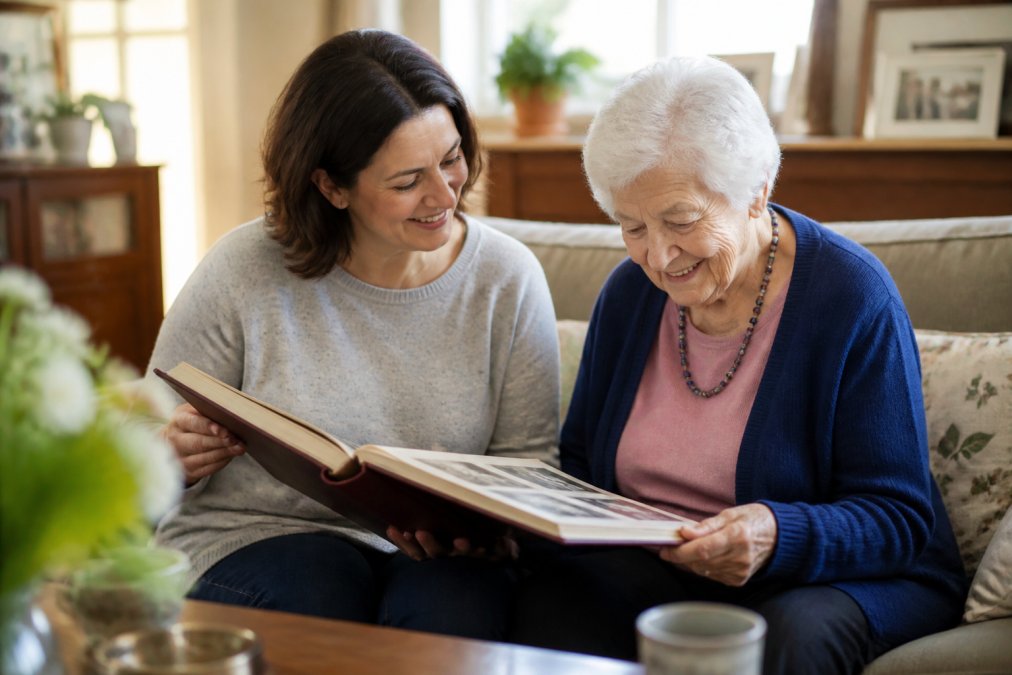
Visual cues and olfactory triggers are powerful. A book of photographs showing everyday scenes from the 1950s through the 1980s provides tangible prompts that make the questions feel natural rather than interrogative.
How Long Should a Reminiscence Session Last?
A reminiscence session should last between 15 and 30 minutes for most people, capturing meaningful engagement without causing mental fatigue (alzheimers.org.uk). For someone in the early stages of dementia, sessions can extend toward 30 minutes; for those with more advanced cognitive impairment, 10 to 15 minutes is often the sweet spot.
Watch the person, not the clock. Signs of fatigue include repeated yawning, looking away, or becoming restless. A session that ends while the person is still smiling builds anticipation for the next one. Frequency matters more than duration: a short daily conversation is far more valuable than a long weekly marathon.
| Session Length | Best For | Frequency |
|---|---|---|
| 10-15 minutes | Advanced dementia, first sessions | Daily |
| 15-20 minutes | Moderate cognitive impairment | 3-4 times weekly |
| 20-30 minutes | Mild impairment, engaged participants | 2-3 times weekly |
These are starting points, not rules. The most useful skill is reading the person's engagement level in real time. Three reliable signals tell you the session is working: the person is leaning forward or maintaining eye contact, speaking in full sentences rather than single words, and initiating topics or asking questions. When you see those signs, gently extend the session; when they disappear, it is time to close.
Structure matters as much as duration. A well-paced session has three phases:
- Warm-up (first 2-3 minutes). Begin with a neutral, low-demand prompt, a cup of tea, a comment about the weather, or a simple observation about a photo. This lets the person settle into the conversation without pressure.
- Core engagement (the middle). This is where the storytelling happens. Follow the person's lead, ask open questions, and let silences breathe. The core should feel like a natural conversation, not an interview.
- Cool-down (final 2-3 minutes). About two minutes before you plan to end, begin gently steering toward a positive or neutral memory. Say something like "That was lovely hearing about your wedding day" or "I always enjoy our chats about the old neighbourhood." Then close with a concrete, forward-looking statement: "Let's have another look at these photos tomorrow afternoon." This gives the person a sense of closure and something to anticipate.
Transitions are where many sessions falter. Ending abruptly, even after a happy conversation, can leave a person with dementia feeling disoriented or flat; the cool-down phase prevents this by providing a gradual landing. If a session is going exceptionally well and the person is clearly energised, it is acceptable to extend by five minutes. The risk is not overrunning; it is ending at a moment of frustration or confusion.
For people with advanced dementia, shorter and more frequent sessions are almost always better. A 10-minute conversation twice a day, once mid-morning and once after lunch, often produces better outcomes than a single 20-minute session, because attention span and emotional regulation fluctuate throughout the day and shorter windows reduce cognitive load.
Many aged care professionals keep a simple log after each session, noting the date, start and end times, the prompt used, and a one-line observation about mood and engagement. Over two to three weeks, patterns emerge: certain times of day work better, certain topics energise, and certain prompts fall flat. This log turns an informal activity into a genuinely responsive therapeutic practice.
Reminiscence Therapy Tools and Resources to Get You Started
You do not need specialist equipment to begin. The most effective reminiscence therapy tools and resources are often already in your home: old photo albums, kitchen utensils from decades past, vinyl records, or a well-worn item of clothing. The key is choosing items that are safe, familiar, and tied to positive memories.
Music is a particularly potent trigger. Playing a song from a person's young adulthood can unlock memories that words cannot reach. Many carers build themed playlists around specific eras. For visual prompts, decade-specific photograph books are invaluable. At Remember When Shop, our nostalgia books, including Australia Remember When and Remember When: Snapshots of Australia 1950s - 1980s, have been widely recognised as helpful by carers in aged care and those working with people with dementia. These books, filled with more than 200 photos each, offer a window into everyday Australian life that residents can explore at their own pace.

Troubleshooting: What to Do When Memories Turn Upsetting
Not every memory is happy, and occasionally a session will surface something painful. This is not a failure of the approach. The first rule is to validate the emotion rather than dismiss it. If a person becomes tearful remembering a lost spouse, saying "you must have loved him very much" acknowledges the feeling without judgement.
Avoid the urge to cheer them up or change the subject abruptly. Sit with the emotion briefly, then gently offer a sensory anchor to shift the mood, such as "would you like to hear that song you both loved?" If agitation persists, end the session calmly and reassure the person that they are safe. Persistent distress after multiple sessions may warrant a conversation with a GP or a memory clinic. Cultural sensitivity matters here too: be mindful that certain topics, including wartime experiences or the removal of Aboriginal and Torres Strait Islander children, may carry deep trauma. Never steer toward these areas; let the person choose which memories to share.
Starting reminiscence therapy at home does not require formal training, only patience, genuine curiosity, and a willingness to follow the person's lead. The rewards are profound: restored confidence, reduced anxiety, and moments of genuine connection that dementia often seems to steal away. At Remember When Shop, our curated collection of Australian nostalgia books, many personally signed by the author, provides the tangible prompts that can help these conversations flow naturally. Explore our range of decade-specific photo books and give the gift of shared memories today.

Frequently Asked Questions
What is an example of a reminiscence therapy activity?
A simple example is looking through a decade-specific photo book together. For instance, opening a page showing a 1960s Australian kitchen and asking, "What was your kitchen like back then?" The photos act as tangible prompts that make it easier for the person to access long-term memories. Other activities include listening to music from their youth, handling old household objects, or smelling familiar scents like lavender or freshly baked bread. The activity is less important than the conversation it creates.
How often should you engage in reminiscence therapy?
Short, regular sessions work best. For most people, a 15 to 30 minute session two or three times per week is a good starting rhythm. The key is to watch for signs of fatigue or frustration and end the session on a positive note before that happens. Consistency matters more than length. A brief, enjoyable session every few days builds trust and creates a routine the person looks forward to, rather than a long session that may feel overwhelming or tiring.
What materials are best for reminiscence therapy?
Visual and tactile materials work well because they give the person something concrete to focus on. Old photographs, particularly of familiar places and everyday life, are excellent starting points. Books filled with pictures from the person's younger decades, such as the 1950s or 1960s, are ideal. Music from their youth, familiar household objects, and even old clothing or fabric samples also work. Choose items that feel positive and comforting. Avoid anything that might trigger difficult memories, especially in early sessions.
Can reminiscence therapy help someone with dementia?
Yes. Reminiscence therapy is a non-pharmacological intervention widely used in aged care and dementia support. It works because long-term memory often remains accessible even when recent memory fades. Engaging with photos and stories from the past can reduce anxiety, improve mood, and create moments of connection. It also provides a way for carers to interact with the person beyond daily care tasks. The goal is not to test memory but to create a positive, shared experience that supports emotional well-being.