

How Do You Prevent Foxing in Antique Books?
Quick Summary
Preventing foxing mainly means controlling the storage environment. Keep antique books in a cool, dry, dark room with good airflow, away from exterior walls, basements and direct light. Check humidity regularly with a hygrometer and act early when conditions drift.
- Use a digital hygrometer placed at shelf level to measure temperature and humidity.
- Log readings at the same time each day for two to four weeks.
- Avoid basements, attics, garages, closets and exterior walls.
- Keep shelves slightly apart so air can move around the books.
- Handle old books with clean, dry hands or soft cotton gloves.
Table of Contents
- What Foxing Is and How It Appears on Paper
- What Causes Foxing in Old Books
- How to Store Antique Books to Prevent Foxing
- Book Storage Humidity and Temperature Targets
- Preventing Mould, Light Damage and Air Stagnation
- A Step-by-Step Inspection and Prevention Routine
- When to Handle Foxed Books Safely and When to Call a Conservator
- Protecting Your Collection From Here: Your Next Steps
- Frequently Asked Questions
What Foxing Is and How It Appears on Paper
Last Updated: November 20, 2026
Foxing is the name for the rust-coloured, reddish-brown spots that appear on the pages of old books. The spots are usually small, round or irregular, and they often cluster in patches rather than spreading evenly across a page. Collectors have long recognised the problem, and it can lower the value of an antique book.
The spots tend to show up on paper, especially on the margins, the endpapers and the edges of the text block. They can look like freckles or stains, and they may appear slowly over many years.
Foxing is a sign that the paper has changed chemically. It does not usually mean the book is falling apart, but it does show that the conditions around it were not ideal, which is why preventing foxing starts with good storage. Knowing what foxing looks like helps you spot it early, before it spreads.
What to look for:
- Small reddish-brown or orange-brown spots
- Clusters that look like freckles
- Spots mostly on margins, endpapers and page edges
- Soft, slightly raised or rough patches on the paper
What Causes Foxing in Old Books
Foxing has no single cause. Researchers and conservators generally agree that it comes from a mix of factors, and the exact chemistry is still not fully understood. That uncertainty is worth keeping in mind when you read older advice. Because moisture is one of the conditions that can complicate preservation, the same caution about controlling humidity applies to other paper collectibles, as The Card Shelf Workshop makes clear.
The factors most often linked to foxing include:
- Moisture: Damp air or wet conditions can encourage the chemical reactions that cause spots.
- Fungal growth: Some foxing is linked to mould or fungi that feed on the paper.
- Iron impurities: Metal traces left in the paper during manufacture may react over time.
- Paper acidity: Acidic paper ages faster and may be more prone to browning.
- Oxidation: Slow chemical reactions with air can darken and weaken paper.
Humidity is often the factor that is easiest to control. This is why prevention focuses so strongly on the storage environment.
How to Store Antique Books to Prevent Foxing
Good storage is the most practical step you can take. Prevention is far easier than removing foxing once it has appeared.
Start by choosing a suitable place, then arrange your books so air can move around them. Keep them away from direct light and sudden changes in conditions.
Choosing a Cool, Dry Storage Location
A cool, dry room with stable conditions works best. Aim for a spot inside the main living area of your home rather than an outer room.
- Pick a room that stays at a steady temperature through the day and night
- Choose a spot with good airflow, but avoid draughts
- Keep books off the floor and away from radiators or heaters
- Use a small hygrometer to check conditions over a few weeks
Avoiding Basements, Attics, Garages and Exterior Walls
Some storage spots are risky, even if they look tidy. Avoid these areas wherever possible:
- Basements: Often damp and prone to water seepage
- Attics: Can swing from very hot to very cold through the seasons
- Garages: Temperature and humidity change sharply, and fumes may be present
- Closets: Poor airflow can trap moisture
- Exterior walls: Can collect condensation in cold weather
If you must use a closet or cupboard, leave gaps between books and the back wall, and check it regularly.
Book Storage Humidity and Temperature Targets
Specific numbers turn vague advice into something you can actually check. Stability matters as much as any exact figure: paper expands and contracts as moisture changes, and repeated cycling stresses fibres and can accelerate staining. Check a conservator's guidance for the figures suited to your own collection.
What to measure and how:
- Use a digital hygrometer (a combined temperature and RH meter) rather than a cheap dial gauge, and place it at shelf level, not on the floor or near a window.
- Log readings at the same time each day for two to four weeks to see the real pattern, including overnight and weekend swings.
- Keep a simple written or spreadsheet log of date, temperature, RH and any action taken, so you can spot seasonal drift before it becomes a problem.
Responding to seasonal change:
- In humid months, run a dehumidifier or use a sealed, dry cabinet, and keep the door closed; in dry months, avoid over-drying, which makes paper brittle.
- Do not site books against exterior walls or on the floor, where condensation and rising damp are most likely.
- If readings drift above the target band for more than a few days, improve ventilation first, then adjust with a dehumidifier rather than opening windows on damp days.
The article's storage advice is easier to check against a few measurable points, summarised below.
| Factor | What the article says | Practical note |
|---|---|---|
| Measuring tool | Digital hygrometer (temperature and RH) | Place at shelf level, not on floor or near windows |
| Logging period | Two to four weeks | Record at the same time each day |
| Humid months | Run a dehumidifier or use a sealed dry cabinet | Keep cabinet door closed |
| Dry months | Avoid over-drying | Over-drying makes paper brittle |
| Locations to avoid | Exterior walls and the floor | Condensation and rising damp are most likely there |
| Drift response | Improve ventilation first, then dehumidify | Act if readings stay out of range for more than a few days |
Preventing Mould, Light Damage and Air Stagnation
Three issues often work together to damage old books: mould, light and stale air. Preventing all three is a good habit.
Mould: Keep humidity from rising for long periods. Check books for any fuzzy growth or musty smell.
Light: Strong sunlight and bright lamps can fade and weaken paper. Store books in darkness or behind closed doors, and keep them out of direct sun.
Air stagnation: Still, damp air encourages mould and spotting. Give books room to breathe by leaving space on shelves and opening the room regularly.
A simple checklist can help:
- Store books out of direct light
- Keep shelves a little apart, not packed tight
- Run a gentle fan or open a window when the weather suits
- Check for mould or musty smells every few weeks
A Step-by-Step Inspection and Prevention Routine
A regular routine catches problems early. Set aside time every few months to check your collection.
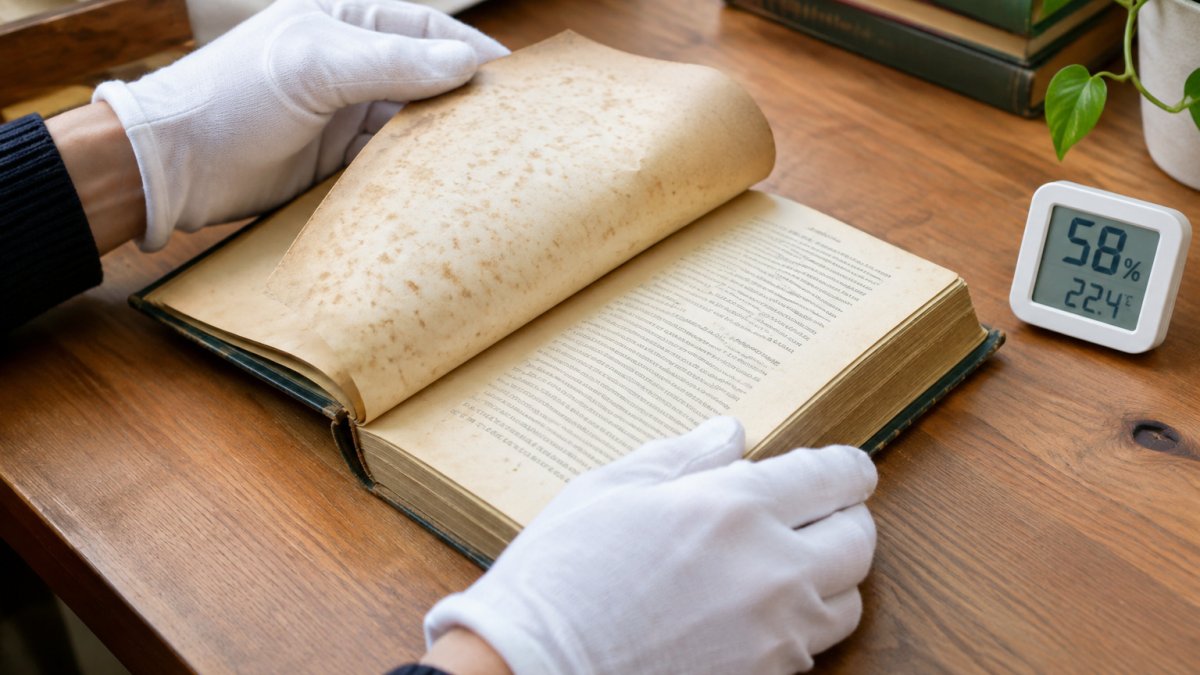
- Check the room: Read the hygrometer and note the humidity and temperature.
- Look at the shelves: Make sure books are not pressed tight and nothing sits against an outside wall.
- Inspect the books: Handle each one gently, looking at margins, endpapers and page edges.
- Note any changes: Record new spots, smells or soft patches in a simple log.
- Adjust the storage: Move books that are at risk, improve airflow or dry the room if needed.
- Repeat: Keep the routine regular so small problems do not become large ones.
Use clean, dry hands or soft cotton gloves when you handle old books. Oils and moisture from skin can add to the problem.
When to Handle Foxed Books Safely and When to Call a Conservator
Handling a foxed book is mostly about limiting two risks: transferring mould or moisture to clean books, and damaging brittle paper through careless movement. Work on a clean, dry surface away from food and drink, wash and dry your hands, and use soft cotton gloves if the book is valuable or the paper feels fragile. Support the spine and open covers gently rather than forcing them flat.
Inspecting and isolating an affected book:
- Look at the margins, endpapers and page edges in good light, and note whether spots are dry and flat or soft and raised.
- Smell the book near the spine; a musty or mushroom-like odour suggests active mould rather than old staining.
- If mould is suspected or the paper feels damp, place the book in a clean, dry, ventilated space away from the main collection, in a breathable enclosure rather than a sealed plastic bag.
- Clean the shelf and surrounding area before returning other books, and check neighbouring volumes for early spots.
- Record what you found and the date, so you can tell whether the problem is spreading.
When to consult a qualified book conservator:
- The book is valuable, rare or personally important, and you want treatment rather than prevention.
- Mould is visible or the paper feels damp, since this needs professional drying and cleaning.
- Pages are brittle, torn or flaking, or the binding is failing.
- Stains are heavy or spreading despite improved storage.
- You are unsure whether a proposed treatment could cause harm.
Removing or reversing foxing is delicate work. Home attempts with bleach or harsh cleaners can damage paper, so a qualified book conservator is the safer route for any treatment.
Protecting Your Collection From Here: Your Next Steps
Preventing foxing comes down to a few habits: keep books in a cool, dry, dark place with good airflow, check conditions regularly, and act early when something looks wrong. Learn how to build and care for a collection from the start. Start with your storage room, then build a simple inspection routine you can keep up.
If you are building a collection and want to start with good habits from the beginning, our guide on how to start a vintage book collection covers choosing, buying and caring for books from day one.
Frequently Asked Questions
What causes foxing in antique books?
Foxing is the term for the reddish-brown spots that appear on old paper. Its exact cause is still debated among conservators, but the most commonly cited contributors are fungal activity in humid conditions, metal impurities such as iron in the paper or in the original sizing, and oxidation of the paper over time. Damp, poorly ventilated storage tends to make existing spots spread or intensify, which is why controlling moisture is the most reliable preventive step you can take.
Can foxing in books be prevented?
Foxing can be reduced but not guaranteed away. Keeping books in a cool, dry and well-ventilated space, away from light and moisture sources, lowers the risk of new spots appearing and stops existing ones from progressing. Because the underlying causes are not fully understood, prevention is best treated as risk reduction. Regular inspection lets you catch early spotting before it spreads to neighbouring volumes.
Can foxing spread from one book to another?
Foxing does not reliably jump from book to book the way an infection does, but books stored tightly together in damp conditions can pick up moisture and fungal growth from one another. Keeping a gap between volumes, avoiding overcrowded shelves and isolating any visibly affected book while you assess it reduces the chance of wider damage in the collection.
When should a foxed book be assessed by a conservator?
Consult a professional paper conservator if the foxing is extensive, if the paper feels brittle or weak, if you can see active mould or fuzzy growth, or if the book is rare or of significant value. Attempting home removal with bleaches, solvents or abrasives can permanently damage paper, so a conservator is the safer route for any treatment beyond cleaning dust from the surface with a soft brush.
