

8 Best Conversation Starters for Dementia Patients
Table of Contents
- 1. Sensory Cues: Using Music, Photos and Objects
- 2. Questions About Childhood and Youth
- 3. Discussing Family and Relationships
- 4. Talking About Hobbies and Interests
- 5. Dementia Communication Techniques That Keep Conversations Flowing
- 6. Reminiscence Therapy Activities for Seniors: Making It a Habit
- 7. How to Start a Reminiscence Therapy Group
- 8. Troubleshooting: When Conversation Starters Fall Flat
- Frequently Asked Questions
Last Updated: September 10, 2026
1. Sensory Cues: Using Music, Photos and Objects
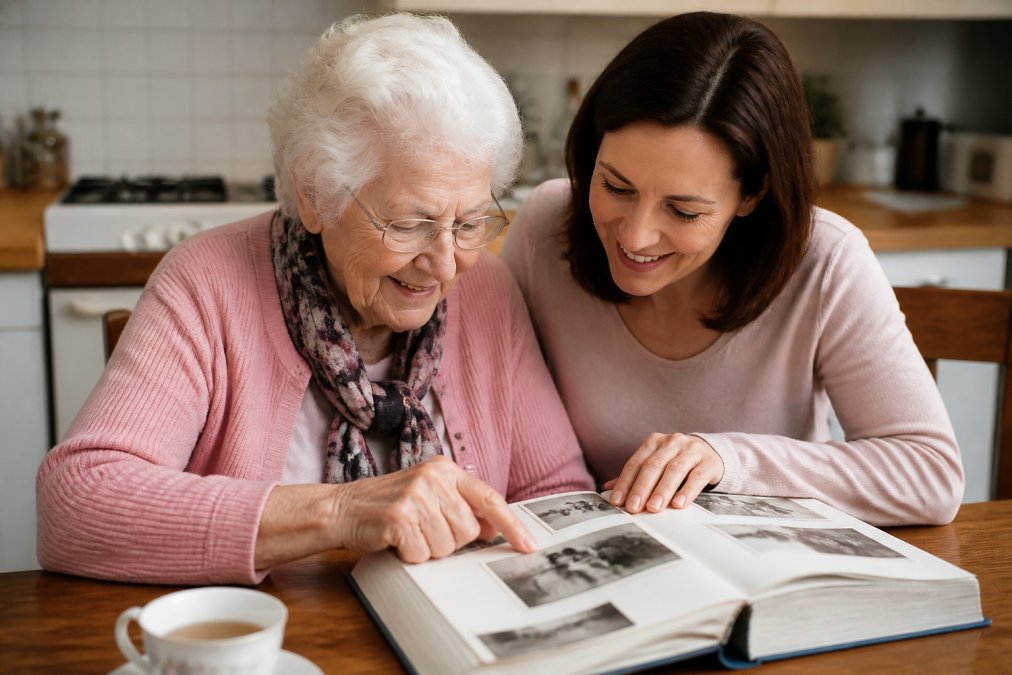
The 8 best conversation starters for dementia patients are objects and senses, not questions. A familiar song, a wedding photo, or a vintage car book gives the person something concrete to respond to, which reduces the pressure of finding words.
This is why sensory cues work so well. Short-term memory fades early in dementia, but long-term memory and emotional memory often remain intact for much longer (alz.org). A photo from the 1950s or a song from someone's twenties can bypass the damaged pathways and reach memories that are still vivid.
At Remember When Shop, we hear regularly from carers who use our Australian nostalgia books exactly this way. The Dementia Australia resources on communication recommends using familiar items and photos as conversation aids, and that advice holds up in practice.
2. Questions About Childhood and Youth
Childhood memories outlast almost everything else. Questions about youth work because they draw on long-term memory, which typically remains accessible well into the later stages of dementia.
Try starters like these:
- What was your favourite game as a kid?
- Did you walk to school, or catch a bus?
- What did your mum cook that you loved?
- Were you a good dancer?
- What was the first record you ever bought?
Notice none of these are yes-no questions. Open-ended questions keep conversational flow going and give the person room to lead. If a question lands flat, move on without comment. There is no failure here, only redirection.
3. Discussing Family and Relationships
Family is emotional territory, and that is precisely why it works. Emotional connection survives longer than factual recall, so a question about a sibling or a wedding day can spark warmth even when names and dates have blurred.
A common mistake is testing memory. "You remember Sarah, don't you?" puts the person on the spot and invites embarrassment. Instead, offer the memory and let them join it: "Sarah brought those flowers last week. She's got your taste in gardens."

Keep old photo albums nearby and let the person hold them. Tactile engagement with a familiar image often prompts speech when direct questions do not.
4. Talking About Hobbies and Interests
Hobbies are a goldmine because they carry skill, pride and identity, not just facts. Someone who fished for forty years may not recall last Tuesday, but they can still talk about bait, tides and the one that got away.
Match the starter to the person's life history. For a car enthusiast, a book like Cars We Used to Drive: Australians on the move, 1940s to 1960s ($54.95) opens doors that a generic question never will. For a Holden family, The Passion for Holden ($39.99) does the same job.
The trick is specificity. "Did you have a Holden?" beats "What cars did you like?"
5. Dementia Communication Techniques That Keep Conversations Flowing
Good dementia communication techniques matter more than the perfect question. The question opens the door; the technique keeps you both inside the room.
- Use short, simple sentences. One idea per sentence.
- Allow long pauses. Silence is processing time, not rejection.
- Repeat back what you heard. "So the milkman came every morning." This validates the memory and invites more.
- Watch non-verbal cues. Crossed arms, a turned head, or a flushed face often signal overload before words do.
- Lower your tone of voice. A calm, warm register settles a room faster than any question.
This approach is often called validation therapy: you accept the person's reality rather than correcting it. If they say their mother is coming to visit, you ask what she might bring, not whether she passed away in 1989. Correction creates distress and ends conversations. manage dementia anxiety.
6. Reminiscence Therapy Activities for Seniors: Making It a Habit
Reminiscence therapy activities for seniors work best as a routine, not a one-off event. Ten minutes of shared looking at photos, done at the same time each afternoon, does more than an hour of intense engagement once a month.
Build a simple kit: a decade-specific photo book, a couple of familiar songs, and one tactile object such as a wooden spoon or an old-fashioned hairbrush. Keep it in the same place so the person can see it and reach for it.
If you're new to this, Photos and Memories of Australia from the 1950s ($29.99) is a solid starting point. Carers tell us the same thing repeatedly: the books do the heavy lifting, and the conversation follows.
7. How to Start a Reminiscence Therapy Group
Starting a reminiscence therapy group takes four decisions: who, where, when, and what you'll use. Get those settled and the rest is repetition.
Step 1: Set the group size. Six to eight people works well. Larger groups mean quieter members get lost.
Step 2: Pick a fixed time and quiet space. Same day, same hour, distraction-free room. Predictability reduces anxiety.
Step 3: Choose a single theme per session. "School days," "the corner shop," "first jobs." One theme, not five.
Step 4: Bring sensory props. A decade book, a song, an object to pass around. The Australian Government aged care resources points to the value of social engagement for residents, and group sessions deliver that in a structured way.
Step 5: Let silence sit. Don't fill every gap. The group will find its rhythm.
8. Troubleshooting: When Conversation Starters Fall Flat
When one of the 8 best conversation starters for dementia patients falls flat, the problem is almost never the person. It's usually timing, tone, or topic. Change one variable and try again.
| Problem | Likely Cause | Fix |
|---|---|---|
| Blank stare, no response | Question too abstract | Switch to an object or photo |
| Agitation or distress | Topic touches a painful memory | Redirect gently to a neutral theme |
| Answers drift off topic | Hearing or processing difficulty | Shorten sentences, reduce background noise |
| Person shuts down | Feels tested or corrected | Stop questioning, offer a memory instead |
| Works once, then never again | Fatigue or time of day | Try a different hour, shorter session |
Two angles most guides skip: technology and cultural sensitivity. A tablet loaded with a slideshow of family photos or a playlist of songs from the person's twenties can work when nothing else does. And respect the generation's frame of reference. A memory from the 1940s carries different weight than one from the 1990s, and a question about a childhood in another country needs a different set of cues entirely.
For a person who grew up in a particular city, a local nostalgia book is often the surest way in. Melbourne Remember When ($34.99) or Adelaide Remember When: The Boomer Stories ($29.99) give you pages of shared reference points to fall back on when words stall.


Conversation with a person living with dementia is a skill, and it rewards patience more than cleverness. The right tool makes it easier. Remember When Shop curates Australian nostalgia books, many personally signed by the author, that give carers and families a ready-made way in: decade-specific photo books, classic Australian car titles, and commemorative editions built around the years your loved one actually remembers. As one customer put it, the books do the work, and the memories follow. Get started with Remember When Shop and turn a quiet afternoon into a conversation worth having.
Frequently Asked Questions
What are some tips for talking to someone with dementia?
Use short, simple sentences and give the person time to respond. Maintain eye contact and a calm tone of voice. Avoid correcting or arguing about facts. Instead, validate their feelings and redirect gently if needed. Open-ended questions can be overwhelming, so try yes-no questions or offer two choices. Creating a distraction-free environment helps them focus. Remember that non-verbal cues like a warm smile or gentle touch often communicate more than words.
How can I use reminiscence therapy to improve communication?
Reminiscence therapy uses prompts like photos, music, or familiar objects to trigger long-term memories, which often remain intact longer than short-term memory. Ask about childhood, favourite holidays, or early jobs. Books such as Australia Remember When, filled with nostalgic images from the 1940s to 1980s, can be a simple starting point. These conversations reduce pressure because the person is recalling events they know well, which builds confidence and opens the door to longer, more natural exchanges.
What is the best way to start a reminiscence therapy group?
Begin by choosing a quiet, comfortable space and a consistent time. Invite 4 to 8 participants who share similar life experiences. Gather simple prompts like old photographs, music from their youth, or decade-specific books. Start with a familiar topic such as childhood games or school days. Encourage sharing without correcting details. Keep sessions to 30 to 45 minutes. Having a co-facilitator helps manage group dynamics and ensures everyone feels included.
What should I say when a dementia patient wants to go home?
Avoid arguing or reminding them where they are. Instead, validate their feeling: 'You miss home, that makes sense.' Then redirect gently by asking about their old home. 'What did your front garden look like?' or 'What was your favourite room?' This shifts the conversation to a comforting memory. If they remain distressed, try a sensory distraction like a photo book or a favourite song. The goal is emotional reassurance, not correcting their reality.
How do I keep conversations dementia-friendly?
Speak slowly and clearly, using simple words. Ask one question at a time and wait patiently for an answer. Reduce background noise from TVs or radios. Use the person's name and maintain gentle eye contact. Follow their lead if they change topics. Avoid quizzing them on recent events. Instead, focus on feelings and long-term memories. A calm, respectful approach helps them feel safe and more willing to engage.