

Bulk books for aged care: A guide for facilities
Table of Contents
- Why bulk books for aged care matter
- Curated reading lists: Staff training manuals versus resident wellbeing collections
- Large print books for seniors and accessibility in aged care
- Library bulk loan services for aged care facilities
- Sourcing and purchasing bulk books for aged care
- Donating books to aged care facilities: Community partnerships
- Reminiscence therapy and evidence-based practice in aged care
- Conclusion
Last Updated: August 15, 2026
Why bulk books for aged care matter
Aged care facilities face a genuine challenge: engaging residents meaningfully whilst managing tight budgets and limited resources. Bulk books for aged care offer a practical solution that goes beyond entertainment, they're tools for connection, memory activation, and wellbeing that directly affect quality of life.
When facilities invest in bulk books, they create opportunities for reminiscence, conversation, and cognitive engagement that research shows improves resident outcomes. A thoughtful collection, particularly one curated around Australian nostalgia and local history, gives carers concrete resources for therapeutic work with residents living with dementia or cognitive decline.
The real challenge isn't finding books, it's finding the right books in sufficient quantities, at sustainable cost, with content that resonates with their demographic. Generic bulk orders often miss the mark. A book about Australian cars from the 1950s lands differently with someone who grew up watching Holdens roll off the production line than generic automotive history.
At Remember When Shop, we've worked with aged care professionals who recognised that nostalgia-driven books celebrating Australian culture and specific decades became their most effective engagement tools. Our collections, especially titles like Australia Remember When and decade-specific photo books authored by Bob Byrne, have been widely recognised by carers and dementia care specialists as genuinely useful for therapeutic work.

Curated reading lists: Staff training manuals versus resident wellbeing collections
Bulk books for aged care serve two distinct purposes, and conflating them creates problems. Staff training manuals and resident wellbeing collections require different selection criteria, formats, and procurement approaches.

Staff training and professional development demands clarity, evidence-based practice guidance, and practical frameworks. Support workers need resources covering dementia care, gerontological nursing principles, occupational therapy applications, and safety protocols. These are reference materials, consulted repeatedly and relied upon for consistency.
Resident wellbeing collections work differently. They're engagement tools and memory prompts. A resident picking up a book of Australian photos from the 1960s suddenly recalls their first car, their wedding day, the suburb they grew up in. The best resident collections combine visual richness (large print, abundant photographs), emotional resonance (content matching their life experience), and accessibility (easy to hold, durable bindings).
Many facilities mistake these as one category, ordering generic wellness guides that satisfy neither need. The solution is deliberate separation: prioritise professional handbooks for staff training, and curate collections around Australian nostalgia and decade-specific photo books for residents. Remember When Shop specialises in resident-facing content, with titles like Photos and Memories of Australia from the 1950s ($29.99) and Australia Remember This Too ($34.99) designed explicitly for this purpose.

Large print books for seniors and accessibility in aged care
Accessibility determines whether bulk books actually get used. A book that's difficult to read becomes a decoration. Large print books for seniors aren't a luxury, they're a necessity for facilities serving residents with age-related vision changes or macular degeneration.
Standard trade paperbacks use 10-11 point print. For seniors with vision challenges, this becomes illegible. Large print editions typically start at 16-18 points, with quality editions reaching 20 points or beyond. A resident who abandons standard-print books will engage with large-print editions they can actually read.
When selecting bulk books for aged care, consider:
- Paper quality and contrast. Cream or off-white paper reduces glare. High contrast between text and background matters significantly.
- Binding durability. Hardcover or reinforced paperback bindings survive repeated handling and communal use.
- Weight and grip. Manageable dimensions prevent fatigue for residents with arthritis or reduced grip strength.
- Illustrations and photographs. Visual content provides engagement points for residents with reduced reading stamina.
- Page layout. Generous margins, adequate line spacing, and uncluttered layouts reduce cognitive load and eye strain.
Remember When Shop's books, particularly the decade-specific Photos and Memories series, prioritise visual content and readable layouts. The combination of large photographs with supporting text creates natural visual breaks and reduces reliance on dense paragraphs.
Library bulk loan services for aged care facilities
Library bulk loan services represent an underutilised resource for many aged care facilities. Rather than purchasing every book outright, facilities can access curated collections through institutional lending arrangements, rotating stock regularly without capital investment.
Public libraries across Australia increasingly offer bulk loan services designed for aged care facilities. These programs typically provide pre-selected collections of 20-100 books tailored to the facility's demographic, rotate stock on regular schedules, handle delivery logistics, and offer thematic collections around Australian history, specific decades, and large print selections.
The advantages are substantial: facilities get variety without storage constraints, residents encounter fresh content regularly, budgets stretch further, and staff time on collection management decreases. However, availability varies significantly by region, and some facilities report inconsistency in collection quality or relevance.
The hybrid approach works well: use library bulk loan services for exploration and rotation, whilst maintaining a permanent collection of proven titles that residents request repeatedly. This balances budget constraints with the ability to build a stable core collection.
When investigating library services, ask about large print availability, thematic curation options, flexibility in rotation schedules, delivery logistics, and whether they offer collections specifically designed for aged care settings.
Sourcing and purchasing bulk books for aged care
Sourcing bulk books requires balancing cost, relevance, accessibility, and logistics. The decision between purchasing outright, using library services, and hybrid approaches depends on your facility's budget, resident demographics, and storage capacity.
Direct purchasing from specialised retailers offers control over selection and permanence. Retailers focused on Australian nostalgia and aged care audiences, like Remember When Shop, understand this market's specific needs. They stock titles curated for this demographic and provide collections designed around decades and themes that resonate with residents.
When purchasing bulk quantities, most retailers offer volume discounts. A facility ordering 10-20 copies of a single title typically qualifies for better pricing. Remember When Shop's bulk-friendly titles include Australia Remember When ($34.99), Australia Remember This Too ($34.99), and the decade-specific Photos and Memories series ($29.99 each).
Negotiating bulk pricing is standard practice. Contact retailers directly with your facility's needs, and many will work with you on pricing, especially for ongoing orders.
Cost per book should account for durability. A cheaper book that deteriorates after light use costs more over time than a durable option. Large print editions cost more but deliver better engagement. Author-signed copies command premium pricing but become keepsakes residents treasure.
Building a sustainable collection means planning for ongoing replenishment. Budget for annual collection refreshment, typically 10-15% of your core collection annually, as books wear out and residents request specific titles repeatedly.
Donating books to aged care facilities: Community partnerships
Community partnerships and book donations offer aged care facilities a way to expand collections beyond purchased inventory. However, donations require careful management to remain useful rather than becoming storage burdens.
Effective donation programs work when donors understand selection criteria, facilities have capacity to evaluate donations, donations supplement rather than replace strategic purchasing, and community partners understand logistics. Providing clear donation guidelines, "We're seeking large print books about Australian history from the 1950s-1980s", transforms vague goodwill into useful contributions.

Many facilities establish formal donation programs through local libraries, community centres, or Rotary clubs. These work best when the facility designates a staff member to manage donations and maintains clear selection criteria.
The reality: donations rarely provide the bulk books that facilities actually need. They're valuable as supplements, particularly for niche requests. Strategic purchasing remains essential for building coherent, accessible, resident-focused collections.
Reminiscence therapy and evidence-based practice in aged care
Reminiscence therapy, the structured use of memories and past experiences as therapeutic intervention, has become increasingly central to aged care practice, particularly for residents living with dementia. Bulk books serve as concrete tools for this evidence-based practice.
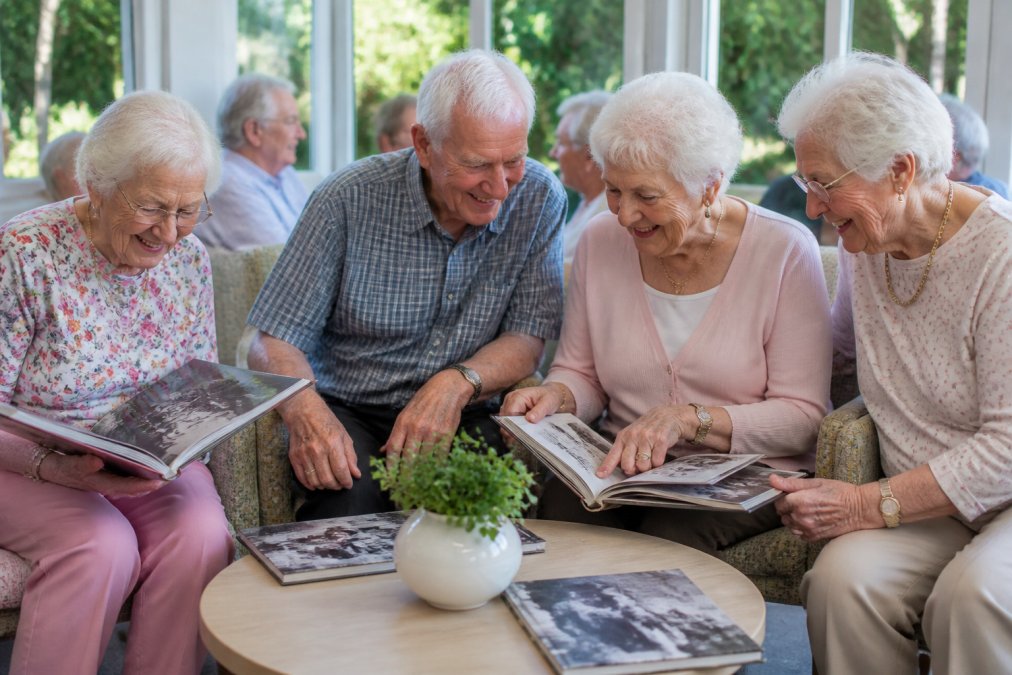
A resident with dementia may struggle with recent memory but retain vivid recall of their youth. A photograph of a 1960s Australian street or vintage car triggers memory activation, creating conversation opportunities and emotional engagement. For residents with limited verbal ability, the shared experience of looking through photographs together creates connection without requiring extensive communication.
Gerontological nursing and dementia care literature increasingly recognises reminiscence therapy as an evidence-based intervention. It's therapeutic work, not entertainment.
Effective reminiscence therapy requires:
- Content matching residents' life experience. A book about Australian culture from the 1950s-1980s works for residents who lived through those decades.
- Accessibility for varied cognitive states. Some residents engage with detailed narratives; others respond better to photographs with minimal text.
- Trained staff facilitation. A carer sitting alongside, asking questions, drawing out memories, and validating experiences transforms the experience therapeutically.
- Consistency and repetition. Residents often request the same books repeatedly, that repetition indicates the book is working therapeutically.
Remember When Shop's collections, particularly Australia Remember When and the decade-specific Photos and Memories series, were specifically recognised by carers and dementia care professionals as effective for reminiscence therapy. The abundance of photographs, focus on everyday life, and Australian cultural specificity make these titles particularly suited to therapeutic use.
Training staff to use reminiscence therapy effectively matters as much as selecting the right books. The goal isn't testing memory but activating memory and facilitating connection. The shift from interrogation to conversation changes outcomes dramatically.
Bulk books for aged care aren't a minor operational detail. They're therapeutic resources, engagement tools, and expressions of respect for residents' life experience. A facility that invests thoughtfully in collection curation, accessibility, and staff training around reminiscence therapy sees measurable improvements in resident engagement and wellbeing.
The Remember When Shop team understands this distinction. Our collections celebrate Australian nostalgia, honour the decades residents actually lived through, and facilitate meaningful conversation that transforms aged care environments. When facilities source bulk books through providers who understand reminiscence therapy and gerontological practice, the results speak for themselves: residents who engage more deeply, carers with better tools for therapeutic work, and communities where memory and connection matter.
Start by assessing your facility's current collection: Is it accessible? Does it match your residents' life experience? Are staff trained to use it therapeutically? The answers will guide your bulk purchasing decisions and help you build collections that genuinely serve your residents' wellbeing.
Frequently Asked Questions
How do I know if bulk books for aged care will actually work for residents with dementia?
Reminiscence therapy using nostalgic books has strong evidence in aged care settings. Residents with dementia often respond positively to familiar imagery and stories from their formative years. Books featuring Australian history from the 1940s-1980s, particularly those with large print and abundant photographs, create opportunities for conversation and memory stimulation. Start with a small collection and observe resident engagement. Many carers report that residents who are typically withdrawn become more communicative when handling decade-specific photo books. The key is matching the book content to the resident's era of memory.
What makes large print books for seniors different from standard editions?
Large print books use font sizes of 16 points or larger, compared to standard 10-12 point text. This reduces eye strain and improves readability for seniors with age-related vision changes. Beyond font size, quality large print editions also feature improved contrast, wider margins, and often thicker paper to reduce show-through. For aged care facilities, large print editions are essential for residents with low vision or macular degeneration. When sourcing bulk books, prioritise publishers who specialise in accessibility; many Australian nostalgia titles come in large print formats designed specifically for older readers.
Are there government grants or funding available for aged care facility library resources?
Funding for aged care library resources varies by state and facility type. Some aged care facilities may access grants through state library services or community health programs, though these are not universal. Enquire with your state's library authority or aged care regulator about available programs. Many facilities find that bulk purchasing directly from publishers or wholesalers offers better value than individual copies. Community donations and fundraising also supplement library budgets. Building partnerships with local libraries or book donation programs can reduce procurement costs significantly.
What is the typical cost of sourcing bulk books for an aged care facility?
Costs depend on the type and quantity of books. Decade-specific Australian nostalgia books typically range from $29.99 to $54.95 per copy when purchased individually. Bulk ordering from publishers or wholesalers may offer modest discounts, though savings are often modest. Specialist titles like training manuals for healthcare professionals cost more. Library bulk loan services sometimes offer lower per-unit costs through annual subscriptions. Consider a mixed approach: purchase key titles in multiple copies (reminiscence therapy books, large print editions) and supplement with donated or loaned collections to maximise your budget.
This article was written using GrandRanker