

How to Engage Dementia Patients: A Practical Guide
Table of Contents
- Step 1: Understand What Engaging Dementia Patients Actually Means
- Step 2: Master Dementia Communication Techniques That Work
- Step 3: Match Activities to the Stage of Cognitive Decline
- Step 4: Activities for Dementia Patients at Home That Actually Work
- Step 5: Sensory Activities for Elderly with Dementia
- Step 6: How to Manage Dementia Agitation During Engagement
- Step 7: Technology-Assisted Engagement and Caregiver Burnout Prevention
- Common Mistakes When Trying to Engage Dementia Patients
Last Updated: August 4, 2026
Knowing how to engage dementia patients is one of the most practical skills a carer or family member can develop. This guide covers communication techniques, stage-specific activities, sensory environments, and caregiver burnout prevention. We'll show you how to match activities to the right moment, what most guides get wrong about non-verbal communication, and why a familiar photograph can unlock conversation that nothing else could.
Here's what most guides get wrong: they treat engagement as something you do to a person with dementia rather than with them. Person-centered care changes that entirely.
Step 1: Understand What Engaging Dementia Patients Actually Means
Engagement for dementia patients is not entertainment. It is purposeful interaction that preserves dignity, supports emotional well-being, and meets a person where they are cognitively, not where they used to be.
According to Dementia Australia's resource library, person-centered care requires understanding the individual's life history, preferences, and current abilities before choosing any activity. Cognitive impairment affects attention span, short-term memory, and language processing, but emotional memory tends to remain intact far longer. A person who cannot remember breakfast may still light up at a song from their twenties.
Three things to establish before any session:
- What time of day is the person most alert and calm?
- What were their interests, work, and hobbies before diagnosis?
- What stage of cognitive decline are they currently at?
Step 2: Master Dementia Communication Techniques That Work
Non-verbal communication carries more weight in dementia care than verbal language. Approach from the front, make steady eye contact, and keep your expression open and calm.
Non-Verbal Communication and Body Language
Practical rules for non-verbal communication:
- Get to eye level before speaking
- Use a slow, warm tone, not a raised volume
- Keep gestures simple and deliberate
- Allow silence without rushing to fill it
- Touch the hand or arm gently to signal connection, if the person is receptive
Short sentences work better than long ones. Active listening means letting the person finish, even when the sentence trails off or loses coherence.
Using Validation Therapy and Reminiscence
Validation therapy acknowledges and respects the feelings of people with dementia rather than correcting their reality. Instead of saying "No, your mother passed away years ago," you might say "You're thinking about your mum. Tell me about her."
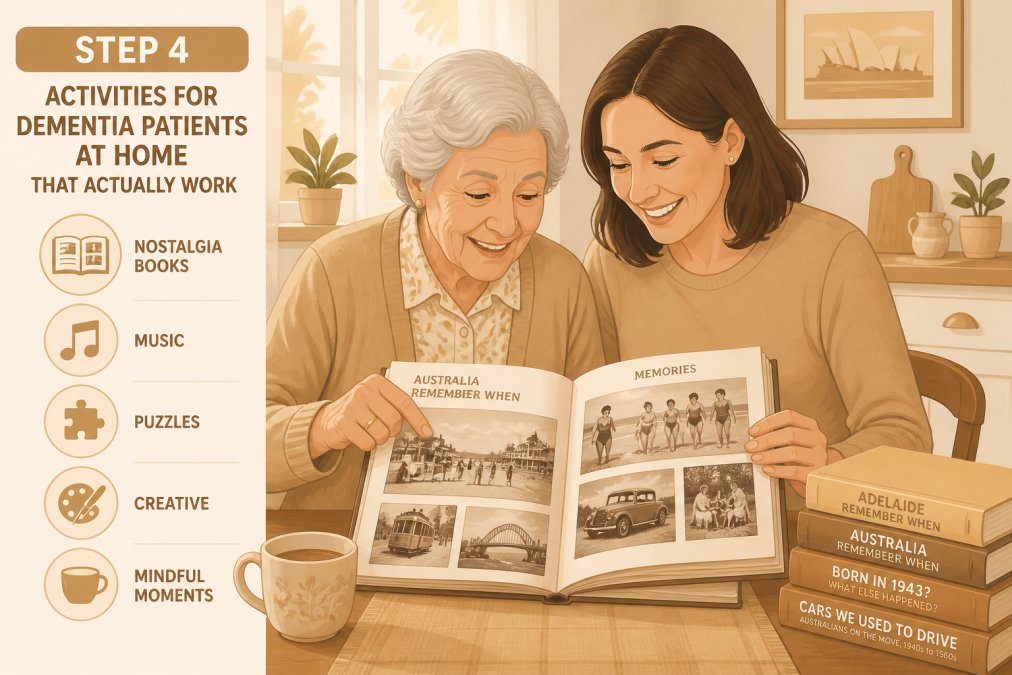
Reminiscence works alongside validation therapy by using sensory cues, photographs, music, and familiar objects to prompt emotional memories. Carers across Australian aged care facilities have found that decade-specific photo books, particularly those covering the 1950s through the 1980s, can prompt unprompted conversation from residents who are otherwise largely non-verbal.
The Remember When Shop Photos and Memories of Australia series by author Bob Byrne draws on exactly this approach. The 1950s edition and 1960s edition are available as author-signed copies, which adds a meaningful personal touch when used as a gift or therapy resource.


Step 3: Match Activities to the Stage of Cognitive Decline
An activity that works beautifully in early-stage dementia can cause distress in late-stage dementia, and vice versa.
Early Stage: Preserving Independence and Routine
People in the early stage retain significant capacity for complex tasks. The priority is preserving independence and maintaining a consistent routine that provides structure without feeling restrictive.
Good early-stage activities include gardening, cooking, baking, reading, crosswords, board games, social outings, and helping with simple household tasks. The goal is to keep the person active in their own life.
Middle Stage: Structured and Supported Engagement
The middle stage brings more significant memory loss, shorter attention span, and sometimes behavioural symptoms like agitation. Structured and supported engagement becomes essential. Repetition is not a failure of the activity, it's how the person engages at this stage.
Effective middle-stage activities include sorting objects by colour or shape, listening to familiar music, looking through a nostalgia book with a carer present, simple crafts, and gentle physical movement like chair exercises or short walks.
Late Stage: Comfort-Focused Interaction
Late-stage dementia calls for comfort-focused interaction rather than cognitive stimulation. Singing familiar songs, holding hands, gentle massage, and sitting together with a calm voice reading aloud are all appropriate. Success is measured by reduced distress and increased visible comfort.
| Dementia Stage | Primary Goal | Example Activities | Key Approach |
|---|---|---|---|
| Early | Preserve independence | Gardening, reading, cooking | Minimal supervision |
| Middle | Structure and support | Music, sorting, nostalgia books | Short, repetitive sessions |
| Late | Comfort and presence | Touch, singing, calm voice | Sensory and emotional focus |
Step 4: Activities for Dementia Patients at Home That Actually Work
The most effective activities connect to the person's real life history rather than generic puzzles or tasks.
Creative Arts, Music, and Reminiscence Books
Creative expression does not require skill. Painting, drawing, or colouring with simple materials gives a person something to focus on and produces a sense of accomplishment. Music is particularly effective because musical memory is stored differently in the brain and often remains accessible even in advanced cognitive decline.
Reminiscence books are underused at home. A decade-specific photo book showing familiar Australian scenes, cars, fashions, and events from the 1940s through the 1970s can prompt extended conversation and visible emotional engagement. The Photos and Memories of Australia from the 1970s and 1940s edition from Remember When Shop are particularly useful for this.

Physical Movement and Fine Motor Activities
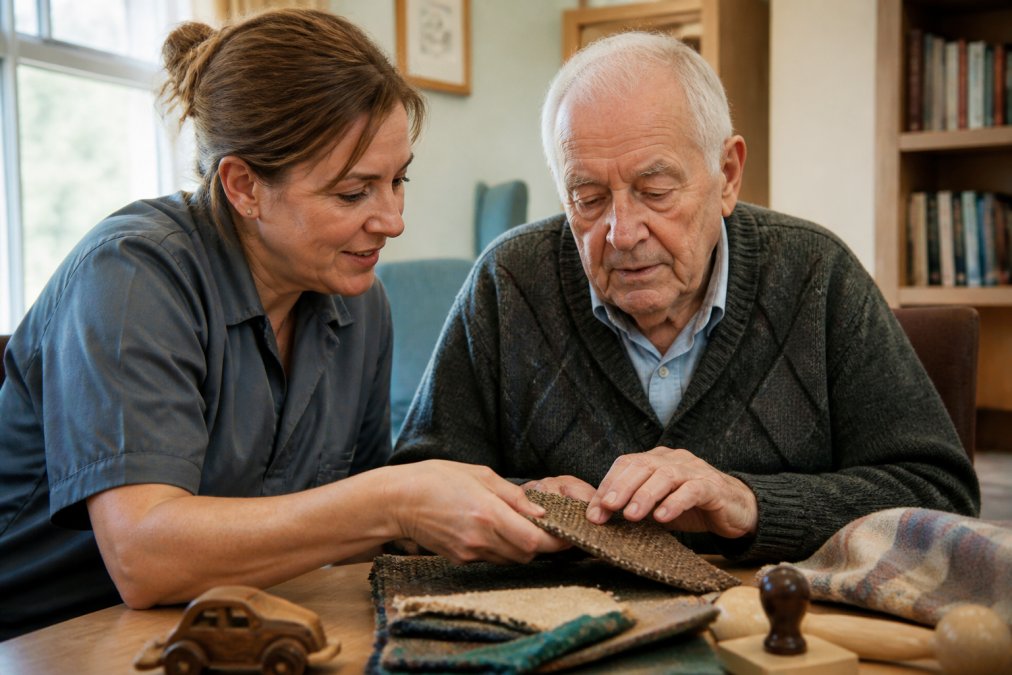
Physical activity supports both cognitive and emotional well-being. Chair-based exercises, gentle walking, and simple stretching maintain mobility and reduce agitation. Fine motor activities such as folding, sorting, threading beads, or handling familiar objects keep hands active and provide sensory stimulation. Match the material to the person's life, a former seamstress responds to fabric, a former mechanic to tools.
Step 5: Sensory Activities for Elderly with Dementia
Sensory stimulation is the most accessible form of engagement across all stages of dementia. It bypasses language and cognition and works directly through the senses.
Effective sensory activities include handling objects with distinct textures, smelling familiar scents, listening to music from the person's past, tasting favourite foods, and looking at bright, high-contrast images or familiar photographs. According to guidance from the Australian Government's Aged Care Quality and Safety Commission, sensory-based activities are a recognised component of quality dementia care.
Setting Up a Sensory-Friendly Environment
The environment shapes engagement before any activity begins. Key modifications include reducing background noise, ensuring consistent warm lighting, keeping the space uncluttered and familiar, using colour contrast, and maintaining a consistent room temperature.
A structured environment reduces the cognitive load required to navigate a space, which leaves more capacity for actual engagement.
Step 6: How to Manage Dementia Agitation During Engagement
Agitation management starts with identifying the trigger, not suppressing the behaviour. Common triggers include fatigue, pain, overstimulation, unfamiliar faces, or being asked to do something beyond current capacity.
When agitation arises mid-session:
- Stop the current activity without drawing attention to the stop
- Lower your voice and slow your movements
- Offer a sensory anchor: a familiar object, a warm drink, or a piece of music
- Avoid asking questions that require the person to remember or explain
- Give the person space to settle before resuming or ending the session
The validation therapy approach is particularly useful here. Acknowledge the feeling: "You seem a bit tired. That's okay. Let's just sit for a minute." This approach, supported by Alzheimer's Disease International's global dementia care guidelines, reduces escalation far more effectively than distraction or correction.
Step 7: Technology-Assisted Engagement and Caregiver Burnout Prevention
Technology-assisted engagement is increasingly relevant as digital tools become more accessible. Simple tablet-based applications can display slideshows of family photographs, play curated playlists, or run gentle cognitive games adapted for people with dementia. Video calls support social interaction for people who can no longer travel. These tools supplement rather than replace human connection.
Caregiver burnout prevention matters as much as engagement itself. A carer who is exhausted cannot provide quality interaction. Practical burnout prevention strategies include scheduling regular breaks with other carers, separating your identity from session outcomes, using structured activity resources to reduce planning load, and connecting with carer support services through Carer Gateway, Australia's national carer support service.
Common Mistakes When Trying to Engage Dementia Patients
Choosing activities based on what the carer enjoys, not the person. Engagement starts with the person's history, preferences, and current capacity.
Talking over or around the person. Discussing someone in the third person while they are present is demeaning and increases agitation. Always address the person directly.
Expecting consistency. Cognitive impairment fluctuates. A person who engaged well on Tuesday may be withdrawn on Wednesday. This is the nature of the condition.
Skipping the sensory environment setup. Five minutes of environment preparation saves thirty minutes of failed engagement.
Abandoning reminiscence tools too quickly. A nostalgia book might not produce an immediate response on first use. Familiarity builds over repeated exposure. Many carers report that the same book that produced nothing in week one becomes a consistent engagement trigger by week three.
The goal when you engage dementia patients is a moment of connection, dignity, and safety. Some days that looks like a long conversation over old photographs. Other days it looks like sitting quietly together with a familiar song playing. Both count.
Engaging a person with dementia takes consistency, patience, and the right tools. Remember When Shop's decade-specific photo books, covering Australian life from the 1940s through the 1970s, are used by carers in aged care facilities across Australia because they trigger emotional memory and prompt genuine conversation. Many are available as author-signed copies, making them a meaningful gift as well as a practical therapy resource. Shop the collection at Remember When Shop and give someone a genuine connection to their past.
Frequently Asked Questions
What are the best activities for someone in the early stages of dementia?
Early-stage dementia patients often respond well to activities that preserve their independence and draw on long-term memory. Good options include looking through decade-specific photo books, gentle gardening, cooking familiar recipes, light physical exercise, and reminiscence conversations about their past. The goal is to maintain a consistent daily routine and offer activities that match their current attention span without causing frustration. Familiar Australian imagery and nostalgic content can be particularly effective at sparking conversation and emotional connection.
How can I communicate effectively with someone living with dementia?
Effective dementia communication techniques include speaking slowly with short, simple sentences, maintaining gentle eye contact, and using a calm, reassuring tone. Avoid correcting or arguing; instead, use validation therapy to acknowledge feelings. Non-verbal communication such as a warm touch on the hand or a smile carries significant weight. Reduce background noise, approach from the front, and give the person time to respond. Active listening and patience are more effective than trying to prompt correct answers.
What should I avoid saying to a person with memory loss?
Avoid phrases like 'Don't you remember?' or 'I already told you that', as they highlight the person's cognitive impairment and cause distress. Never argue about what is real or correct. Avoid speaking about the person as though they are not present, using baby talk, or rushing them. Closed questions that demand a specific answer can also create anxiety. Instead, use open, gentle prompts and focus on emotional reassurance rather than factual accuracy to protect their dignity and emotional well-being.
How do I handle agitation during activities with a dementia patient?
When managing dementia agitation, stop the activity calmly without drawing attention to the behaviour. Speak in a low, steady voice and avoid crowding the person's space. Try redirecting attention to something soothing, such as familiar music, a tactile object, or a reminiscence book with comforting images. Check whether environmental factors like noise, lighting, or fatigue are contributing. Keep activities short and structured. If agitation is frequent, speak with a healthcare professional or contact Dementia Australia on 1800 100 500 for carer support.
Can nostalgia books really help engage someone with dementia?
Yes. Reminiscence therapy using familiar images and stories is widely used in Australian aged care settings to support emotional well-being and social interaction. Books featuring Australian history and photography from the 1940s through to the 1980s can prompt long-term memories that remain accessible even with significant cognitive impairment. Carers at aged care facilities have noted that titles like those from the Remember When Shop spark conversation and recognition in residents who are otherwise difficult to engage. The visual format suits shorter attention spans and requires no reading ability to enjoy.
How can I prevent caregiver burnout when engaging a dementia patient every day?
Caregiver burnout is a genuine risk for those supporting someone with dementia. Build short, structured engagement sessions into the daily routine rather than attempting long, open-ended activities. Accept that not every session will go well. Use ready-made resources like nostalgia books, music playlists, or simple craft kits to reduce preparation time. Take regular breaks, connect with Carer Gateway (1800 422 737) for Australian carer support services, and share the engagement role with other family members or professional respite carers where possible.
This article was written using GrandRanker