

How to Start a Reminiscence Therapy Group
Table of Contents
- What Reminiscence Therapy Is and Why It Matters
- Before You Begin: Planning and Preparation
- Creating a Reminiscence Therapy Session Plan
- Reminiscence Therapy Topics and Prompts for Group Discussion
- Reminiscence Therapy Activities for Older Adults
- How to Facilitate a Reminiscence Group Effectively
- Your Group Setup Checklist
- Conclusion
- Frequently Asked Questions
Last Updated: October 12, 2026
What Reminiscence Therapy Is and Why It Matters
Reminiscence therapy uses guided conversation, photographs, music, and personal objects to help people recall past memories, creating connection and engagement for older adults and people living with dementia.
Its beauty is its simplicity: you're not fixing memory loss, just creating a safe space where people share stories, feel heard, and reconnect with who they've been.
Carers and healthcare professionals find reminiscence therapy activities spark joy and comfort in ways other approaches don't.
Before You Begin: Planning and Preparation
Starting a reminiscence therapy group requires planning: who participates, where you'll meet, and what resources you'll use.
Identifying your participants and group size
The best group size is 4 to 8 people, small enough that everyone is heard, large enough for natural conversation. Larger groups can work, but quieter members may withdraw.
Think about who would benefit most. Reminiscence therapy groups work well for:
- Older adults in residential aged care facilities
- Community-dwelling seniors seeking social connection and mental stimulation
- People in early to mid-stage dementia who can still engage in conversation
Consider participants' abilities: can they sit comfortably for 45-60 minutes, hear and see reasonably well, and speak even if communication is sometimes unclear?
Setting up your space and practical logistics
Your space should feel welcoming, not clinical, a comfortable lounge, community room, or quiet corner of a care facility. Avoid harsh fluorescent lighting; natural light or warm lamps work better.
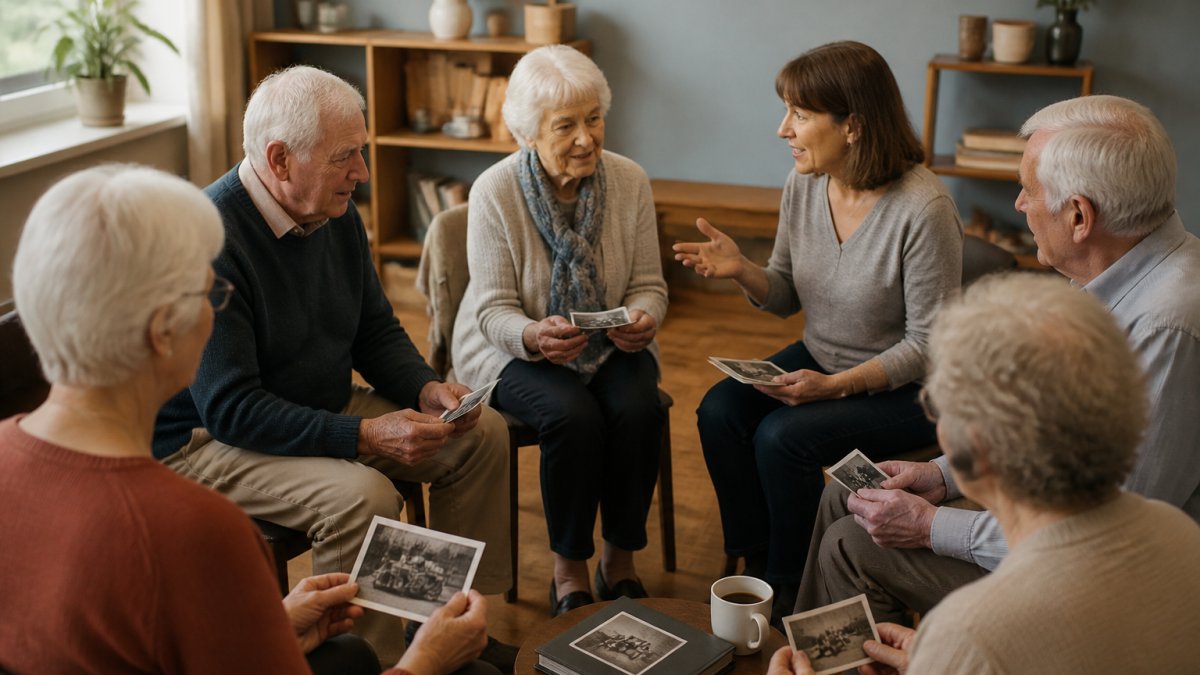
Arrange seating in a circle or semi-circle so everyone sees each other's faces, which encourages conversation.
Minimize background noise, a ticking clock or distant television distracts from conversation. In a care facility, tell staff you need quiet time during sessions.
Plan for practical details:
- Choose a regular day and time so participants know when to expect the group
- Keep sessions to 45-60 minutes (longer sessions can tire people out)
- Have water and light refreshments available
Creating a Reminiscence Therapy Session Plan
A well-structured session keeps energy flowing and gives participants confidence about what to expect. The same framework works every time, even as content changes.
Session structure and timing
A typical reminiscence therapy session follows this rhythm:
-
Welcome and settling (5 minutes): Greet participants warmly as they arrive and help them settle in. Set a calm, friendly tone.
-
Introduction to the theme (5 minutes): Explain today's topic in simple, clear language. Example: "Today we're going to talk about holidays and celebrations you remember."
-
Opening prompt or activity (10 minutes): Start with a photograph, piece of music, or object related to your theme. Let people respond naturally, there's no pressure to speak.
-
Guided discussion (25-30 minutes): Ask open-ended questions that invite people to share memories. Listen more than you talk. Encourage quieter members gently.
-
Creative activity or reflection (10 minutes): Drawing, writing, or simply sitting together with a meaningful song playing.
-
Closing and thanks (5 minutes): Summarize what you've heard. Thank people for sharing. End on a positive, warm note.
Sample first session with prompts
Your first session sets the tone. Choose a broad theme likely to resonate, such as "childhood memories" or "favourite places we've lived."
Theme: Childhood Homes and Neighbourhoods
Opening prompt: Show a photograph of a typical suburban street from the 1950s or 1960s.
Discussion questions:
- What did your street look like? What was your house like?
- Who lived nearby? Do you remember any neighbours?
- What did you like to do outside as a child?
Secondary prompts (if conversation stalls):
- "What was the corner shop like?"
- "Did you have a backyard? What grew there?"
- "How did children travel around, on foot, bikes, or by car?"
Closing activity: Pass around old photographs of suburban streets or neighbourhoods from that era. Let people point out similarities to their own memories.
Reminiscence Therapy Topics and Prompts for Group Discussion
The right theme keeps sessions fresh. Choose themes tied to shared experiences or universal life events, and avoid topics that are too recent or focused on loss.
Strong reminiscence therapy topics:
- Childhood homes and neighbourhoods
- School days and teachers
- First jobs and workplaces
Sample prompts for each theme:
Childhood and School:
- What was your school like? Who was your favourite teacher?
- What games did you play at lunch time?
- Do you remember what you wore to school?
Work and Careers:
- What was your first job? How did you get it?
- Who were your workmates? Do you remember their names?
- What did you enjoy most about working?
Food and Family:
- What was your favourite meal as a child?
- Who cooked in your family? What was their specialty?
- Do you remember special occasions and what you ate?
Music and Entertainment:
- What music did you love when you were young?
- Did you go to dances? What was that like?
- What was your favourite film or radio show?
Reminiscence Therapy Activities for Older Adults
Beyond conversation, structured activities deepen engagement and appeal to different learning styles. Some people connect through words, others through images, music, or hands-on activity.
Using photographs and visual prompts
Photographs are the most powerful tool in reminiscence therapy, they bypass words and trigger vivid memories instantly.
How to use photographs effectively:
- Choose images that match your session theme
- Use large, clear prints (at least A5, ideally A4)
- Pass photos around so people can hold them
Where to find photographs:
- Books like Australia Remember When by Bob Byrne, which contains over 200 photographs from the 1940s to 1980s
- Local history libraries and museums
- Participants' own family albums (ask them to bring photos to share)
At Remember When Shop, we've found decade-specific photo books invaluable for reminiscence therapy groups. Australia Remember When and books focused on specific regions or eras spark immediate recognition and conversation, and many carers in aged care facilities use them because the photographs are authentic, high-quality, and genuinely resonate with older Australians.

Music, objects, and sensory triggers
Music unlocks memory like few other things can, a song from someone's youth can instantly transport them back decades.
Book; Australia Remember When. Bob Byrne →
Using music in reminiscence sessions:
- Choose songs from the era your group grew up in (typically 1950s-1980s for most older adults)
- Play instrumental versions or well-known recordings
- Invite people to sing along if they wish
Objects and sensory triggers:
Physical objects engage memory through touch and sight. A vintage kitchen tool, old coins, or a piece of fabric can spark detailed stories.
Try these:
- Old kitchen implements (wooden spoons, manual egg beaters, scales)
- Vintage coins and banknotes
- Fabric swatches (wool, cotton, lace)
Pass objects around. Ask: "Have you used one of these? What was it for?" Scent is particularly powerful, a whiff of something familiar can bring back a flood of memories.
How to Facilitate a Reminiscence Group Effectively
Good facilitation means creating safety, encouraging participation, and knowing when to step back. You're a guide who helps people tell their own stories, not a lecturer or therapist.
Core facilitation skills and techniques
Listen more than you talk. Create space for others rather than filling silence with your own stories.
Ask open-ended questions. Avoid yes-or-no questions.
Validate all responses. If someone's memory doesn't match historical fact, it doesn't matter.
Use gentle prompts, not corrections. If someone misremembers a detail, don't correct them.
Manage the pace. Give people time to think and speak. Don't rush to fill pauses.
Managing distress and safeguarding participants
Reminiscence therapy is generally safe and positive, but painful memories can occasionally surface, so be prepared.
Watch for signs of distress:
- Sudden tears or emotional withdrawal
- Changes in breathing or body language
- Expressions of sadness, anger, or fear
How to respond:
-
Pause gently. Stop the activity if needed. Say: "I notice this is bringing up some difficult feelings. That's okay. We don't have to talk about this."
-
Offer comfort. Sit nearby, offer a tissue or water, and let them know they're safe.
-
Validate the feeling. "That sounds like it was hard. Thank you for trusting us with that memory."
-
Move forward thoughtfully. Shift to a lighter topic, take a break, or end the session early if someone is very distressed.
-
Follow up after. Check in with the person later. Let them know you're there if they need to talk.
Consent and safeguarding:
- Always ask permission before using someone's stories or photographs in the group
- Respect privacy, don't share personal details outside the group
- If someone has dementia, involve their family or carer in discussions about participation
Inclusive facilitation for people living with dementia
People living with dementia can absolutely participate in and benefit from reminiscence therapy groups. The key is adjusting your approach to their needs.
Adaptations for dementia:
- Use very large, clear photographs
- Speak slowly and clearly, but not loudly (unless hearing is an issue)
- Use shorter, simpler sentences
Conversation tips:
Instead of "Tell me about your childhood," try "What was your mum's kitchen like?" Specific questions are easier to answer than broad ones.
If someone becomes confused or agitated, redirect gently to something calming, music, a familiar photograph, or a simple activity.
Your Group Setup Checklist
Use this checklist to cover the essentials before your first session.
| Task | Status | Notes |
|---|---|---|
| Identify 4-8 participants | ☐ | Consider cognitive and physical abilities |
| Confirm commitment from participants and carers | ☐ | Get consent and explain the group's purpose |
| Choose a regular meeting day and time | ☐ | Consistency helps people remember and attend |
| Book a quiet, comfortable space | ☐ | Circle or semi-circle seating works best |
| Arrange transport if needed | ☐ | Check if participants need help getting there |
| Gather opening photographs or objects | ☐ | Decade-specific books are excellent resources |
| Source music from relevant era | ☐ | Create a playlist for background and activities |
| Brief any support staff | ☐ | Help them understand the group's therapeutic purpose |
| Plan your first three session themes | ☐ | Childhood, work, and celebrations are safe starters |
| Prepare opening prompts and questions | ☐ | Have them written down so you don't forget |
| Set up a simple record-keeping system | ☐ | Note what works for each person |
| Communicate with families or carers | ☐ | Keep them informed about progress and outcomes |
Conclusion
Starting a reminiscence therapy group is one of the most rewarding ways to support older adults and people living with dementia.
The foundation is simple: create a safe space, choose meaningful themes, gather good visual and audio prompts, and listen with genuine interest.
At Remember When Shop, we've worked with carers, families, and healthcare professionals who use reminiscence therapy to transform the lives of older people in their care.
Start small with one group.
Frequently Asked Questions
How long should a reminiscence therapy session last?
Most reminiscence therapy sessions run 45 to 60 minutes, though this depends on your group's needs and attention span. Older adults and people living with dementia often respond better to shorter, focused sessions of 45 minutes. Always allow 10-15 minutes for settling in and 5-10 minutes to wind down gently. If participants become fatigued or distressed, end earlier rather than pushing through. Consistency matters more than length, regular weekly sessions of 45 minutes often work better than occasional longer sessions.
What materials help prompt memories in a reminiscence therapy group?
Photographs are the most powerful memory trigger, especially decade-specific images that match your group's era. Books like Australia Remember When or Photos and Memories of Australia from the 1950s work exceptionally well because they feature familiar Australian landmarks, vehicles, shops, and everyday scenes. Music from the participant's youth, familiar objects (old coins, tools, household items), and scent (lavender, baking smells) also spark vivid memories. Encourage participants to bring personal items, old letters, postcards, or keepsakes. The more sensory and personal the prompt, the richer the conversation.
How do you make reminiscence sessions comfortable for people living with dementia?
Use open-ended questions rather than testing memory: instead of 'Do you remember this?', try 'What does this remind you of?' Focus on feelings and sensations, not accuracy. Keep the environment calm and free from distractions. Validate all contributions without correction. Allow silence, some participants process slowly. Use visual prompts heavily since verbal cues alone may not work. Seat people where they can see and hear easily. Have a quiet space nearby if someone becomes overwhelmed. Always obtain informed consent and check in regularly about comfort. People living with dementia often enjoy the social connection and emotional warmth more than perfect recall.
Can reminiscence therapy really help someone with dementia engage better?
Yes. Reminiscence therapy activates long-term memory, which is often better preserved in dementia than short-term memory. Even when people cannot recall specific details, the emotional warmth and social connection of group reminiscence improves mood, reduces anxiety, and increases engagement. Carers and family members frequently report that familiar photographs and stories spark recognition and conversation. The goal is not perfect memory recall but meaningful connection, comfort, and pleasure. Many aged care facilities use reminiscence therapy specifically because it works, it meets people where they are and celebrates their life story.
Dementia Australia resources on memory and reminiscence
Aged Care Quality Standards from the Australian Aged Care Quality Agency
National Dementia Support Program guidance on therapeutic activities