
Is Reminiscence Therapy Good for Alzheimer's? A 2026 Review
Table of Contents
- What Reminiscence Therapy Is and Why It Matters for Alzheimer's
- The Evidence: Is Reminiscence Therapy Good for Alzheimer's Patients?
- Reminiscence therapy techniques That Work in Practice
- Reminiscence Therapy Activities for Dementia: Practical Ideas to Try
- How to Start a Reminiscence Therapy Group: A Step-by-Step Guide
- Choosing the Right Nostalgia Book for Your Loved One
- Frequently Asked Questions
Last Updated: September 13, 2026
What Reminiscence Therapy Is and Why It Matters for Alzheimer's
Reminiscence therapy is a psychosocial intervention that uses prompts from a person's past, photographs, music, objects, familiar stories, to spark memory recall and conversation. For someone with Alzheimer's, it works with long-term memory rather than against it.
Short-term memory deteriorates early in Alzheimer's, but long-term memory often survives much longer. Reminiscence therapy leans on that preserved capacity, which is why carers in aged care keep returning to it. At Remember When Shop, we hear regularly from carers who use our nostalgia books for exactly this purpose.
It sits within person-centered care, which treats the individual's history and identity as central to dementia care, and is classified as a non-pharmacological treatment: it supports well-being without medication.
The Evidence: Is Reminiscence Therapy Good for Alzheimer's Patients?
The short answer: yes for mood, engagement and quality of life; no for reversing cognitive decline. The longer answer tells you what to expect and what to stop expecting.
What the research actually shows. The most-cited evidence is a Cochrane systematic review of reminiscence therapy for people with dementia, pooling randomised trials that found benefits for quality of life and communication, with some positive signals for mood. Effect sizes are modest and the trials small and heterogeneous: a reliable, low-risk intervention with real but moderate benefit, not a breakthrough.
Why it works, mechanically. Alzheimer's attacks the hippocampus and related medial temporal structures early, which is why short-term and episodic memory fail first. Long-term autobiographical memory, especially from adolescence and early adulthood, is stored more diffusely and degrades later. This is the reminiscence bump: people recall more from roughly ages 10 to 30 than any other period. Reminiscence therapy deliberately targets that preserved window, working with the part of the memory system the disease has not yet reached.
What it does not do. It does not raise Mini-Mental State Examination scores, slow hippocampal atrophy, or change the underlying pathology. Any guide claiming cognitive restoration overstates the evidence; where trials show cognitive benefit, it is usually within-session orientation or recall, not durable improvement.
Where the benefit is strongest. The outcomes families actually notice are behavioural and emotional:
- Reduced agitation and restlessness, particularly in the late afternoon and evening when sundowning is common
- Fewer depressive symptoms and less withdrawal
- More spontaneous speech and longer conversational turns
- Improved carer-patient relationship and reduced carer strain
Those are the symptoms antipsychotic medication manages poorly and with significant risk. Australian clinical guidance, including the Royal Australian College of General Practitioners' aged care resources and the Dementia Australia care framework, positions psychosocial interventions like reminiscence therapy ahead of medication for behavioural symptoms where a non-drug approach is safe and workable.
How it compares with other psychosocial interventions. Reminiscence therapy overlaps with life review therapy (more structured, one-on-one, aimed at resolving past conflicts), validation therapy (accepting the emotional truth of a statement rather than correcting it) and cognitive stimulation therapy (structured group activities targeting cognition). It sits between them: less clinical than life review, more memory-focused than general social activity. Most practitioners combine approaches.
The practical verdict. Is it worth trying? Almost always yes, low downside, and the upside is a better day for both of you. Will it slow the disease? No, and no psychosocial intervention currently does.
Reminiscence therapy techniques That Work in Practice
The techniques that work best are the ones a carer can sustain. Fancy protocols fail when they demand equipment, training or an hour of undivided attention; simple, repeatable sessions win.
A common mistake is treating a session like a quiz. Asking "Do you remember when...?" puts a person with dementia on the spot and can trigger frustration or withdrawal. Share a memory alongside them instead, so the conversation becomes mutual rather than a test.

Simple One-on-One Techniques
- Photo-led conversation: Open a book to a single image and describe what you see first, then let them respond.
- Object handling: Pass a familiar item, such as a kitchen utensil or old tool, and let the person hold it while you talk.
- Music pairing: Play a song from their twenties or thirties and let the conversation follow.
- Open prompts: Use "Tell me about..." rather than "Do you remember..."
Group Techniques and Validation Therapy
Group sessions add social interaction one-on-one work cannot replicate. Keep groups small, four to six people, and use a shared theme such as school days, first jobs or holidays. Validation therapy fits naturally: rather than correcting a misremembered detail, accept the feeling behind it and respond to that. Correcting a factual error rarely helps and often causes distress.
Reminiscence Therapy Activities for Dementia: Practical Ideas to Try
Activities need not be elaborate. The most effective draw on memory triggers you already own, which is why most families should start with the practical DIY approach.
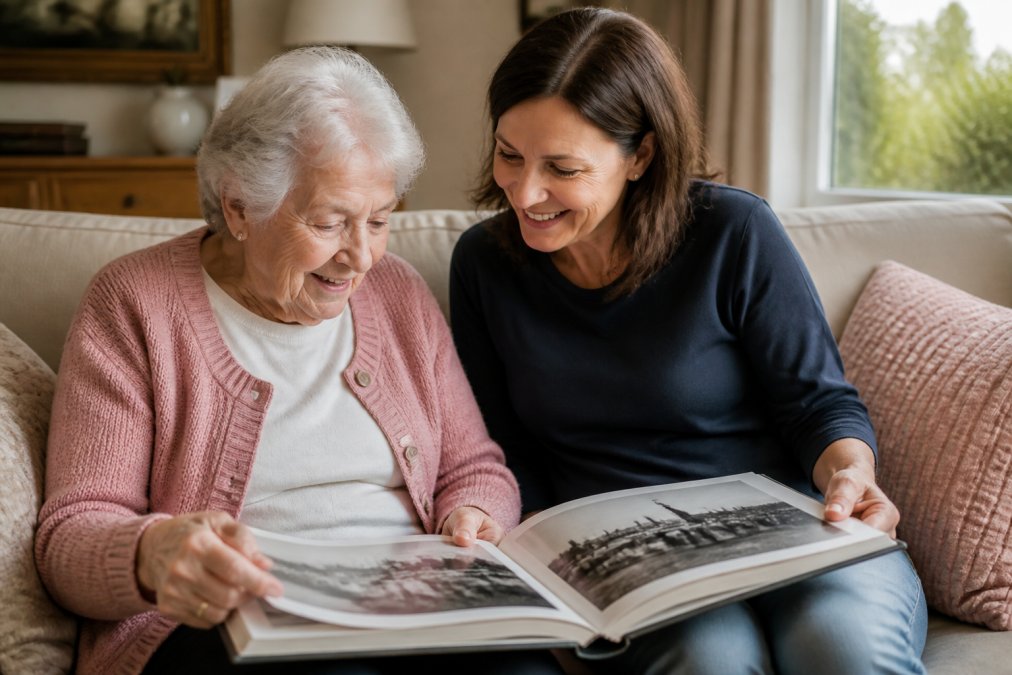
Memory Triggers You Already Have at Home
- Old family photo albums and framed pictures
- Records, cassette tapes or a playlist from their youth
- Kitchen items, tools or sewing equipment they once used daily
- Letters, postcards and newspaper clippings
- A decade-specific nostalgia book with large, clear photographs
Technology-Assisted Reminiscence
Tablets and smart speakers open up options that did not exist a decade ago: historical footage, a radio program from a specific year, a slideshow of family photos set to music. The caveat is that technology can become the focus rather than the memory. If the screen is doing the talking, the person is watching rather than participating. Use it as a prompt, then put it down.

How to Start a Reminiscence Therapy Group: A Step-by-Step Guide
Most guides stop at 'gather some photos and chat'. The difference between a session that lifts the room and one that flattens it comes down to preparation, group composition and how you handle the moments that go wrong.
Before You Start: The Setup That Matters
- Room: quiet, well-lit, no echoing surfaces, no television. Background noise is the most common reason a session fails.
- Seating: a loose circle or semicircle so everyone can see the prompts and each other. Avoid rows.
- Numbers: four to six participants. Below four the conversation stalls; above six the quieter members disengage.
- Duration: 30 to 45 minutes. Fatigue and agitation rise sharply after about 45 minutes for most people with moderate dementia (dementia.org.au).
- Timing: mid-morning or early afternoon. Avoid late afternoon if sundowning is an issue.
- Ratio: one facilitator per six participants, plus a support person for significant mobility or hearing needs.
The Session Sequence
- Choose a theme with a shared hook: schooldays, first jobs, weddings, holidays, a specific decade, or a local landmark.
- Gather prompts covering more than one sense: photographs, objects to hold, music, a nostalgia book, even a familiar smell.
- Invite participants with overlapping reference points. Similar ages or shared geography matter more than similar diagnoses.
- Open with a shared item, not a question. Pass an object around and describe it yourself first, which lowers the pressure and models the behaviour.
- Use open prompts ('Tell me about...', 'What was that like?') rather than memory tests ('Do you remember...?').
- Let the conversation wander. Off-topic is not failure; following the group's energy keeps engagement higher than forcing the theme.
- Close on a positive, familiar note: a song, a shared laugh, or a recap of something someone said well.
Facilitation Troubleshooting
- One person dominates: thank them, then redirect with 'I'd love to hear what [name] remembers about that.'
- Someone goes quiet: do not single them out. Offer a prompt near them and let them choose to join.
- A factual disagreement erupts: do not adjudicate. Validation therapy applies here: respond to the feeling, not the fact. 'It sounds like that was a really important day for you' works better than correcting a date.
- Someone becomes distressed: redirect to a neutral, pleasant topic immediately. Do not push through.
- The group loses energy: switch modality. If photos have stalled, move to music or an object.
Safety and Contraindications
Not every memory is a safe one, and most guides are silent on this. Reminiscence therapy can surface grief, trauma, wartime experiences, migration loss, institutional care or bereavement, and for some people that does more harm than good.

Watch for rising distress: agitation, tearfulness, repeated questioning, restlessness or sudden withdrawal. If these appear, redirect rather than push through; if distress recurs across sessions, stop and speak with the person's treating clinician or aged care team. Reminiscence work complements professional dementia care, it does not replace it. Integrating these therapeutic practices into a broader framework of dementia home care ensures that emotional support remains consistent and responsive to the evolving needs of the individual.
Caution is warranted for those with a recent significant bereavement, a known history of trauma, severe depression, or a tendency toward catastrophic reactions. That is not a reason to avoid the therapy, but it is a reason to start one-on-one, keep sessions short, and have an exit strategy ready.
Adapting for Cultural Background
A person's memories are shaped by where they grew up, what language they spoke at home and what community they belonged to. A generic national nostalgia book will miss more than it hits for someone from a migrant household, a rural town or a culturally distinct community.
Practical adaptations:
- Match the reference points, not just the decade. Food, radio programs, shops, streets and celebrations vary enormously between communities.
- Use the person's first language where possible. Memories often surface more readily in the language of childhood, even when conversational fluency has faded.
- Involve family members as prompt-gatherers. They know which songs, foods and places carry weight.
- Avoid assuming shared national touchstones. Ask rather than presume.
Choosing the Right Nostalgia Book for Your Loved One
The right book matches the years your loved one actually remembers. A person born in 1943 has different touchstones from someone born in 1955, and a generic nostalgia title will miss more than it hits.
Decade-specific books solve this. Bob Byrne's Photos and Memories of Australia series covers the 1940s through the 1970s, each volume built around the events, objects and daily life of a single decade. For a broader sweep, Australia Remember When draws on more than 200 photographs spanning the 1940s to the 1980s, and Remember When...Snapshots of Australia packs almost 200 images across 250 pages. Several titles come as author-signed copies, making them a keepsake as well as a therapy aid.
| Title | Decade Focus | Format | Price |
|---|---|---|---|
| Photos and Memories of Australia from the 1940s | 1940s | Paperback | $29.99 |
| Photos and Memories of Australia from the 1950s | 1950s | Paperback, 208 pages | $29.99 |
| Photos and Memories of Australia from the 1960s | 1960s | Paperback, 181 pages | $29.99 |
| Photos and Memories of Australia from the 1970s | 1970s | Paperback | $29.99 |
| Australia Remember When | 1940s-1980s | Paperback, 250+ pages | $34.99 |
| Remember When...Snapshots of Australia | Baby boomer years | Paperback, 250 pages | $39.99 |
| Born in 1943? What else happened? | Single year | Paperback, 184 pages | $25.99 |
Cultural sensitivity matters here too. Someone who grew up in a particular city or migrant community responds to books reflecting their own streets, shops and landmarks. Melbourne Remember When, Adelaide Remember When: The Boomer Stories and Growing up in Adelaide in the 1950s speak directly to those experiences in a way a national title cannot.
Frequently Asked Questions
Is reminiscence therapy effective for people with dementia?
Yes, reminiscence therapy is widely recognised as an effective psychosocial intervention for dementia. It uses long-term memory, which often remains intact longer than short-term memory, to support cognitive function, mood and social interaction. Many carers find it reduces agitation and improves quality of life. It works best as part of a person-centered care approach alongside other therapies, not as a replacement for medical treatment.
How does reminiscence therapy improve quality of life for Alzheimer's patients?
Reminiscence therapy improves quality of life by giving people a sense of identity and achievement. Recalling happy memories from the 1940s to the 1980s can lift mood, reduce depressive symptoms and encourage conversation. It also strengthens the therapeutic alliance between the person and their carer. Activities like looking through a nostalgia book or handling familiar objects provide structure and purpose, which supports emotional regulation and well-being.
What are reminiscence therapy techniques I can use at home?
Start with simple techniques: ask open-ended questions about childhood, play music from their youth, or look through old photo albums together. Use memory triggers like a favourite recipe, a classic car book or a decade-specific photo book. Follow the person's lead and validate their feelings. For more structure, try a life review timeline or a themed memory box. Keep sessions short, around 15 to 30 minutes, and always end on a positive note.
Can reminiscence therapy help reduce agitation in dementia?
Many studies and carer reports suggest reminiscence therapy can reduce agitation and other behavioral symptoms. By focusing on familiar, comforting memories, it lowers anxiety and provides a sense of safety. It is often used as a non-pharmacological treatment alongside other approaches. If agitation is severe, speak with a geriatric care professional. Reminiscence activities are generally safe but should be tailored to the individual's mood and energy levels.
Choosing the right resource is the difference between a book that sits on the shelf and one that becomes part of your weekly routine. Remember When Shop curates Australian nostalgia titles built for exactly this purpose, including decade-specific photo books, author-signed copies and city-specific collections that carers in aged care have found genuinely useful. Browse the collection and find the decade your loved one remembers best.