

Using Historical Photo Books for Dementia Care Activities
Table of Contents
- Why Historical Photo Books Work in Dementia Care
- Step 1: Choose and Prepare the Photos Safely
- Step 2: Set Up the Room and Run the Session
- Step 3: Reminiscence Therapy Questions That Open Conversation
- Step 4: Responding to Difficult Memories and Strong Emotions
- Step 5: Adapting Reminiscence Activities for Dementia at Every Stage
- Step 6: Consent, Privacy and Involving the Whole Family
- Step 7: Checking Whether the Activity Is Actually Helping
- Frequently Asked Questions
Last Updated: October 18, 2026
Why Historical Photo Books Work in Dementia Care
Using historical photo books for dementia care activities gives people with dementia a way back into conversation. The Dementia Australia guidance on reminiscence describes this as person-centred care: starting from who the person is, not what they have lost.
At Remember When Shop, we hear the same thing from carers again and again. A book of old photographs does what a quiz or a television set cannot. It waits patiently for the person to find their words.
How Photographs Reach Long-Term Memory
A photograph works on several channels at once. It gives the eye something concrete to rest on, it triggers a stored story, and it hands the person a role: the one who remembers. That is why a single image can produce a sentence when a direct question produces silence.
What a Good Memory Book for Dementia Looks Like
A good memory book for dementia is large enough to share, light enough to hold, and simple on the page. Look for:
- One or two photographs per page, not a crowded collage
- Clear, large captions with names, places and dates
- Strong contrast between images and background
- A portable size for visits and outings
- Sturdy paper that survives repeated handling
Decade-specific books help here. A person who grew up in the 1950s or 1960s recognises the milk bars, the first Holdens and the corner shops of their own childhood. Our Photos and Memories of Australia from the 1950s is built around exactly that kind of everyday detail.

Step 1: Choose and Prepare the Photos Safely
Start with the person, not the book. Ask family which years and places mattered most, then select photographs that match. Keep the following in mind:
- Choose images of family, friends, homes, schools, weddings, holidays and workplaces
- Mix one clear face per page with wider street or suburb scenes
- Skip photographs of funerals, hospitals or recent loss unless the person raises them first
- Copy irreplaceable originals rather than handing over the only print
- Write names and dates on the back in pencil, and add the same details to the caption
Safety matters with original material. Old prints are fragile, and some people put things in their mouths. Laminate or copy loose photos, and keep originals in an archive the person does not handle alone.
Step 2: Set Up the Room and Run the Session
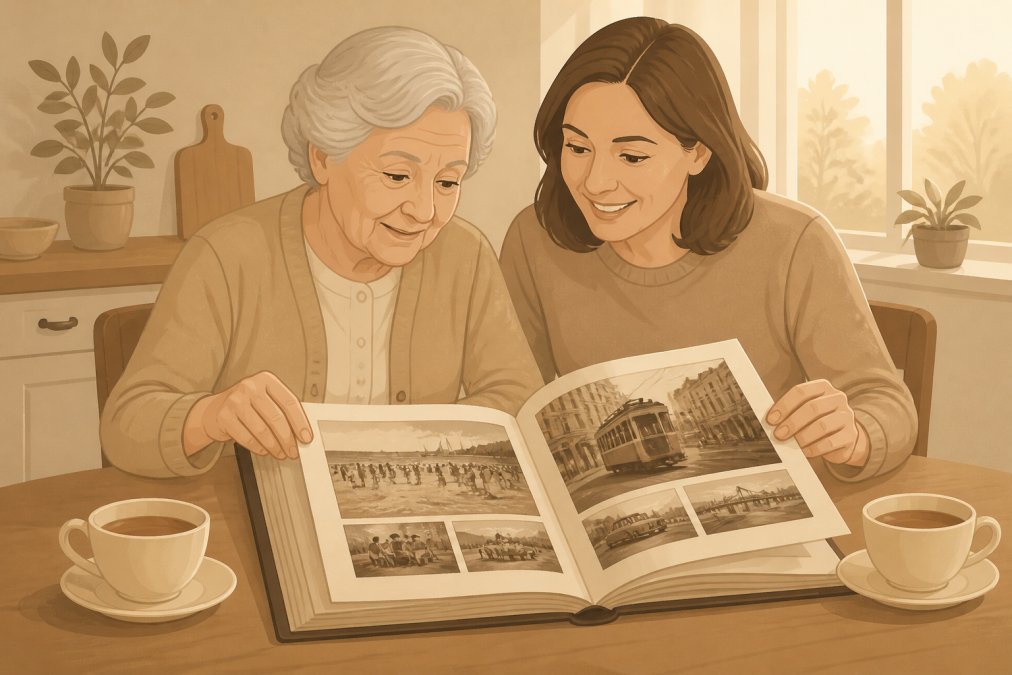
A photo session works best when the room and the timing do half the work before you open the book. Pick a quiet time of day, usually mid-morning, when the person is rested and fed.
Before You Start: A Five-Minute Preparation Checklist
- Have the book open at a page you already know is a strong starter, a familiar face or a childhood street, not a funeral or a hospital ward
- Clear the table of clutter, mail and remote controls so the page is the only thing competing for attention
- Have a glass of water and a tissue within reach
- Know two or three open prompts for the first page so you are not improvising
- Put your phone on silent and out of sight
A Simple 20-Minute Session Plan
- Minutes 1-3: Settle in. Say what you are about to do: "I brought some old photos." Name one thing you are looking forward to showing them.
- Minutes 3-15: Work through four to six pages. One page, one question, then wait. Do not turn the page while they are still looking.
- Minutes 15-18: Follow whatever the person lingers on. Let them lead, even if it means staying on one page for five minutes.
- Minutes 18-20: Close gently. Thank them and mention one thing they told you: "I didn't know you had a dog called Rex."
Adapting the Session to the Person in Front of You
Twenty minutes is a starting point, not a rule. A person in the early stages may happily spend forty minutes and want to go back through the book; a person in the later stages may manage five minutes and one page, and that is a success.
If the person has a hearing loss, sit on their better side and keep your voice low and clear rather than loud. If they have low vision, hold the book closer and angle it to the light, and favour pages with large, high-contrast images.
Step 3: Reminiscence Therapy Questions That Open Conversation
Good reminiscence therapy questions are open, specific and easy to answer. Avoid "Do you remember?" because it invites failure. Try these instead:
- "What was your street like when you were small?"
- "Who taught you to drive?"
- "What did your mum cook on Sundays?"
- "Where did you go on holidays as a kid?"
- "What job did you have first?"
- "What music did you dance to?"
Ask one question, then stop talking. Count to ten in your head. Silence is often the person assembling an answer.
Step 4: Responding to Difficult Memories and Strong Emotions
Some photographs bring up sadness. A war year, a lost sibling, a hard time. When that happens, acknowledge the feeling and stay with it rather than steering away.
- Name it simply: "That sounds like a tough year."
- Do not rush to cheer them up
- Do not argue with the memory
- Offer a gentle redirect only if distress continues: "Let's look at the next one. Was this the house with the big tree?"
Strong emotion is not failure. It is often the sign that the activity reached something real. If distress lingers, note it and mention it to their care team.
Sample Responses to Common Moments
Most carers meet the same handful of hard moments.
When the person becomes tearful. Stay with them.
Book; Photos and Memories of Australia from the 1950s →
When the person tells a different version of a memory. A date, a place or a name may not match the caption.
When the person becomes agitated or wants to stop. Close the book without debate. "Let's put it away for now.
When the person asks about someone who has died. Answer honestly but simply, and follow their lead.
Knowing When to Pause the Activity
A single tearful moment is not a reason to abandon using historical photo books for dementia care activities. A pattern is. If the same section of the book reliably upsets the person, remove those pages or move them to the back. If sessions consistently end in distress, set the book aside for a few weeks and try again later, or try a different decade.
Step 5: Adapting Reminiscence Activities for Dementia at Every Stage
Match the activity to the stage, not the other way around.
| Stage | What Works | What to Avoid |
|---|---|---|
| Early | Full books, detailed questions, group sessions | Rushing, too many people |
| Middle | One page at a time, yes/no prompts, familiar faces first | Long sessions, abstract questions |
| Later | Single large images, touch and sound, short visits | Crowded pages, complex sentences |
For later stages, try a single laminated photograph, a familiar song from the same decade, or the smell of a familiar soap. Sensory cues often reach further than words.
Step 6: Consent, Privacy and Involving the Whole Family
Ask before you build the book. The person may still be able to say whether they want their photographs shared, and family members may have their own views on images of children or of people who have died. Keep these points in mind:
- Ask permission from the person first, then close family
- Keep copies of photographs rather than lending originals
- Store the book where the person can reach it but visitors cannot take it
- Agree who holds the digital copies
- Follow your care facility's privacy policy if you are a staff member
Step 7: Checking Whether the Activity Is Actually Helping
Judge the session by engagement, not by memory. You are looking for signs of connection, not a quiz score.
- Did the person look at the pages for longer than a minute?
- Did they say anything unprompted?
- Did they smile, laugh or gesture?
- Did they seem calmer afterwards?
- Did they return to the book on their own later?
If the answer is mostly no, change one thing: a different decade, a smaller book, a quieter room, or a different time of day. Our Photos and Memories of Australia from the 1960s and 1970s titles let you switch decades without starting over.


For guidance on how reminiscence fits into a broader care plan, the National Ageing Research Institute publishes practical resources for families and aged care staff. And for a wider look at how the World Health Organization frames dementia support, its public guidance is a useful starting point.
Frequently Asked Questions
How can photo books be used in dementia care?
Photo books work as a low-pressure conversation tool. You sit beside the person, open the book and let the images do the prompting. Historical photo books for dementia care activities are especially useful because the scenes, cars, shopfronts and fashions come from the person's own era, so the memories sit in long-term memory rather than recent memory. Use them one-to-one or in small groups, keep sessions to around 20 minutes, and follow the person's interest rather than working through the book in order. A memory book for dementia also gives visiting family members something concrete to do instead of filling silence.
What should you do if a photo brings up a difficult memory?
Stay calm and stay with the person. Acknowledge the feeling without arguing about the facts: 'That sounds like it was a hard time.' Then gently shift to something neutral on the same page, such as the clothes, the weather or the street. Don't rush to correct a detail that seems wrong to you; the emotion behind it is what matters. If distress continues, close the book, offer a drink or a change of room, and try again another day. Note which pages triggered a reaction so you can skip them next time.
How long should a reminiscence activity last?
Aim for 15 to 20 minutes for a first session, then extend to 30 minutes only if the person is still engaged and comfortable. Watch for signs of tiredness or agitation, such as looking away, fidgeting or going quiet, and stop before that point. Short, frequent sessions tend to work better than one long one. For people in later stages of dementia, five to ten minutes may be plenty. The goal is a pleasant experience, not a completed book.
What makes a photo book suitable for someone with dementia?
Look for large, clear images with strong contrast, a simple layout with one or two photos per page, and a clear font for any captions. A portable book that sits flat on a lap or table is easier to handle than a heavy hardback. Content matters too: decade-specific books covering the years the person actually remembers will prompt far more than generic images. Books in the Remember When Shop range, such as Photos and Memories of Australia from the 1950s at $29.99, are built around Australian social history from the 1940s to the 1970s, which suits people who grew up in those decades.
Using historical photo books for dementia care activities works best when the book fits the person, the session stays short, and you follow their lead rather than a script. If you are looking for a ready-made starting point, Remember When Shop offers decade-specific Australian photo books, many personally signed by the author, with clear captions and large images built for shared reading. Browse the collection and pick the decade that matches the memories you want to reach.