

Where to Find Rare Signed Children's Books
Table of Contents
- Where to Find Rare Signed Children's Books
- Understanding Signed and Inscribed Copies
- How to Verify Signed Book Authenticity
- Collectible Children's Books Australia: What Makes Them Valuable
- Caring for Vintage Children's Books: Storage and Preservation
- Provenance, Condition, and Investment Potential
- Avoiding Scams and Ethical Sourcing
- Frequently Asked Questions
Last Updated: September 20, 2026
Where to Find Rare Signed Children's Books
Finding rare signed children's books requires knowing where collectors, institutions, and specialist dealers source their treasures, online marketplaces, antiquarian dealers, auction houses, and private networks.
At Remember When Shop, we understand the appeal of signed editions, particularly Australian nostalgia titles where the author's inscription adds personal value. This guide explores where to find these treasures, how to authenticate them, and what makes them valuable.
Understanding Signed and Inscribed Copies
A signed copy bears the author's autograph on the title page. An inscribed copy includes a personal message, such as "For Sarah, with warm wishes," alongside the signature.
A signature alone proves the author handled the book; an inscription proves the author wrote a unique message for a specific person. When evaluating rare signed children's books, determine whether you're looking at a signature only or a full inscription, as this affects both authenticity verification and market value.
Clarify what you're purchasing, as many sellers conflate the two terms. Remember When Shop carries author-signed editions of Australian nostalgia titles, where inscriptions often reflect the author's connection to the era or subject matter.
How to Verify Signed Book Authenticity
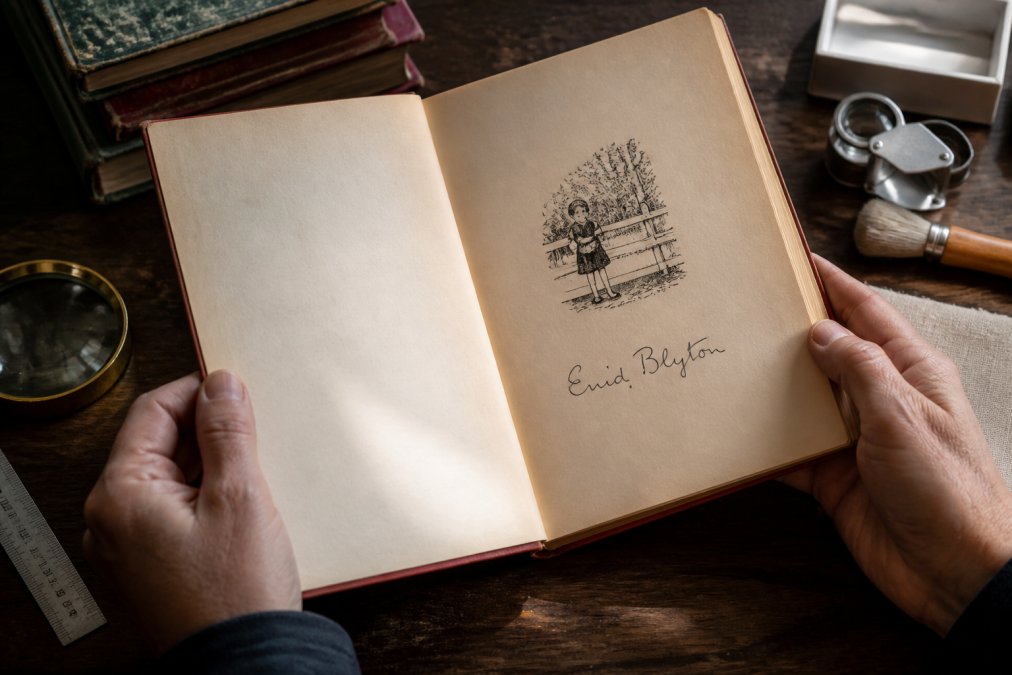
Verifying authenticity is essential when purchasing rare signed children's books. The most reliable approach combines visual inspection, provenance research, third-party authentication, and critical evaluation of documentation.
Signature Comparison and Visual Inspection
Compare the signature against known exemplars from reputable dealers' databases or published references. Signatures evolve over time; forgers typically copy a single example identically, while authentic signatures show natural variation in pressure, slant, and spacing.
Authentic inscriptions contain personalisation details: a recipient's name, date, or specific reference to the book's subject. Generic inscriptions are easier to forge. Cross-check the inscription date against the book's publication date; an inscription dated before publication is a red flag.
Authentic signatures show ink saturation consistent with the pen and paper. Photocopied or printed signatures appear flat and lack dimensional quality. Check for ink bleed-through on the reverse side, indicating genuine pen pressure.
Evaluating a Certificate of Authenticity
A legitimate Certificate of Authenticity (COA) demonstrates the dealer's authentication methodology and professional standing. Evaluate it against these criteria:
Dealer Credentials: The COA should identify the dealer by full business name, physical address, and professional affiliations such as the Antiquarian Booksellers' Association. Cross-reference the dealer online; established dealers maintain websites, customer reviews, and documented transaction histories.
Authentication Methodology: The COA must explicitly state how the signature was authenticated, referencing specific sources such as published signature guides, institutional archives, or auction records. Vague language such as "believed to be signed" indicates insufficient authentication.
Book Description and Condition Details: The COA should include edition, publication year, dust jacket condition, binding material, page quality, and defects. This creates a permanent record and allows you to verify the description matches the physical book. Discrepancies suggest substitution or careless authentication.
Provenance Documentation: A strong COA includes previous owner, acquisition date, and how the book entered the dealer's collection. Provenance strengthens authentication by creating a chain of custody and increases value.
Signature Exemplar References: The best COAs include photographs or references to signature exemplars used for comparison. Request comparison images if not provided; legitimate dealers will supply them.
Common COA Red Flags: Certificates issued by the seller without third-party verification carry less weight. COAs dated years after the book's sale, lacking specific detail, using hedging language, or failing to cite sources should raise suspicion. Beware of COAs that authenticate only the signature without addressing edition status or condition.
Cross-Verification Strategies
For high-value purchases, request multiple forms of verification: condition report, photographs from multiple angles, references to published guides, and professional credentials. Contact the dealer directly with specific questions; legitimate dealers welcome scrutiny. For particularly valuable copies, commission independent authentication from a professional appraiser.
Collectible Children's Books Australia: What Makes Them Valuable
Australian collectible children's books command strong prices when they combine rarity, historical significance, and condition. First editions from the 1950s-1980s appeal to collectors seeking nostalgia and cultural connection.
First edition signed copies outprice later printings; inscribed copies outprice unsigned signatures; books with exceptional provenance outprice those without documented history. A first edition, signed and inscribed copy of a significant Australian title can command a premium.
Decade-specific content adds substantial value for Australian collectors. Books celebrating the 1950s-1980s resonate with readers reconnecting with their past. Illustrated editions featuring Australian landscapes, cars, or cultural references attract premium interest.
Limited editions and out-of-print titles command higher prices due to supply scarcity. Commemorative editions, gift books, and school prizes often become rare because they were treated as consumables rather than collectibles. Beyond these physical volumes, the pursuit of niche book merchandise often uncovers unique ephemera that provides a deeper context for the provenance of a treasured library.
Condition significantly impacts value. A fine binding, pristine dust jacket, and unmarked pages can double or triple a book's worth. Investment-grade collectors expect archival-quality preservation.
Caring for Vintage Children's Books: Storage and Preservation
Preserving rare signed children's books requires protecting against temperature fluctuations, humidity, light exposure, and physical handling.
Store books upright on shelves or flat in archival boxes, never spine-down or crammed tightly. Allow air circulation. Avoid basements and attics; choose climate-controlled rooms instead.
Maintain relative humidity between 30-50%. Use a hygrometer to monitor conditions. If you notice foxing, consult a professional conservator rather than attempting DIY cleaning.
Protect dust jackets with archival-quality mylar sleeves. Store books away from direct sunlight, which fades cloth and paper.
Handle signed copies with clean, dry hands or cotton gloves. Never write notes, dog-ear pages, or use staining bookmarks. These habits preserve condition and protect your investment.
Provenance, Condition, and Investment Potential
Provenance, the documented ownership history, dramatically affects value and authenticity confidence. A book with clear provenance commands premium prices because its history is verifiable.
Understanding Provenance and Its Impact
Provenance operates on a hierarchy: institutional provenance (university collection, named estate) commands highest premiums; family provenance (inherited from relative who purchased from author) is highly valued; retail provenance (documented bookshop purchase) is moderately valued; unknown provenance is least valuable.
Look for documentation: original receipts, previous owner inscriptions, auction catalogues, estate records, or accompanying letters. The more detailed and verifiable the provenance, the higher the value.
Condition Grading and Market Standards
Condition grading follows a standard scale across the antiquarian book trade. Understanding this scale is essential because condition directly determines value.
Fine (F): The book appears unread. Dust jacket is pristine with no fading, tears, or creasing. Binding is tight, pages are clean and unmarked, with no foxing. Fine condition is rare for books over 20 years old and commands premium prices.
Very Good (VG): The book shows minimal wear. Dust jacket may have minor fading or a small tear. Binding is sound with slight wear at corners or spine. Pages are clean with perhaps minor foxing. Very Good is the most common condition for collectible vintage books.
Good (G): The book shows obvious wear. Dust jacket may be significantly faded, torn, or price-clipped. Binding is sound but visibly worn. Pages may have foxing, stains, or pencil marks. Good condition books command lower prices, particularly if the dust jacket is damaged or absent.
Fair (FR): The book has heavy wear, loose pages, or significant staining. Dust jacket is likely missing or severely damaged. Fair condition books are readable but not suitable for investment-grade collections.
Poor (P): The book has significant damage: broken spine, loose or missing pages, or water damage. Poor condition books have minimal value.
For investment-grade rare signed children's books, collectors typically accept only Fine to Very Good condition. A Good condition book with a damaged dust jacket may sell for less than an identical Very Good copy.
The Dust Jacket Factor
Dust jacket condition often determines whether a book is investment-grade. A pristine dust jacket adds to value; a missing dust jacket reduces value. When evaluating, assess the dust jacket separately: Is it present? Price-clipped? Torn, creased, faded, or stained? A small tear or minor fading is acceptable for Very Good. Multiple tears or heavy fading downgrades to Good. A missing dust jacket significantly reduces value.
Auction Houses Versus Private Dealers: Navigation and Strategy
Collectors source books through auction houses and private dealers, each offering distinct advantages.
Auction House Purchasing
Auction houses such as Sotheby's and Christie's offer transparent pricing, competitive bidding, detailed catalogues, and professional authentication. However, actual hammer prices often exceed estimates. Budget above the estimate and factor in the buyer's premium.
Bid online or in person. Online bidding allows you to set a maximum bid; in-person bidding lets you inspect the book before the sale.
Private Dealer Purchasing
Building an Investment-Grade Collection
Avoiding Scams and Ethical Sourcing
The rare book market attracts forgers and unethical sellers. Protect yourself by purchasing from established dealers with verifiable credentials and transparent return policies.
Frequently Asked Questions
Where can I buy legitimate rare signed children's books?
Specialised rare book dealers, antiquarian bookshops, and curated online retailers focus on authenticity and provenance. Look for sellers who provide certificates of authenticity, detailed condition reports, and clear provenance history. Reputable dealers often belong to book collecting associations and offer transparent authentication processes. Avoid sellers unable to verify the book's history or provide documentation of the signature's authenticity.
How can I verify the authenticity of a signed children's book?
Request a certificate of authenticity from the seller and examine the signature's characteristics against known examples of the author's handwriting. Check the book's publication date, edition details, and dust jacket condition. Authentic signatures typically show consistent pressure, pen flow, and style matching other verified examples. Professional appraisers can authenticate signatures through forensic analysis. Always ask sellers for detailed provenance documentation and the book's complete ownership history.
Are signed children's books worth more than unsigned first editions?
Yes, signed copies typically command higher prices than unsigned first editions of the same title. The premium varies depending on the author's prominence, the book's rarity, condition, and market demand. Limited edition signed copies or books inscribed to notable individuals can be worth more. However, value depends on multiple factors including dust jacket condition, first printing status, and provenance. Rare signed copies by beloved Australian authors often appeal to collectors seeking personal connections to literary history.
What should I look for when buying rare children's books?
Prioritise first edition status, original dust jacket condition, and clear provenance history. For signed copies, verify the signature's authenticity through certificates or expert appraisal. Assess the book's overall condition, including binding integrity and page quality. Check whether the edition is limited or out of print, which increases collectibility. Research the author's significance and the title's cultural importance. Consider the book's appeal to reminiscence therapy or historical value, particularly for vintage Australian literature that resonates with personal memories.