

5 Best Memory Aids for Elderly With Dementia in 2026
Table of Contents
- 5 Memory Aids for Elderly With Dementia: A Quick Comparison
- 1. Nostalgia Photo Books: A Window to Happier Times
- 2. Digital Calendars and Clocks: Keeping Time in Focus
- 3. Medication Reminders and Dispensers: Safety First
- 4. Assistive Technology for Dementia Patients: Smart Home Safety
- 5. Memory Boxes and Conversation Prompts: Engaging the Senses
- Reminiscence Therapy Activities for Dementia at Home
- How to Start a Reminiscence Therapy Group
- Frequently Asked Questions
Last Updated: September 4, 2026
Supporting a loved one with dementia often comes down to finding the right memory aids for elderly with dementia that spark joy rather than frustration. While no tool can reverse cognitive decline, the right aid can reduce anxiety, support independence, and open a door to meaningful connection.
This guide from Remember When Shop examines five categories of memory aids, from photo books that trigger long-term recall to digital reminders that manage the present moment.
5 Memory Aids for Elderly With Dementia: A Quick Comparison
| Memory Aid | Primary Purpose | Best For | Key Benefit |
|---|---|---|---|
| Nostalgia Photo Books | Stimulate long-term recall | Conversation & mood | Evokes happy memories |
| Digital Calendars & Clocks | Orientation & time management | Reducing confusion | Clear day/date display |
| Medication Dispensers | Medication adherence | Safety & routine | Prevents missed doses |
| Smart Home Assistants | Independence & safety | Monitoring & alerts | Voice-activated help |
| Memory Boxes | Sensory stimulation | Engagement & calm | Tactile connection to past |
1. Nostalgia Photo Books: A Window to Happier Times
Our top pick for engaging a person with dementia is a nostalgia photo book, a tool that taps into the long-term memories that often remain intact long after short-term recall fades.
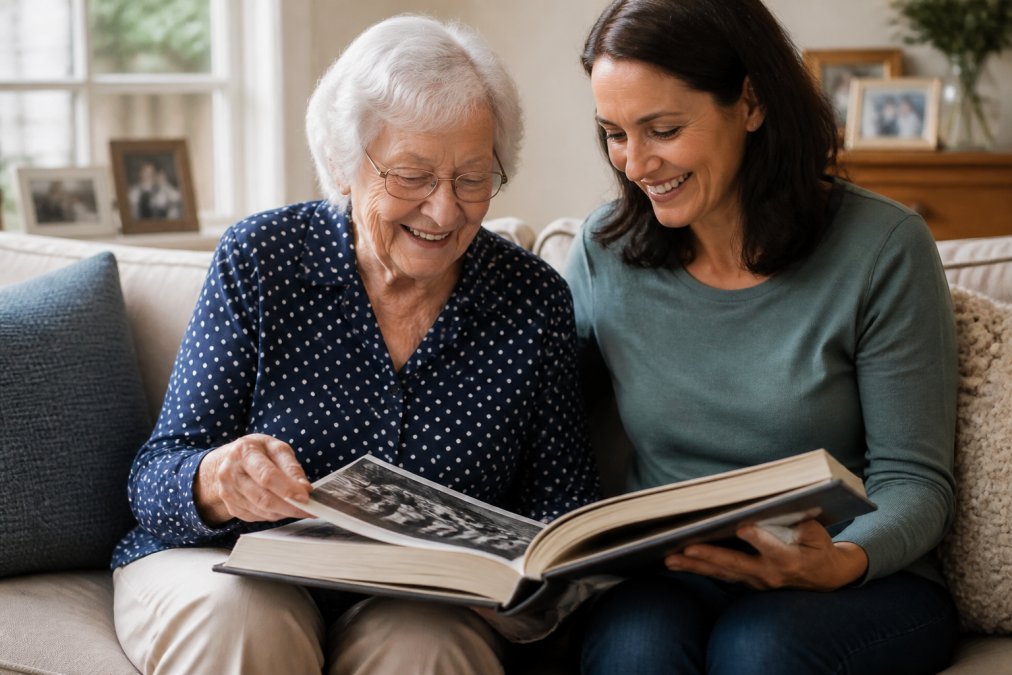
The Remember When Shop collection, particularly Australia Remember When by Bob Byrne, is widely recognised by carers in aged care as a helpful resource. With more than 200 photos spanning the 1940s to the 1980s, it covers the era your loved one likely remembers best.

The therapeutic value comes from the shared experience. Sit beside your loved one, let them lead the page turning, and ask open questions like, "Do you remember what the milkman looked like?" The photos act as visual cues that can unlock stories and emotions, supporting memory recall and mood enhancement. According to guidance on person-centered dementia care, activities that connect to a person's life history are more effective at reducing agitation than generic entertainment.
2. Digital Calendars and Clocks: Keeping Time in Focus
Digital calendars and clocks are assistive technology designed to combat the disorientation that comes with cognitive decline. They display the day, date, and time in large, clear text, often with a simple "morning," "afternoon," or "evening" indicator.
These tools are most valuable when confusion about time causes anxiety, such as a person repeatedly asking when dinner is or waking confused in the night.
The key is to choose a model with a high-contrast display and no unnecessary buttons that could cause confusion. Set it up and leave it alone; this is a passive aid that works through constant visual presence rather than active engagement.
Choosing the Right Model: A Practical Guide
- Entry-Level Day Clocks (A$50-A$100): Simple, plug-in devices that display the day, date, and time in large, bold text, often with a single, pre-set message like "Good Morning" or "Time for Lunch." Ideal for someone who only needs a visual anchor to reduce repeated questions about the time of day.
- Mid-Range Calendar Clocks (A$100-A$250): These offer more customisable features, such as multiple visual reminders (e.g., "Physio at 10:00" or "Dinner at 6:00") on the screen. Some have a simple icon-based display (a cup for tea, a bed for sleep) which can be easier for someone with moderate dementia to interpret than text alone.
- High-End Smart Displays (A$250+): Essentially dedicated tablets or smart screens running specialised dementia-friendly software. They can show a photo slideshow when idle, play music, and allow for video calls with family, but are more complex to set up and maintain, requiring software updates and a stable Wi-Fi connection.
Integrating the Clock into a Daily Routine
Introducing a calendar clock is not as simple as plugging it in. Follow this implementation guide:
- Placement is Everything: Position the clock in the room where the person spends the most time, typically the living room, at eye level and in their direct line of sight from their favourite chair.
- Introduce it Casually: Do not make a formal announcement. Simply say, "I found this nice new clock for the living room, it's very clear to read, don't you think?" Avoid framing it as a tool to fix a problem.
- Connect it to a Routine: Use the clock to anchor daily activities. For example, say, "When the clock says 12:00, we will have lunch."
- Be Patient with Resistance: It is common for a person to initially dismiss the clock. Do not argue. Leave it in place and continue to reference it yourself. "Oh, the clock says it's 3 pm, time for a cup of tea." Over a few days, it will become part of the furniture.
Troubleshooting Common Issues
- The Person Ignores It: This is often because the clock is not visually salient enough or is placed outside their habitual gaze. Try moving it closer to their chair or to the kitchen counter.
- The Person Finds It Distracting or Agitating: Some individuals may become fixated on the clock or anxious about the time. If this occurs, cover the clock for a few days and reintroduce it later. If agitation persists, discontinue its use.
- Battery and Maintenance: While most calendar clocks are plug-in, some portable models use batteries. Set a recurring monthly reminder on your own phone to check and replace batteries. For plug-in models, ensure the power cord is safely tucked away to prevent a trip hazard.
3. Medication Reminders and Dispensers: Safety First
Medication management is often the highest-stakes part of dementia caregiving, and automated dispensers are a critical safety tool for medication adherence. These devices pre-fill doses and release them at the correct time, often with an audible alarm.

A common approach for families is to start with a simple seven-day pill organizer. However, as memory loss progresses, a person may forget whether they have already taken the dose for that day. An automatic dispenser removes that uncertainty entirely.
Low-Tech vs. High-Tech: A Cost-Benefit Analysis
One of the most common dilemmas for caregivers is deciding when to move from a simple pillbox to an expensive automatic dispenser. Here is a practical framework:
When a Simple Pill Organiser is the Right Choice:
- Cost: A basic seven-day pill organiser costs between A$10 and A$30 from any pharmacy. A weekly refill takes a caregiver about 10 minutes.
- Best For: The early stages of dementia, when the person can still follow a routine and only needs a visual cue. It is also suitable when a caregiver is present at every dose time.
- Limitations: It does not prevent double-dosing if the person forgets they have already taken a dose, nor does it provide an alert if a dose is missed.
When an Automatic Dispenser is Worth the Investment:
- Cost: Automatic dispensers range from A$200 for basic models to over A$800 for units with cellular connectivity and caregiver alerts. Some models require a monthly SIM card plan for remote notifications.
- Best For: The middle to later stages of dementia, when the person is living alone or is unsupervised for parts of the day. It is also essential if there has already been a missed dose or a double-dose incident.
- Key Benefits: The dispenser locks the medication and only releases the correct dose at the programmed time. It sounds an alarm that continues until the dose is taken. Many models send an alert to a caregiver's phone if a dose is missed.
:::takeaway The decision is not about cost alone; it is about risk. If a missed or double dose could lead to a hospital visit, the cost of an automatic dispenser is almost always justified. If the person is supervised and the risk is low, a simple organiser is perfectly adequate.
A Step-by-Step Guide to Introducing an Automatic Dispenser
Introducing a locked medication box can feel like a loss of independence. Here is how to introduce it with minimal friction:
- Frame it as a Safety Tool, Not a Surveillance Tool: Say, "This machine is going to help us make sure you are safe and that your medicines are working properly. It will remind you so you don't have to worry about it." Avoid saying, "This is because you forgot your pills."
- Involve Them in the Setup: If possible, let them be present while you load the dispenser. Explain that you are putting the pills in for the week, just like you used to do with the pillbox.
- Start with a Familiar Routine: Program the first dose for a time when you are present. When the alarm sounds, walk them through pressing the button and taking the pill. Do this for the first few days until the routine feels automatic.
- Expect a Transition Period: It is normal for the person to be suspicious or frustrated for the first week. Do not give in and unlock the machine manually, as this will train them to wait for you. Be consistent and reassuring.
Maintenance and Battery Management: The Hidden Burden
A major pain point for caregivers is keeping electronic dispensers operational. A dead battery or a forgotten refill can undo all the safety benefits. Here is a practical maintenance checklist:
- Set a Weekly Refill Alarm: Choose a specific day and time each week to refill the dispenser. Put this in your own phone's calendar with a recurring alert.
- Check the Power Source: Most dispensers have a backup battery in case of a power outage. Check this battery monthly and replace it according to the manufacturer's instructions.
- Test the Alert System: If your dispenser sends alerts to your phone, test this feature weekly by pressing the test button.
- Keep the Manual Handy: Store the user manual in a drawer near the dispenser for troubleshooting.
4. Assistive Technology for Dementia Patients: Smart Home Safety
Assistive technology for dementia patients has advanced significantly, moving beyond simple reminders to comprehensive home safety systems. These tools focus on preventing accidents and enabling independence.
Smart home automation can include motion sensors that turn on lights for nighttime bathroom trips, preventing falls. GPS tracking devices allow a person who wanders to move about freely while giving the caregiver the ability to locate them quickly. Safety alarms on stoves and doors provide another layer of protection.
The benefit of these systems is that they work quietly in the background. They do not require the person to learn anything new, which is crucial because learning new tasks becomes increasingly difficult. Instead, the technology adapts to the person's existing behaviour, reducing caregiver burden and extending the period of safe independent living. As documented in research on smart home technology for ageing in place, these systems can significantly delay the need for residential care.
5. Memory Boxes and Conversation Prompts: Engaging the Senses
A memory box is a physical container filled with objects that hold personal significance, such as old coins, a favourite perfume bottle, a cricket ball, or a piece of fabric. Unlike a photo book that relies on sight, a memory box engages multiple senses, including touch and smell.
These boxes are a cornerstone of reminiscence therapy activities for dementia because they provide a tangible prompt for conversation. The objects can be passed between hands, encouraging tactile engagement and reducing restlessness.
To create one, gather items from the person's younger years. For an Australian of the 1950s, this might include a small Vegemite jar, a 45rpm record, or an old cigarette card. Let the person explore the objects at their own pace, and follow their lead in the conversation.
Reminiscence Therapy Activities for Dementia at Home
Reminiscence therapy activities for dementia at home do not require a clinical setting; they simply require intention and a quiet space.
Start by choosing a regular time of day when the person is most alert, often mid-morning. Keep the session short, around 15 to 20 minutes, and always end on a positive note. Use a single aid, such as a photo book or memory box, and let the person guide the pace.
The role of the caregiver is to listen more than to speak. Ask open-ended questions and validate every response, even if the memory shared is factually incorrect. The emotional truth of the memory matters more than the factual detail. This person-centered care approach turns a simple book into a powerful therapeutic activity. For families looking for resources, the national guidance on dementia support and activities offers practical advice on structuring these sessions at home.
How to Start a Reminiscence Therapy Group
Starting a reminiscence therapy group, whether in a residential facility or a community setting, is a rewarding way to extend the benefits of these aids to multiple people. Gather a small group of 4 to 8 participants with similar life experiences and cognitive abilities.
The facilitator's role is to create a safe, non-judgemental space. Choose a theme for each session, such as "School Days" or "The Beach," and select a memory aid that aligns with that theme. A book like Melbourne Remember When can be passed around, with each person choosing a photo that resonates with them.

Bulk orders for aged care facilities are often a practical consideration, and many suppliers accommodate this need. The key is to keep sessions structured but flexible, allowing conversation to flow naturally while gently guiding it back on track when needed.
Choosing the right support for a loved one with dementia is an ongoing process of trial and gentle observation. The challenge is to remain patient and flexible, adapting your approach as their needs evolve. For the moments when connection feels hardest, a tangible link to their past is often the most reliable bridge. Explore the curated collection of Australian nostalgia books at Remember When Shop to find a meaningful tool that evokes happy memories and supports your caregiving journey.
Frequently Asked Questions
What is the most effective non-pharmacological memory aid for dementia?
Photo books and reminiscence tools are among the most effective non-drug aids because they tap into long-term memory, which often remains intact longer. Seeing familiar images from the 1950s or 1960s can spark conversation and positive emotions. For best results, pair the book with a calm, quiet setting and let your loved one lead the discussion. Consistency helps: a short 10-minute session most days often works better than a long session once a week.
How do reminiscence tools help with memory recall in seniors?
Reminiscence tools use visual cues and familiar topics to stimulate memory recall. A photo of a 1956 Holden or a corner milk bar can trigger a flood of associated memories, even when recent events are hard to recall. This works because long-term autobiographical memory is often preserved longer in dementia. The goal is not a perfect factual recollection but the joy of connection and the comfort of sharing a story, which supports mood and self-esteem.
Are there specific memory aids recommended by Dementia Australia?
Dementia Australia recommends a person-centred approach, choosing aids that match the individual's interests and remaining abilities. They support the use of visual prompts, memory books, and meaningful activities like looking at old photos. While they do not endorse specific brands, the principle is to use tools that reduce confusion and promote independence. A nostalgia book filled with local history often aligns well with this guidance, as it builds on personal experience rather than abstract information.
How can I create a memory-friendly environment at home?
Start by reducing clutter and keeping essential items like glasses and a phone in a consistent, visible spot. Use labels and signs with pictures to help with orientation. A large-print calendar and clock in the living area supports time management. Create a quiet space for looking at memory aids, such as a photo book or memory box, free from TV noise. Good lighting and familiar objects reduce confusion and help the person feel safe and settled.
What stage of dementia is short-term memory loss?
Short-term memory loss is typically one of the earliest signs of Alzheimer's disease and often appears in the mild or early stage. A person may forget recent conversations, misplace items, or repeat questions. Long-term memories from decades ago often remain vivid at this point. This is why reminiscence tools like decade-specific photo books can be so effective: they focus on the memories that are still accessible and bring comfort rather than frustration.
This article was written using GrandRanker